There was another part of the hotel visit I couldn't separate from the room.
My father and the piano.
Even thinking about it changed the way I remembered the place.
The room beside the ice machine was one part of the story.
The piano was another.
And the two had become linked in my mind because they concerned the same man.
My father.
Eighty years old.
Quiet in the face of an unpleasant arrangement.
A person I had spent my life thinking I understood.
I knew he had sat at a piano in the hotel.
A piano that was not meant to be used freely.
That detail mattered.
It was not simply an instrument waiting for any guest who wanted to play.
There was a restriction attached to it.
My father had sat there anyway.
And the hotel's owner had recognized him.
That was the connection I could not ignore.
Recognition.
Such an ordinary word.
People recognize strangers for all sorts of reasons.
A familiar face.
A remembered meeting.
Something from long ago.
But the fact of recognition doesn't explain its cause.
I didn't know what the owner had seen in my father.
I didn't know what past experience, if any, lay behind it.
And I didn't know what that moment would mean for the dispute at reception.
I wished I did.
I wanted a simple account that connected everything.
The room.
The manager.
The clerk.
The piano.
The owner.
My father.
But I couldn't honestly put those pieces together without filling gaps in the story.
And I had already spent too much time filling gaps with guesses.
I thought about my father's quietness during the room disagreement.
I had assumed he wanted to avoid trouble.
That might have been true.
It might not have been the whole truth.
I couldn't know.
But I could see how readily I had turned his silence into an explanation that suited my own expectations.
I thought he was tired.
I thought he was willing to make do.
I thought he wanted me to let the room assignment go.
Those were my interpretations.
They were not words he had given me.
Looking back, that difference mattered.
I had been speaking about dignity while barely allowing my parents the dignity of having thoughts I couldn't automatically understand.
It was an uncomfortable admission.
I loved them.
I wanted to protect them.
Yet I had been treating their age as though it told me everything about what they wanted.
It didn't.
Eighty years was a fact about their lives.
It wasn't the entirety of who they were.
My father had a history beyond being an elderly hotel guest.
My mother did too.
And I didn't have to know every part of that history to respect it.
The piano reminded me of that.
It was an object that belonged to the hotel.
But my father's presence at it had apparently meant something to the owner.
Something recognizable.
I could not say more without pretending to know what had not been explained.
Still, the fact stayed with me.
The very hotel where my parents had been treated as less deserving had contained something that drew attention to my father as an individual.
Not merely a room number.
Not merely an eighty-year-old guest.
Him.
I found that contrast difficult to forget.
I wondered whether the manager knew about the recognition.
I wondered whether the clerk did.
I had no evidence that either of them knew anything about it.
So I couldn't use it as an accusation.
Nor could I assume that the owner's recognition had changed their behavior.
Those connections needed more information than I had.
But I could consider what the contrast meant to me.
I had been angry because the hotel appeared to have reduced my parents' worth to how much money someone had given at reception.
And the piano reminded me of how little a stranger can know about the person standing in front of them.
You see an elderly man.
You see a guest.
You see someone who may not complain.
You do not see eighty years of living.
You do not know what he has done.
You do not know who remembers him.
You do not know what an ordinary object might mean when he sits before it.
Those thoughts were mine.
They weren't an explanation of the owner's recognition.
I kept that distinction clear.
But they changed the way I thought about the dispute.
The point was never that my father deserved better treatment because somebody important recognized him.
That would have been another version of the same unfairness.
My father deserved fair treatment before anyone recognized him.
So did my mother.
So did the other couple.
So did every guest whose tip was smaller than somebody else's.
I kept coming back to that.
The hotel should not have needed a reason to consider my parents worthy of courtesy.
Not their age.
Not a connection to the owner.
Not a hidden history.
Not anything special.
They were guests.
That should have been sufficient.
I thought about how easy it would be to tell the story differently.
To make the recognition seem like the reason my parents mattered.
To suggest that people should be careful whom they disrespect because the person might turn out to be someone significant.
But that would miss what had troubled me from the beginning.
My parents mattered when nobody knew anything about them.
They mattered when the clerk looked at the papers.
They mattered when the manager went quiet.
They mattered in the room beside the ice machine.
The piano couldn't create that worth.
The owner's recognition couldn't create it either.
At most, those things could reveal how little the hotel staff had known about the man they were dealing with.
And even that conclusion depended on details I didn't possess.
I didn't know what the owner remembered.
I didn't know why the piano was restricted.
I didn't know what happened after the recognition.
I knew only that those elements belonged to my father's experience at the hotel.
I was not going to invent an explanation.
There had already been too much confusion.
Too much uncertainty.
Too much opportunity to turn suspicion into a story that sounded complete simply because it was satisfying.
I wanted the truth more than I wanted a dramatic answer.
That was something I had to admit.
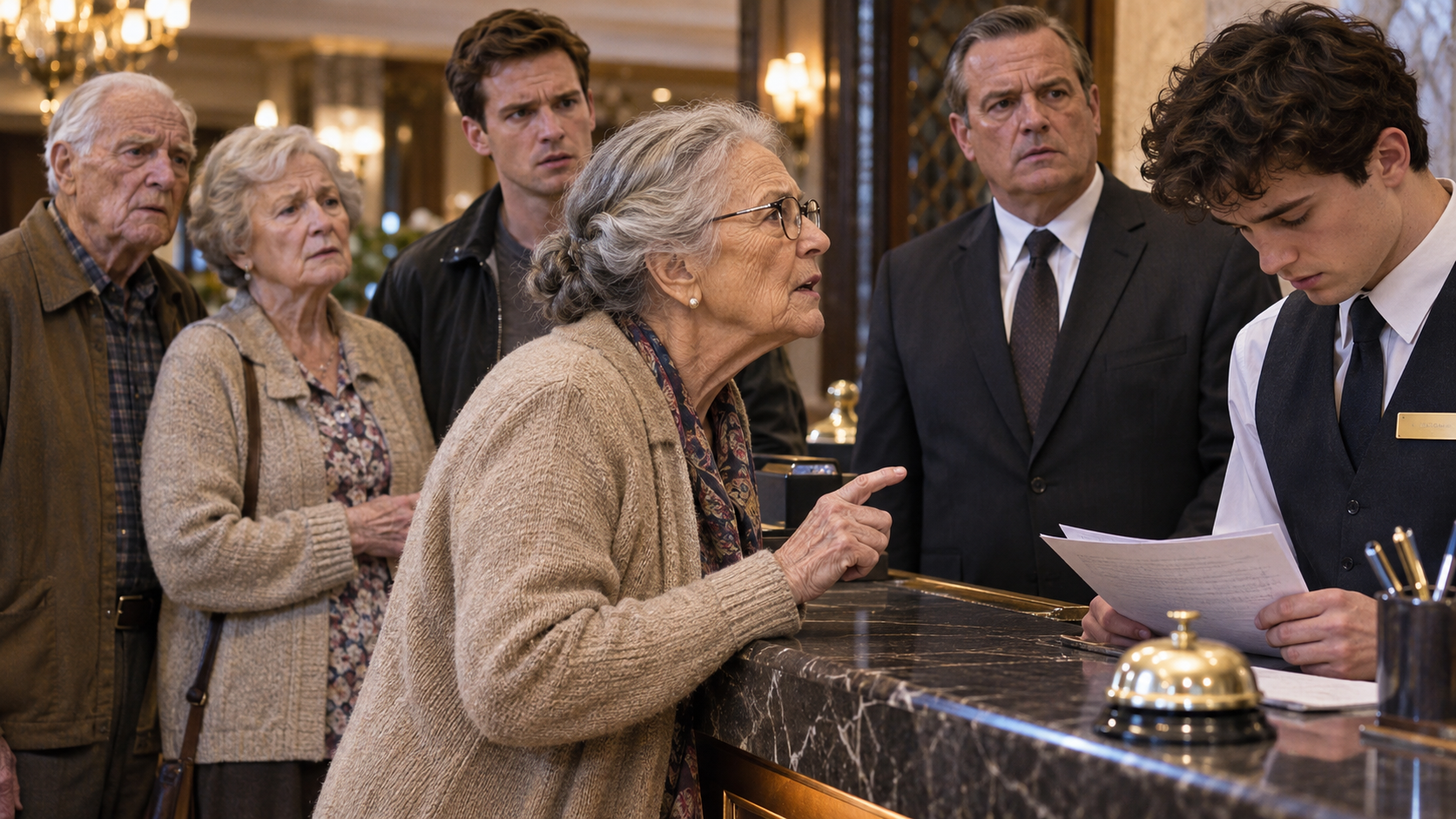
At the reception desk, I had wanted the manager to look ashamed.
I had wanted the clerk to stop hiding behind the papers.
I had wanted Evelyn's question to expose exactly who had made the decision.
But those wants were not facts.
The truth was still limited.
And my father, sitting at a restricted piano and being recognized by the hotel's owner, remained part of the visit I could not fully explain.
I could only hold that detail beside the room dispute.
One man.
Two very different ways of being seen.
In one part of the hotel, he was an elderly guest whose comfort had apparently counted for less than somebody else's tip.
In another, he was someone the owner recognized.
I didn't need to know why to understand that I had been wrong to think I understood everything about him.
And I didn't need the recognition to know the room decision deserved an explanation.
That was the lesson I could stand behind.
Nothing more.
Click here to continue reading: PART 8: I Finally Understood That My Parents Deserved Respect Before Anyone Recognized My Father, Even Though the Hotel Had Yet to Explain Its Decision
I Had Brought My Elderly Parents to a Hotel Where One Small Room Change Told Me How Little Respect They Were Given
Part 7 of 8