I didn't go to Ms. Castellanos's office expecting money.
I want that understood.
When she called, I thought perhaps Mr. Pickett had left a short note.
Maybe he wanted to acknowledge what had happened on the ice.
Maybe he had decided to say the words he couldn't bring himself to say while he was alive.
I didn't know.
And I didn't spend much time imagining anything larger.
I had a job.
I had a house.
I had a life that had been difficult enough without worrying about somebody else's property.
But I was curious.
Mr. Pickett had requested the meeting.
And after eleven years of almost complete silence between us, I wanted to know why.
When I arrived, Lyndon was already there.
He sat at the table tapping his foot.
He looked impatient.
Ms. Castellanos greeted me and explained where to sit.
Before much could happen, Lyndon turned his attention to me.
He wanted to know why his uncle would have left me anything.
To him, I was simply a neighbor.
A woman who happened to live across the road.
I explained that I'd cleared Mr. Pickett's driveway.
Lyndon laughed.
Not because he thought it was funny in a pleasant way.
He seemed to think he'd caught me admitting something.
He accused me of making myself useful to his lonely uncle because I hoped to benefit from his death.
Then he mentioned the house.
He apparently believed I was trying to get it.
I stared at him.
For years, I'd gone across the street before daylight without even knocking on the door.
I'd never asked Mr. Pickett for anything.
I hadn't talked about his property.
I hadn't asked what he owned.
And I certainly hadn't expected to inherit his house.
Lyndon kept talking.
He warned that he would challenge anything Mr. Pickett had left me.
He brought up his uncle's age.
He suggested Mr. Pickett couldn't have been thinking clearly.
He threatened to take legal action against me.
I could hardly believe what I was hearing.
My husband had died.
I'd raised our children while working at a pharmacy.
I'd spent eleven winters helping an elderly neighbor who often treated my family badly.
And now a man who'd barely visited his uncle was suggesting I'd done it all for money.
I felt my face grow warm.
I wanted to defend myself.
I wanted to tell him about the December morning when I'd first seen his uncle struggling with a shovel.
I wanted to tell him about the ice.
The blue lips.
The emergency call.
The hours at the hospital.
I wanted to ask where he'd been during all those winters.
But I didn't turn the meeting into an argument.
Ms. Castellanos had something to give me.
That was why I was there.
She placed a sealed envelope in front of me.
My name was written on it.
The handwriting was unsteady.
I recognized that it had come from Mr. Pickett.
For a moment, I just looked at the envelope.
I'd seen his house almost every day for eleven years.
I'd seen him stand in his doorway with a shovel he couldn't manage.
I'd seen him lying on the ice.
I'd seen him recovering in a hospital bed.
But I had never received a personal letter from him.
Not once.
I opened the envelope carefully.
There was one folded sheet inside.
The message was short.
Mr. Pickett addressed me by name.
He told me he'd been aware that I was the one clearing his driveway.
All those years.
All those mornings.
He had known.
I stopped reading.
I had spent eleven winters thinking I was doing something he never noticed.
I had believed I could cross the street before sunrise and leave without anyone knowing.
Apparently, I had never fooled him.
Not even when he remained silent.
Not even when he complained about my dog.
He knew.
Then I read the next part of his message.
He said there was something he'd done without telling me.
I didn't understand.
I looked beneath the letter.
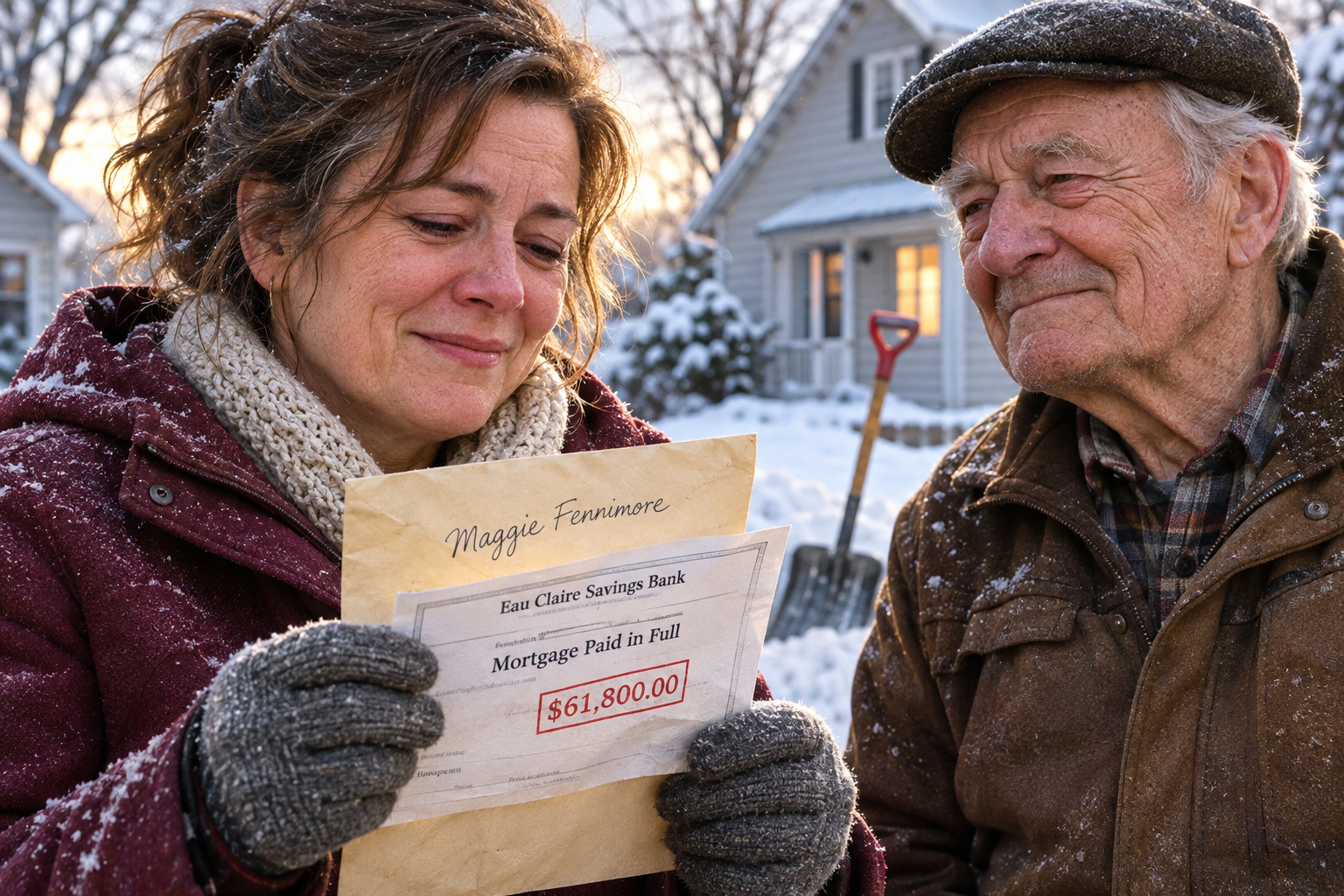
An old bank document was attached.
It carried my name.
The date went back eleven years.
I recognized the period immediately.
It was the January after Conrad died.
Six weeks after his death.
I read the document once.
Then again.
I knew what a mortgage payoff letter looked like because I'd received one that winter.
I'd never forgotten it.
Our mortgage had been paid in full.
Sixty-one thousand eight hundred dollars.
The bank had confirmed that the entire balance was settled.
The money had come from someone who hadn't disclosed their identity to me.
For eleven years, I'd wondered about that letter.
I remembered the first time it arrived.
I remembered sitting with it, unable to understand how the mortgage on our house could suddenly disappear.
Conrad had died only weeks earlier.
I was struggling to pay ordinary bills.
I couldn't see how I'd ever manage everything on my salary.
Then the bank told me the mortgage was gone.
At first, I thought someone had made an error.
A serious error.
I called the bank.
They said the payment was real.
I called again.
I wanted to make sure there wasn't some misunderstanding that would leave me owing thousands of dollars later.
They repeated that the loan had been settled.
I called a third time.
I asked who had paid it.
They told me the person wanted to remain unnamed.
And they couldn't give me any more information.
Eventually, I had to accept what they were telling me.
The house was paid for.
I didn't understand why.
I had wondered whether Conrad had left behind some insurance benefit I hadn't known about.
I had wondered whether someone connected with the bank had quietly helped us.
I considered possibilities.
But I never learned the truth.
And as the years passed, I stopped expecting an answer.
Now I was sitting in Ms. Castellanos's office, holding a document from that same January.
The amount matched.
The date matched.
The mortgage was mine.
And Mr. Pickett had kept the proof.
I looked at the paper again.
The man who'd complained about my trash cans had paid off the mortgage.
The man who'd called the police about my dog had protected the house where my children lived.
The man who barely spoke to me had done something enormous at the worst moment of my life.
And he hadn't told me.
For eleven years.
My hands were shaking.
I thought about the first December after Conrad died.
I'd been outside before sunrise, crying while trying to clear our driveway.
I believed I was alone in handling everything.
Then I'd looked across the street and seen an elderly man who couldn't manage his own snow.
I went over and helped him.
I hadn't known that he was the person who had made it possible for me to keep paying for the rest of our lives without a mortgage hanging over us.
I had never connected the two things.
Not once.
I thought about the angry complaints.
The neighborhood meeting.
The years of silence.
I thought about those oranges.
The dog bone.
The hospital bed.
Everything felt different now.
Not because Mr. Pickett had suddenly become a pleasant man in my memory.
He hadn't.
He had been difficult.
Sometimes he had been hurtful.
I wasn't going to pretend otherwise.
But there had been another part of his life that I hadn't seen.
And it was sitting in my hands.
Lyndon had accused me of wanting something from his uncle.
He had threatened to sue me.
He had assumed that a woman clearing snow must have been trying to earn a reward.
But the payment had been made eleven years earlier.
Before all those winters had passed.
Without any request from me.
Without an explanation.
Without a public announcement.
I couldn't even bring myself to respond to Lyndon.
I kept looking at the date.
January.
Six weeks after Conrad died.
That was when my family had been most frightened.
That was when I was trying to work out how to keep our house.
And that was when Mr. Pickett had paid the bank.
Ms. Castellanos then handed me another letter.
This one was longer.
Four pages.
I looked at the first page and recognized my name.
Mr. Pickett had written directly to me.
He began by acknowledging something I already knew.
He hadn't been an easy man to live beside.
He understood that people had unpleasant things to say about him.
And he didn't try to deny that he'd given them reasons.
I held the letter for a moment.
I could still picture him standing in his doorway, looking at the snow.
I remembered the shovel in his hands.
I remembered how he'd gone back inside.
And I remembered crossing the street because I couldn't bear to leave him struggling.
For eleven years, I had thought that morning was the beginning of a kindness he never noticed.
Now I knew it wasn't that simple.
He had known about my help.
And he had helped me in a way I couldn't have imagined.
Neither of us had told the other.
Neither of us had asked for recognition.
But our lives had been connected by those quiet decisions for more than a decade.
I had walked across the street with a shovel.
He had paid a debt I couldn't afford.
I had found him on the ice.
He had left me the truth in an envelope.
I couldn't claim to know everything he had meant to say in those four pages.
But I finally knew the answer to the question I'd carried since the bank's letter arrived.
Who had paid our mortgage?
Horace Pickett.
The difficult old man across the street.
The man I'd helped through eleven winters.
The man who had never once explained what he'd done for my family.
I had thought I'd been the one keeping a secret.
All along, he had been keeping one too.
Click here to continue reading: PART 5: I Sat Across From the Man Who Threatened to Sue Me While Holding Proof That His Uncle Had Saved My Family Years Before
For Eleven Winters I Cleared the Driveway of a Man Who Hated My Family Without Ever Knowing Why I Kept Going Back
Part 4 of 10