There was something I wanted to tell Conrad.
That was the thought I kept coming back to.
Not because I believed he could hear me.
But because he would have understood what that mortgage meant.
He knew our house.
He knew our children.
He knew the life we'd been trying to build before the accident.
And he knew how much work it took to keep everything going.
I wished I could tell him that someone had looked after us.
Someone neither of us would have expected.
The grumpy old man across the street.
Horace Pickett.
I could almost imagine Conrad asking whether I was certain.
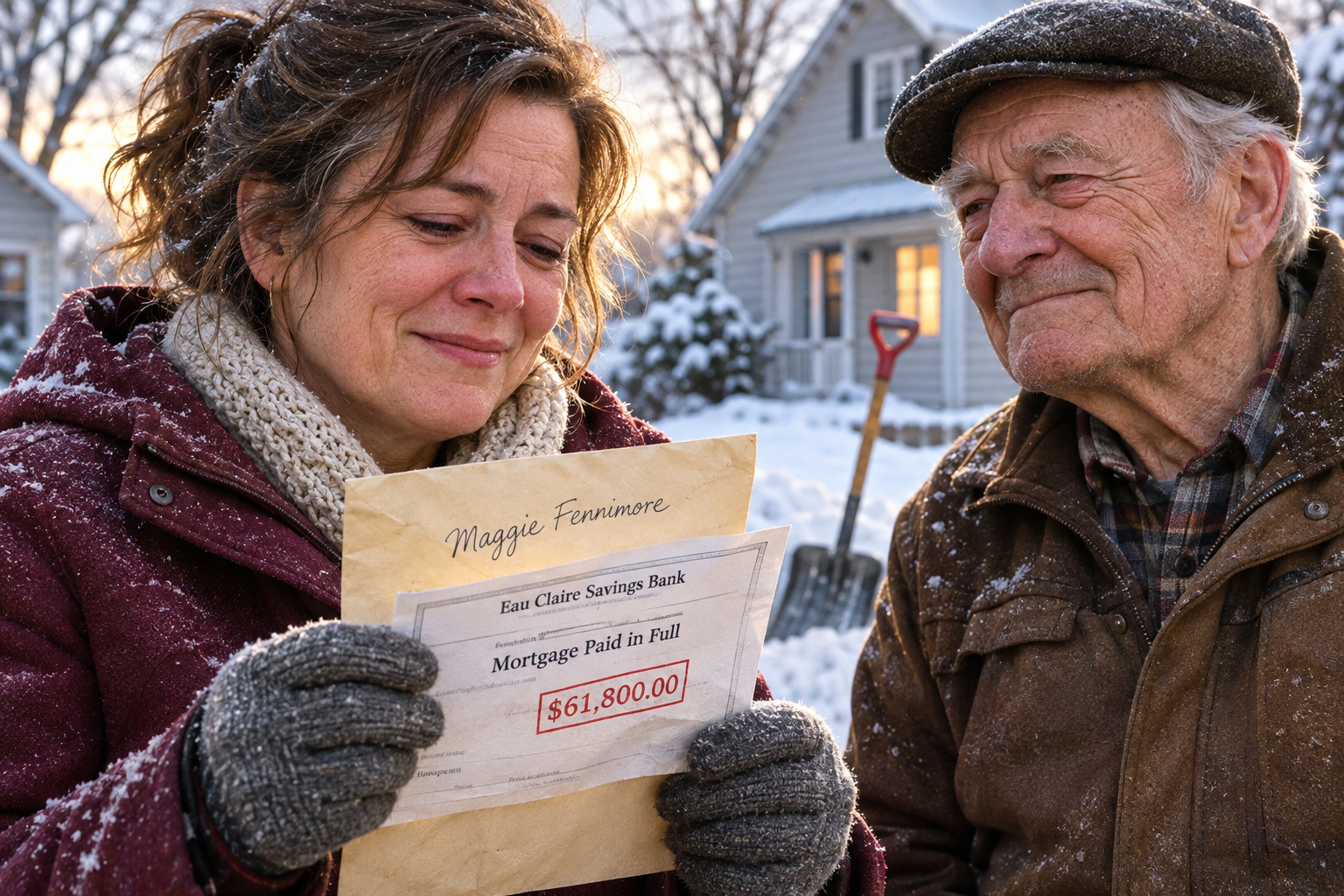
I would have shown him the paper.
The amount.
The date.
The payment confirmation.
It was all there.
Sixty-one thousand eight hundred dollars.
Paid six weeks after his death.
I had been carrying that mystery for eleven years.
And I had finally learned the answer.
I couldn't remember Conrad without remembering the life that followed his accident.
The two children.
The mortgage.
The pharmacy job.
The long winter mornings.
The fear that I wouldn't be able to keep everything together.
I'd learned how to live with all of it.
But that didn't mean it had been easy.
People sometimes assume that when enough years pass, the difficult parts stop mattering.
They don't.
They become part of how you remember your life.
I could still remember the first winter.
I could still remember trying to manage the snow.
I could still remember crying because Conrad had always been the one outside with the shovel.
That memory hadn't become less painful just because I was older.
But now there was something else attached to it.
Something I hadn't known at the time.
Across the street lived a man who had quietly helped my family.
And I had quietly helped him.
We had never discussed it.
Not once.
I sat with that knowledge and tried to understand why it affected me so deeply.
It wasn't only the money.
Of course the money mattered.
It mattered enormously.
Without that payment, I had no idea how I would have managed the mortgage on my cashier's salary.
But there was something else.
Mr. Pickett had helped without making me feel watched.
He hadn't come over and reminded me of what he'd done.
He hadn't asked me to express gratitude.
He hadn't used his help to control how I lived.
He hadn't even allowed me to know who was responsible.
For eleven years, I had been free to make up my own mind about him.
And I had.
I thought he was unpleasant.
I thought he disliked my family.
I thought his complaints told me everything I needed to know.
He had never corrected me.
Even after I started clearing his driveway.
Even after I found him on the ice.
Even after I sat beside him in the hospital.
He hadn't told me.
That was the part I found hardest to understand.
I could imagine wanting credit for something so generous.
I could imagine wanting to be appreciated.
I could imagine feeling hurt when the person I'd helped continued to think badly of me.
But Mr. Pickett had kept his secret.
I didn't know whether it was pride.
Or embarrassment.
Or simply the way he was.
I wasn't going to decide that for him.
I didn't have the right.
I knew only that the mortgage was paid.
And that he'd chosen to remain anonymous.
I thought about how I had treated him.
I hadn't been cruel.
But I had judged him.
I remembered thinking he was an angry old man who would never change.
I remembered telling myself that his complaints were just part of living across the street from him.
I remembered expecting nothing good from him.
And I remembered how surprised I'd been when the oranges appeared.
Looking back, that surprise made me uncomfortable.
I'd become so used to seeing him as unpleasant that even a bag of fruit seemed impossible to explain.
The dog bone had surprised me even more.
I had almost laughed when I saw it.
The same man who complained about barking had left a gift for the dog.
I hadn't understood why.
Maybe I still didn't.
But I no longer felt the need to explain every gesture.
I could simply accept that people sometimes act in ways that don't match the labels we've given them.
Mr. Pickett was not an easy man.
I still believed that.
His temper was real.
His complaints were real.
The way he treated my children had been real too.
Knowing about the mortgage didn't erase those memories.
And I didn't think it should.
A generous act doesn't make every hurtful act disappear.
But an unpleasant manner doesn't mean someone is incapable of kindness either.
That was what I'd learned.
Not from a speech.
Not from advice.
From a bank document that had been kept for eleven years.
And from a man who rarely spoke to me.
I thought about his funeral.
Lyndon had traveled from Phoenix.
He talked about taking care of the house.
At the time, I hadn't questioned it.
I had no reason to.
The property belonged to Mr. Pickett.
What happened to it was a family matter.
But the meeting at the lawyer's office had shown me how quickly Lyndon assumed the worst.
He saw me as someone trying to gain something.
He believed my help had been part of a plan.
He couldn't understand why anyone would clear another person's driveway for years without expecting a reward.
I knew why.
I had been there that first December morning.
I remembered the old man holding his shovel.
I remembered how he looked at the snow.
I remembered the door closing.
I knew why I'd crossed the street.
Because I could do something.
Because he couldn't manage it.
Because I had already learned what it felt like to need help.
That was all.
I hadn't thought about the next winter.
Or the winter after that.
I hadn't thought about eleven years.
I hadn't thought about an inheritance.
I had only thought about the snow in front of me.
Lyndon could believe whatever he wanted.
I couldn't change his mind by repeating the story.
And I didn't want my memories of Mr. Pickett to become a fight over money.
The truth was already difficult enough.
I thought about the four-page letter.
It had begun with an admission.
Mr. Pickett knew he had been unpleasant.
He knew what people thought of him.
He knew he'd given them reasons.
Those words mattered to me.
They showed that he wasn't entirely unaware of how he treated people.
I wished I knew everything he wanted to explain.
But I wouldn't invent the rest of his thoughts.
That wouldn't be fair to him.
His short note had been clear.
He knew who had cleared his driveway.
And there was something he'd done without telling me.
The bank document explained that secret.
Those were the things I could trust.
They didn't answer every question.
But they answered the one I'd carried since Conrad died.
I thought about the hospital again.
That memory was still painful.
Mr. Pickett lying on the ice.
The open door.
The porch light.
His blue lips.
The terrible feeling that I might have arrived too late.
I remember how carefully I tried to keep him warm.
I remember the ambulance coming.
I remember hearing that he had hypothermia and a broken hip.
And I remember the doctor's warning.
Another thirty minutes might have been too long.
I couldn't forget that.
I had lost Conrad in an accident.
I knew what it was like when someone left home and never returned.
I knew what it was like to receive terrible news and realize there was nothing more anyone could do.
Finding Mr. Pickett alive had been a relief.
Watching him recover had been another.
And seeing him return home after three weeks had mattered to me more than I expected.
He still had his difficult ways.
He still wasn't talkative.
But he was alive.
I was grateful for that.
I thought about the years he'd been given after the accident.
Two winters.
More mornings.
More ordinary days.
More time in the house across the street.
Then October came.
And he died in his sleep.
Ninety-two years old.
I couldn't decide whether that made his death easier to accept.
He'd lived a long life.
But I still found myself looking at his house differently after he was gone.
For eleven winters, it had been part of my routine.
I'd look across the street and decide whether his driveway needed clearing.
Sometimes it did.
Sometimes it didn't.
I didn't need to think very hard about it.
It had become as ordinary as getting ready for work.
Now the routine had lost the person it was built around.
That was a strange feeling.
I didn't miss his complaints.
I didn't miss being called the neighbor with the noisy dog.
But I missed knowing he was there.
I missed the quiet certainty that another winter morning might find me crossing the street with my shovel.
I hadn't expected to feel that way.
Then again, there was a great deal I hadn't expected about Mr. Pickett.
I hadn't expected him to pay my mortgage.
I hadn't expected him to know about the shoveling.
I hadn't expected him to leave me a note.
And I hadn't expected to learn so much about my own assumptions after his death.
I used to think gratitude required someone to say thank you.
That if you helped a person and they never acknowledged it, the kindness had somehow disappeared.
But those eleven winters hadn't disappeared.
They were part of both our lives.
Mr. Pickett knew.
I knew.
And now I understood that something else had been happening too.
I had lived in a house he helped me keep.
He had lived across the street from a woman who cleared his snow.
Neither fact depended on public recognition.
Neither required a conversation.
They had happened.
That was enough.
I thought about what I would say if I could have one more conversation with him.
I wouldn't begin with the complaints.
I wouldn't mention the neighborhood meeting.
I wouldn't ask why he'd been so difficult.
I would ask about that January payment.
I would tell him how frightened I had been.
I would explain that I thought the bank had made a mistake.
I would tell him I called three times because I couldn't believe the mortgage was gone.
And I would thank him.
Not with a grand speech.
Just a few words.
I think he would have preferred that.
But I couldn't know.
And that was the part I had to accept.
There would be no final conversation.
No chance to compare memories.
No opportunity to ask when he learned I was clearing his driveway.
No way to discover what he had been thinking during those winters.
He was gone.
The only things he had left for me were the things he'd chosen to reveal.
I couldn't ask for more.
I had to learn how to be grateful without expecting an answer.
That was harder than I thought it would be.
For years, I'd imagined that if I ever discovered who paid our mortgage, I'd finally understand everything.
But knowing the person's name wasn't the same as knowing his reasons.
It didn't explain his temper.
It didn't explain his loneliness.
It didn't explain why he preferred silence.
It only showed me that I had known less about him than I believed.
And maybe that was the lesson I needed.
I had spent years thinking there were two kinds of people.
The pleasant ones who cared.
And the difficult ones who didn't.
Mr. Pickett had shown me how incomplete that idea was.
Some people are difficult.
Some people are generous.
And sometimes the same person is both.
I could remember his faults without denying his kindness.
I could be grateful without pretending we'd been close friends.
I could miss him without pretending he'd been easy to live beside.
That was a more complicated truth.
But it was the real one.
I thought again about the two houses.
Ours and his.
One street between them.
For eleven years, that distance had been small enough for me to cross with a shovel.
Yet it had been large enough for us to hide things from each other.
I had kept my winter mornings quiet.
He had kept his mortgage payment secret.
I had thought I was helping a stranger.
He had helped a family without telling them.
And both of us had gone on living our ordinary lives.
I didn't know what else his life had contained.
I didn't know every hardship he had faced.
I knew he'd been a widower.
I knew he'd worked for the railroad.
I knew he'd grown old alone in that house.
And I knew he'd been capable of an act of kindness that changed my family's future.
I didn't need to make him into a perfect man to appreciate that.
He hadn't been perfect.
Neither had I.
But we had helped each other.
That was enough for me to remember him with gratitude.
I thought about Conrad.
About our children when they were eight and ten.
About that first winter when everything felt impossible.
I remembered myself standing outside before sunrise, trying not to cry while clearing the driveway.
Then I remembered looking across the street.
A man in a bathrobe.
A shovel in his hands.
A driveway buried in snow.
At the time, I'd thought I was making one small decision.
I would help him.
Nothing more.
I hadn't known our lives were already connected by an act of generosity I couldn't see.
Now I did.
And that knowledge changed how I remembered every winter that followed.
I had never needed Mr. Pickett to smile at me.
I had never needed him to become a different person.
But I wished I'd known enough to thank him while he was alive.
That regret would stay with me.
So would the gratitude.
I couldn't return his money.
I couldn't undo the years of silence.
I couldn't bring him back.
But I could remember what he'd done.
I could remember the way his secret had protected my family during the hardest time of our lives.
I could remember the cold morning when I found him.
And I could remember the man himself as more than the angry neighbor everyone called the Grinch.
He was Horace Pickett.
A retired railroad worker.
A widower.
An old man who complained about my dog.
A man who knew someone was clearing his driveway.
And the person who paid $61,800 to make sure my mortgage was gone.
I had spent eleven winters thinking kindness traveled only from my house to his.
The envelope showed me that kindness had crossed the street long before I understood it.
I would always wish we'd talked.
But I no longer believed the silence meant nothing.
Sometimes what people do matters more than what they manage to say.
Mr. Pickett and I had spent eleven years proving that to each other without realizing it.
And though I learned the whole truth too late to thank him, I would never again forget who had helped keep my family home.
The End
Read more original stories on Feel Every Story.
For Eleven Winters I Cleared the Driveway of a Man Who Hated My Family Without Ever Knowing Why I Kept Going Back
Part 10 of 10