
I had spent fifty-six years believing my husband was dead.
Now I was standing in my kitchen, holding a note that suggested he had never forgotten me.
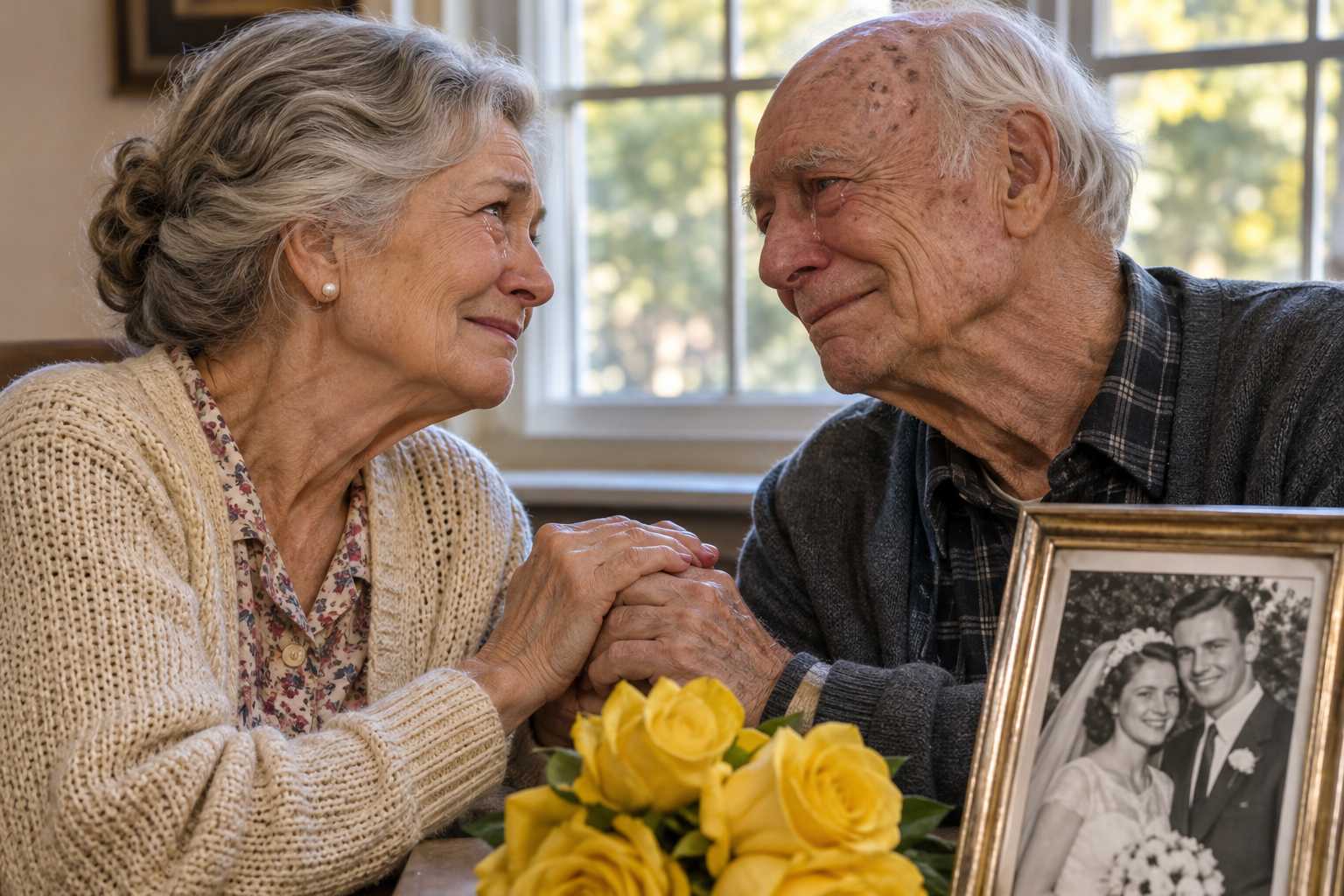
The yellow roses were still on the table.
There were so many of them that I could hardly see across the bouquet.
I touched one of the petals.
Soft.
Real.
And somehow more frightening than anything I had experienced in years.
I looked at James's signature again.
The handwriting seemed familiar, but fifty-six years had passed.
I no longer trusted my memory enough to be certain.
I had old letters from him.
I knew that.
But I was afraid to compare them.
Because if the writing matched, I would have to face a possibility I had spent most of my life refusing to consider.
James might have been alive.
I placed the note beside the flowers.
Then I sat down.
My kitchen was quiet.
The clock above the doorway continued ticking, completely indifferent to the fact that my entire life had just been turned upside down.
I wanted to call somebody.
But who?
My parents had been gone for many years.
Most of the people who remembered our wedding were gone too.
And the few who knew about James had heard the same story I had heard.
He went to Vietnam.
His unit was attacked.
He never came home.
That was the entire explanation.
At least, it was the explanation I had accepted.
I looked toward the old photographs I had been sorting through before the delivery arrived.
One showed James standing beside me in my parents' backyard.
It had been taken during the summer of 1970.
I was wearing my wedding dress.
James had one arm around my waist.
We both looked impossibly young.
I remembered how nervous he had been when we cut the cake.
His hand had trembled slightly.
I had laughed.
He had smiled at me.
And two days later, he was gone.
For fifty-six years, that photograph had been one of the few things I could hold without questioning its meaning.
Now even that seemed different.
I picked it up.
I studied his face.
His eyes.
His smile.
The way he stood slightly turned toward me.
I wondered whether he had grown old somewhere.
Whether his hair had turned gray.
Whether he had wrinkles around his eyes.
Whether he had ever looked at a photograph of me and wondered the same things.
Then I stopped myself.
I was getting carried away.
A note was not proof.
Flowers were not proof.
And hope could be a dangerous thing when you had already survived losing the same person once.
I returned to the bouquet.
The florist had wrapped the stems in thick paper.
A narrow ribbon held everything together.
I had been so distracted by the note that I had barely examined anything else.
I lifted the wrapping.
Something slipped against my hand.
A small white envelope.
It had been tucked beneath the ribbon, almost hidden among the stems.
My heart began beating faster.
I pulled it free.
There was nothing written on the front except my name.
Mary.
I knew I should have opened it immediately.
Instead, I held it for several moments.
I was frightened of finding more promises.
Frightened of another apology.
Most of all, I was frightened of discovering that whoever sent these flowers knew enough about James to hurt me deliberately.
Finally, I opened the envelope.
Inside was a folded sheet of paper.
The first sentence was short.
Mary, there is something you deserve to know before you decide whether you want to see me.
I covered my mouth.
See me.
Those two words seemed to lift the floor beneath my feet.
I read the sentence again.
Then the next.
The writer explained that he had survived the explosion in Vietnam.
He said he had been badly injured.
That he had disappeared into circumstances neither of us could have imagined when we said goodbye.
And that, for a long time, he had not even known who he was.
My hands began to shake.
I put the paper down.
I could not understand what I was reading.
James had survived?
Adrian had told me he saw the explosion.
He had looked me in the eyes and said there was almost no chance James could have lived through it.
I remembered that conversation.
I remembered Adrian's expression.
The exhaustion in his face.
The way he struggled to speak.
He had been James's closest friend.
They had served together.
I had believed him.
For more than half a century, I had believed him.
The letter continued.
It explained that James had been found alive after the attack, but not by the people searching for missing American soldiers.
He had been taken away from the battlefield.
For a long time, there had been no official record connecting the injured man to James.
No reliable identification.
No proper notification.
No way for me to know what had happened.
I read slowly.
Some words seemed impossible to absorb.
I had imagined James dying in Vietnam thousands of times.
I had imagined him frightened.
In pain.
Calling for help.
Those thoughts had followed me through the years.
And now I was being told that he had survived the very event I had mourned.
I pressed my fingers against my forehead.
It was too much.
I needed to hear a human voice.
At the bottom of the paper was a telephone number.
Beneath it was another sentence.
If you want the rest of the truth, please call. Nobody will ask you to forgive anything.
I stared at the number.
I could not decide whether to dial it.
What would I say?
Hello, this is Mary, the woman whose husband disappeared fifty-six years ago?
I almost laughed.
The sound that came out of me was closer to a sob.
I reached for my phone.
Then I pulled my hand back.
I remembered something.
My old letters.
They were in a box I had kept for decades.
I went to the bedroom and opened the drawer where I stored them.
The box was faded.
Its corners had softened over the years.
Inside were photographs, cards, and the letters James had sent before our wedding.
I lifted one carefully.
The paper was thin.
His handwriting crossed the page in familiar uneven lines.
I carried it to the kitchen.
Then I placed it beside the new message.
I compared the letters.
The long strokes.
The way he formed his capital letters.
The unusual shape of his J.
My eyes filled again.
It looked like his writing.
Older.
Less steady.
But unmistakably similar.
I sat down before my knees could give way.
For a long time, I simply stared at the two pieces of paper.
One written by a young man preparing to marry me.
The other apparently written by an old man who had spent fifty-six years away.
I wanted to ask him why.
Why had he not found me?
Why had I been allowed to believe he was dead?
Why had no one told me anything?
And why, after all these years, had he finally decided to speak?
I picked up my phone.
My fingers were stiff as I entered the number.
The call rang twice.
Then a woman answered.
"Hello?"
I swallowed.
"My name is Mary."
There was a brief silence.
Then the woman's voice softened.
"Mary. I'm glad you called."
I gripped the phone.
"Who are you?"
"My name is Elena. I've been helping James."
I could barely speak.
"Is he alive?"
Another silence.
Only a moment.
But it felt endless.
"Yes, Mary."
I closed my eyes.
"He's alive."
I heard her take a breath.
"Yes."
I lowered my head.
For fifty-six years, I had lived with the belief that my husband had died in a war.
Now a stranger was telling me he was alive.
I wanted to shout.
I wanted to demand proof.
Instead, I asked the smallest question I could manage.
"Does he remember me?"
Elena did not hesitate.
"He remembers your wedding."
I covered my mouth.
"He remembers the roses."
The room blurred.
I had to put my elbow on the table to keep the phone steady.
Then Elena said something that made me realize the story was far from finished.
"Mary, James wants to tell you what happened himself. But first, there are things about those missing years that you need to understand."
I looked at the flowers.
Fifty-six years.
An entire lifetime.
And for the first time, I understood that James's disappearance might not have been the ending of our story.
It might have been the beginning of something neither of us had chosen.
Click here to continue reading: PART 6: The Woman Helping James Told Me What Happened After the Explosion, and Every Answer Made Our Fifty-Six Lost Years Harder to Bear
Fifty-Six Years After My Husband Left for Vietnam, a Message Arrived That Made Me Question Everything I Thought I Knew
Part 5 of 10

One Comment on “PART 5 – I Thought the Yellow Roses Were Someone’s Cruel Joke Until I Found a Second Message That Changed Everything I Believed”