Elena called again the following afternoon.
I had barely slept.
The yellow roses were still on my kitchen table.
I had changed the water that morning.
I did not know why that mattered to me.
Perhaps because the flowers were the only part of this impossible situation I could actually touch.
Everything else was words.
A message.
A telephone call.
A story about an explosion and a wounded man who had forgotten his own name.
I wanted something solid.
Something I could believe without having to argue with myself.
When my phone rang, I stared at the screen.
Then I answered.
"Mary?"
It was Elena.
"Yes."
"James is here."
I closed my eyes.
She waited.
I had known this moment was coming.
I had agreed to it.
And now I wanted to hang up.
I was afraid of hearing a stranger.
Afraid that the voice would not sound like James.
Afraid that it would sound exactly like him.
"Are you ready?" Elena asked.
"No."
She said nothing.
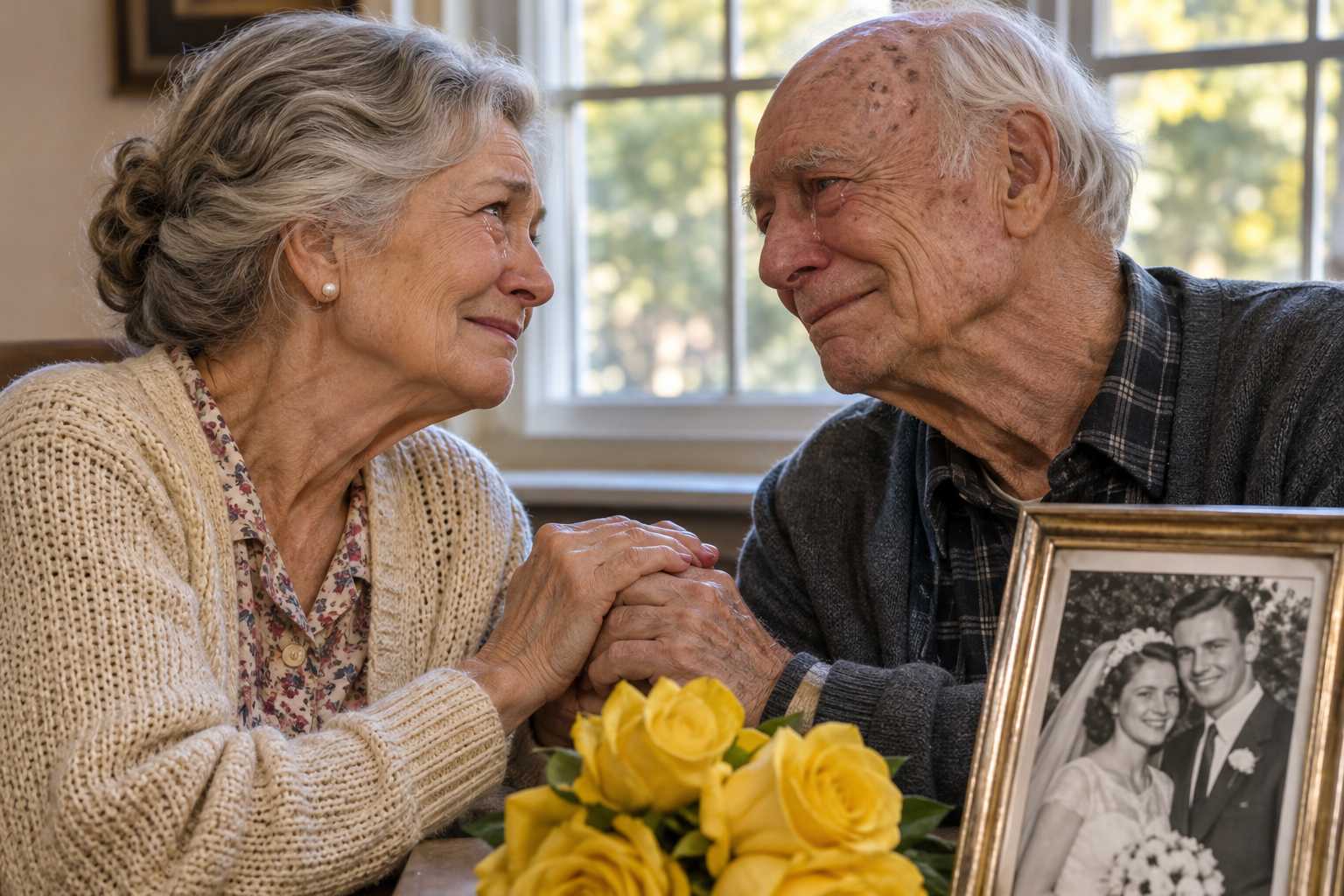
I looked at the wedding photograph.
Then I took a breath.
"Put him on."
I heard a faint movement.
A little rustling.
Then silence.
For one terrible moment, I wondered if the call had ended.
And then a man's voice spoke.
"Mary?"
It was old.
Unsteady.
Thin in a way James's voice had never been.
But something in the way he said my name made my chest ache.
I gripped the phone.
"James?"
A breath came through the line.
Then another.
"Hello, Honey."
I began crying before I could answer.
I had not heard that voice in fifty-six years.
I knew it could not sound the same.
Time had changed both of us.
But there was a familiar softness in those two words.
Something I recognized without understanding how.
I covered my mouth.
"James."
"I'm here."
I shook my head.
"No."
He went quiet.
"No, you can't be."
My voice broke.
"You were dead."
I heard him breathing.
"I know."
I wiped my face with the back of my hand.
"Adrian told me you were dead."
"I know."
"He said he saw the explosion."
"He did."
"Then how are you talking to me?"
I was almost shouting.
I had not meant to.
But fifty-six years of confusion were pushing against the small space between us.
James did not interrupt.
When I finally stopped, he spoke softly.
"I survived."
I closed my eyes.
"Why didn't you come home?"
There was a long silence.
I could hear him breathing.
I wondered whether he was crying.
Then he answered.
"I don't have a good enough reason for all of it."
I opened my eyes.
That was not what I expected.
I had imagined excuses.
Complicated explanations.
Stories about circumstances beyond his control.
I had expected him to defend himself.
Instead, he sounded ashamed.
"Tell me anyway," I said.
He began with the explosion.
He remembered very little of the attack itself.
There had been noise.
Fire.
Then darkness.
He did not know how long he had been unconscious.
When he began to recover, he could not remember his full name.
He knew he was American.
He remembered pieces of military life.
But other memories came and went.
Sometimes he remembered nothing about home.
Sometimes he dreamed about a woman whose face he could not clearly see.
I sat very still.
"Was it me?"
"I think so."
His voice trembled.
"I wanted it to be."
I looked at the wedding photograph.
My young face smiled back at me.
James continued.
He told me about years of medical problems.
Confusion.
Pain.
The difficulty of explaining who he was when his own memories would not stay in place.
He had depended on people who knew little about his previous life.
He had lived in Vietnam long after the war ended.
For years, he had been known by a name that was not his.
I tried to imagine that.
A man losing his country.
His family.
Even his own identity.
I could understand why someone in that condition might not know how to come home.
But that was not the question I needed answered.
"Elena said you remembered enough to look for me."
James fell silent.
"Is that true?"
"Yes."
I gripped the phone harder.
"When?"
He took a long breath.
"Not all at once."
"James."
"I know."
"When?"
He explained that his memory had returned in fragments over many years.
He had eventually remembered his name.
Then parts of his military service.
Then our wedding.
But remembering those things did not mean he knew how to find me.
His information was old.
The people he asked could not immediately confirm what had happened to him.
And for a long time, he had no reliable way to establish his identity.
I listened.
Some of it made sense.
Some of it did not.
And I was no longer willing to accept every explanation simply because it came from him.
"That doesn't explain everything," I said.
"No."
"Did you eventually know you had a wife?"
"Yes."
"Did you remember my name?"
"Yes."
"Did you remember where I lived?"
"Not exactly."
"But you remembered enough to try."
He began crying.
I could hear it.
An old man struggling to keep his voice steady.
I had imagined James crying many times over the years.
Usually in my dreams.
In those dreams, he was still young.
Now he sounded exhausted.
"Mary, I was ashamed."
I stared at the table.
"Of what?"
"Of what I'd become."
I frowned.
He continued.
He told me that when his memories began returning, he did not feel like the man who had married me.
His body had been damaged.
His mind was unreliable.
He needed help with things he had once done without thinking.
He had lost years.
And he did not know whether I was still waiting.
"I thought you would have a life," he said.
"I did have a life."
"I know."
"A life without you."
He stopped speaking.
I felt my anger rise again.
"You didn't get to decide whether I wanted you back."
"I know."
"You didn't get to decide what I could handle."
"I know."
I stood up.
My chair scraped against the kitchen floor.
"Do you understand what those years were like?"
His answer was barely audible.
"No. Not completely."
I pressed my fingers against my forehead.
"I waited for you."
He cried harder.
"I know that now."
I looked toward the window.
For a moment, I felt as though I were twenty again.
Waiting for a letter.
Waiting for news.
Waiting for somebody to tell me my husband was coming home.
Except now I was seventy-six.
And the man on the telephone was someone I had believed buried in the past.
"I never married anyone else," I said.
"I know."
"Not because nobody asked."
He remained silent.
"Because I couldn't stop loving you."
There it was.
The truth I had carried for fifty-six years.
I had not intended to say it.
But once the words were out, I could not take them back.
James made a small sound.
Then he said my name.
"Mary."
I sat down again.
I was shaking.
"Did you love me?"
The question sounded foolish.
I hated that I needed to ask it.
But I needed the answer.
"Yes."
I closed my eyes.
"Then why didn't you find me?"
He took a long time to respond.
Finally, he said something that changed the way I understood his silence.
"Because I was afraid that finding you would mean you had to lose me all over again."
I frowned.
"What does that mean?"
He seemed to struggle for breath.
Then he explained that his injuries had never fully healed.
His memory continued to fail him.
There were periods when he could function reasonably well.
And other periods when he could not.
He had become dependent on others.
He had convinced himself that I would be better off believing the man I married had died than watching him struggle through the life that remained.
I listened.
And I felt two things at once.
Pity.
And anger.
Because I understood his fear.
But I also understood what his decision had cost me.
"You should have let me choose," I said.
"I know."
"You should have told me."
"I know."
I rubbed my forehead.
"We could have faced it together."
He did not answer.
I waited.
Then he whispered something I had never expected to hear.
"That is what I regret most."
For a while, neither of us spoke.
I could hear faint sounds around him.
Voices in the distance.
The quiet movement of people nearby.
I pictured him sitting in a room somewhere, old and tired, holding a telephone.
I wondered whether his hands shook as much as mine.
Finally, I asked about the flowers.
"Why now?"
He took a breath.
"Because I finally understood that keeping the truth from you wasn't protecting you."
I looked at the roses.
He continued.
"Elena helped me find you."
I closed my eyes.
"And you remembered the yellow roses?"
His answer came immediately.
"Always."
I pressed the phone closer.
"They were supposed to come on our first anniversary."
"I know."
"James, it's our fifty-sixth."
His voice broke.
"I'm sorry, Honey."
I began crying again.
Not because the apology was enough.
It wasn't.
Nothing could return those years to us.
But for the first time, I was hearing the man who had broken his promise admit that he knew what he had lost.
And that mattered.
After a while, Elena came back on the line.
She explained that James was tired.
The conversation had taken a great deal out of him.
I understood.
I was exhausted too.
But before she ended the call, James asked to speak once more.
"Mary?"
"Yes."
"Could I see you?"
I looked at the wedding photograph.
Then the roses.
Then the old letter lying beside the new one.
I had spent fifty-six years imagining that question.
I had thought I knew my answer.
But now, with James alive and waiting, I realized that wanting someone to come home was not the same as knowing how to welcome them.
"I need some time," I said.
"I understand."
I closed my eyes.
"James?"
"Yes?"
"I'm glad you're alive."
He began crying again.
"So am I, Honey."
When the call ended, I remained at the table.
I did not feel relieved.
Not completely.
I felt grateful.
Angry.
Heartbroken.
And frightened of what came next.
But I knew one thing.
For the first time in fifty-six years, James was no longer only a memory.
He was a man who could answer me.
And I had not finished asking my questions.
Click here to continue reading: PART 8: I Traveled to See the Husband I Had Mourned for Fifty-Six Years, Unsure Whether I Could Recognize the Man He Had Become
Fifty-Six Years After My Husband Left for Vietnam, a Message Arrived That Made Me Question Everything I Thought I Knew
Part 7 of 10