The next morning, I went back to see James.
I arrived earlier than I had planned.
I had slept badly.
Every time I closed my eyes, I saw him sitting beside the window with our wedding photograph in his lap.
I kept remembering the way he asked whether I would return.
There had been fear in his voice.
A fear I understood too well.
For fifty-six years, I had been the one waiting.
Now James was waiting for me.
I did not want him to spend another morning wondering whether someone he loved would come back.
When Elena saw me, she smiled.
"You're early."
"I know."
"He's awake."
I nodded.
"How is he?"
"Better rested."
I felt relieved.
She walked beside me toward his room.
Before we reached the door, she stopped.
"Mary, there's something I want you to understand."
I looked at her.
"James's health can change from one day to the next."
"I know."
"Some days he'll remember things clearly. Other days may be harder."
I nodded again.
She continued gently.
"And there may be times when he becomes confused or tired without much warning."
I looked toward his door.
I had already seen how fragile he was.
I understood that the man I had come to see was not going to become young and healthy simply because I had found him.
"I don't expect miracles," I said.
Elena smiled sadly.
"I know."
I took a breath.
"I just want whatever time we can have."
She opened the door.
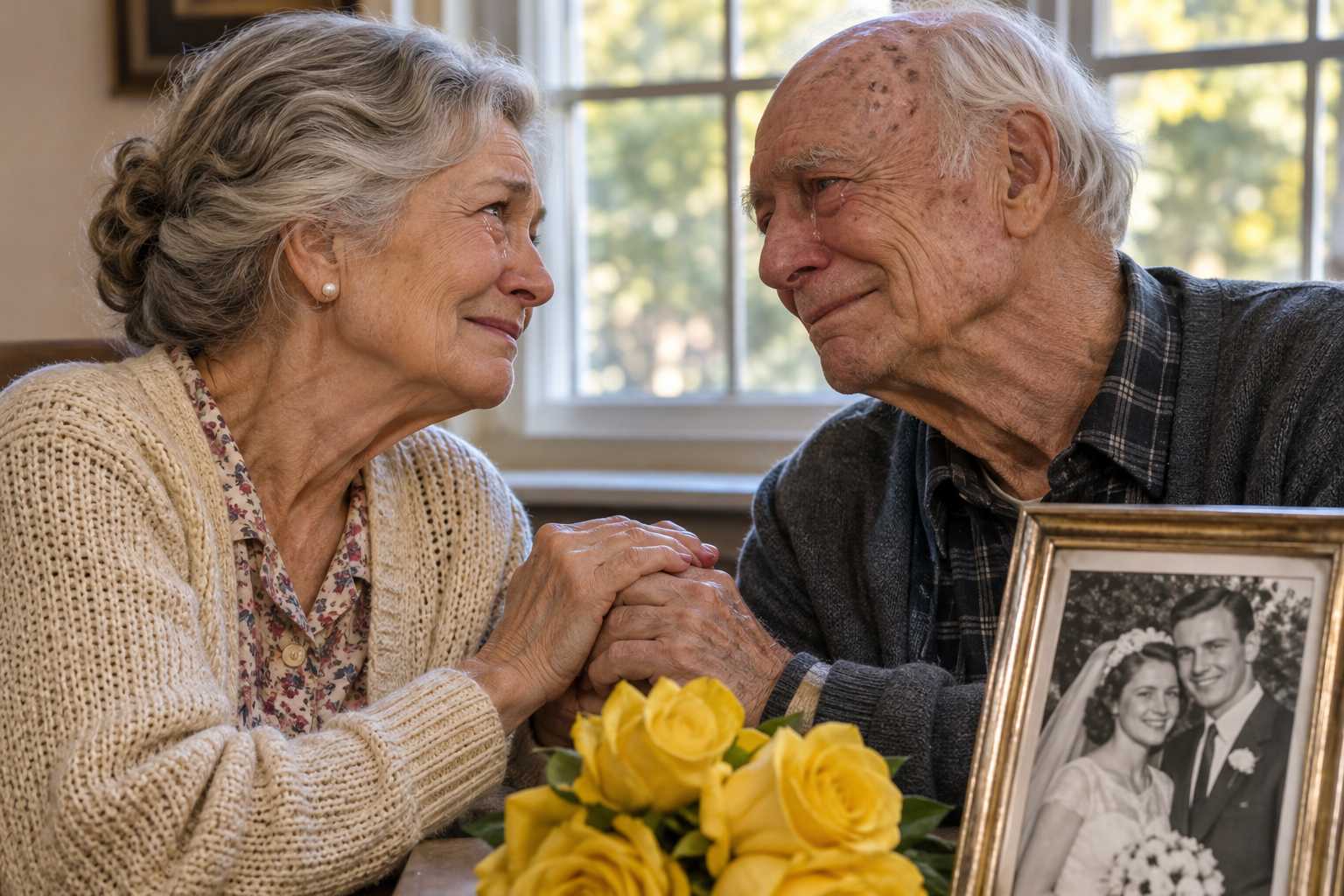
James was sitting in the same chair.
The wedding photograph was on the table beside him.
When he saw me, his expression changed.
His eyes widened.
Then he smiled.
"Mary."
I felt something loosen inside my chest.
"Good morning, James."
He held out his hand.
I walked toward him.
This time, I did not hesitate.
I took his hand and sat down beside him.
He looked at me for a long moment.
"You came back."
I smiled.
"I told you I would."
His eyes filled.
"I know."
I looked at our wedding photograph.
It was still on the table.
I picked it up.
"Did you look at this?"
He nodded.
"All evening."
I laughed softly.
"You should have been resting."
"I know."
He smiled.
"I couldn't stop looking."
I handed him the picture.
He studied it carefully.
Then he pointed toward my younger face.
"You were so happy."
I felt tears gathering.
"I was."
He looked at himself.
"So was I."
We sat quietly.
I had spent so many years remembering that wedding.
Now I could remember it with someone who had actually been there.
Someone who knew the small things.
The cake.
The backyard.
The nervous young man who nearly dropped the knife.
The promises we made without knowing how much life could change.
I asked him what else he remembered.
He told me about standing beside me.
About feeling nervous.
About being afraid that he would have to leave before we had enough time together.
I smiled sadly.
"You were right about that."
He lowered his eyes.
"Yes."
I touched his arm.
"James, I don't want every conversation we have to be about what went wrong."
He looked up.
"Neither do I."
"But we can't pretend it didn't happen."
"I know."
I took a slow breath.
"I spent fifty-six years learning how to live without you."
He nodded.
"I know."
"And now I need to learn how to know you again."
His eyes filled.
"I'd like that."
I looked at the photograph.
"There's something I need you to understand."
He waited.
"I don't know whether I can forgive everything."
His expression became serious.
"I understand."
"I want to."
He swallowed.
"But wanting to forgive someone isn't the same as being ready."
He nodded slowly.
I looked down at our hands.
"For a long time, I thought forgiveness meant saying the hurt didn't matter anymore."
James remained quiet.
"But it does matter."
"I know."
"Those years mattered."
His eyes filled.
"They did."
I looked directly at him.
"We lost our marriage before we had a chance to live it."
James began crying.
I squeezed his hand.
"We lost the ordinary things."
He nodded.
"Breakfast together."
I paused.
"Anniversaries."
My voice broke.
"Growing old beside each other."
James covered his eyes.
I waited until he could look at me again.
Then I continued.
"We can't get those things back."
He shook his head.
"No."
"And I don't want us to spend whatever time remains pretending we can."
His voice trembled.
"What do you want?"
I looked at him.
The answer surprised me by how simple it was.
"I want to know you."
He stared at me.
"The man you are now."
I reached toward his face.
"Not only the boy I married."
He closed his eyes as my fingers touched his cheek.
"I want to know what makes you laugh."
I smiled faintly.
"What you remember."
I took a breath.
"What hurts."
He opened his eyes.
"And I want you to know me."
His lips trembled.
"I'd like that, Mary."
I nodded.
"Then that's where we start."
For the first time since the flowers arrived, I felt a little peace.
Not because everything was settled.
Not because the pain had disappeared.
But because I had stopped demanding that the past become something different.
It could not.
James had survived the explosion.
His injuries had taken his memory.
He had struggled for years to understand who he was.
And when enough of his memories returned, fear had helped keep him away.
Those things were true.
So was my waiting.
So was my loneliness.
So was the love I had carried through all those years.
None of those truths canceled the others.
I began to understand that forgiveness did not require me to erase what had happened.
It required me to decide what I wanted to do with the truth.
And I wanted to stop losing time.
Over the following days, I visited James whenever I could.
Some mornings, he was bright and talkative.
He remembered details about our wedding.
He asked questions about my life.
He wanted to know what I had done during all the years we had been apart.
Those conversations were difficult.
How could I explain fifty-six years?
How could I describe an entire lifetime without turning it into a list of things he had missed?
I tried.
I told him about ordinary days.
About learning to do things alone.
About anniversaries when I looked through our photographs.
About the way I kept his letters.
About the years when I could not bear to hear people speak about husbands returning home.
He listened carefully.
Sometimes he cried.
Sometimes he held my hand.
Sometimes he simply looked at me with an expression I could not quite understand.
I did not expect him to make those years better.
I only wanted him to know they had happened.
And slowly, he began telling me about his own years.
Not all at once.
Not in a neat order.
His memory did not work that way.
Some days he recalled something from his recovery.
Other days he remembered almost nothing about that period.
He spoke about confusion.
About waking without understanding where he was.
About trying to remember words and names that seemed to slip away whenever he reached for them.
He told me how frightening it had been to realize that other people knew more about his life than he did.
I listened.
There were moments when I wanted to ask why he had not tried harder.
But I learned to recognize when that question came from my hurt rather than from a need for information.
I had already asked him.
He had already answered.
There was no explanation that would return the missing years.
I had to decide whether I wanted to spend our remaining time asking the same question.
And I did not.
One afternoon, James became confused during our conversation.
He had been telling me about something he remembered from Vietnam.
Then he stopped.
His eyes moved toward the window.
He looked frightened.
I touched his hand.
"James?"
He turned toward me.
For a moment, he seemed uncertain.
"Mary?"
"I'm here."
He looked at me carefully.
Then his expression softened.
"Honey."
I smiled.
"Yes."
He closed his eyes.
"I'm sorry."
I knew what he meant.
But I did not want him to spend every moment apologizing.
I leaned closer.
"James, look at me."
He opened his eyes.
"You're here."
He nodded.
"And I'm here."
His fingers tightened around mine.
"That's enough for this afternoon."
He began crying.
I held his hand until he settled.
Later, Elena explained that days like that were part of his condition.
I understood.
But seeing it was different from hearing about it.
The man I loved could remember our wedding cake from 1970.
Yet sometimes he struggled with things that had happened only moments earlier.
It was painful.
It was unfair.
And it reminded me how fragile our remaining time might be.
That evening, I thought about the young James I had married.
The confident smile.
The nervous excitement.
The way he promised me yellow roses as though our future were something he could guarantee.
I realized how easy it had been to love that young man.
I had not known what sickness would look like.
Or aging.
Or the helplessness of watching someone struggle with a damaged memory.
Now I was being given a different kind of choice.
Not whether I loved the man James had been.
I had answered that question fifty-six years ago.
The question was whether I could love the man he had become.
I sat quietly with that thought.
And I knew the answer.
Yes.
Not because the years had been fair.
Not because his silence had been harmless.
Not because everything could be forgiven immediately.
But because he was still James.
And I was still Mary.
We were different people now.
Older.
More frightened.
Carrying wounds that neither of us could completely understand.
But we were alive.
And for the first time in decades, we could choose what happened next.
I began making plans to spend more time near him.
I did not rush into decisions about where we would live or what arrangements might eventually be possible.
His health needed consideration.
So did mine.
We had to be practical.
At our age, love could not replace medical care or make physical limitations disappear.
But it could give us a reason to face those things together.
I spoke with Elena about James's needs.
About the help he received.
About what he could manage on his own.
About the things that were difficult for him.
I wanted to understand.
I wanted to know how to help without pretending I could solve everything.
And I wanted James to have a voice in those decisions.
He had spent too many years feeling powerless.
I did not want to take his choices away from him now.
When I told him I hoped to spend more time nearby, he stared at me.
"Mary, you don't have to do that."
I smiled.
"I know."
"You've already given up so much."
I looked at him.
"James, I'm not doing this because I owe you anything."
He lowered his eyes.
"Then why?"
I took his hand.
"Because I want to."
His eyes filled.
I leaned forward.
"And this time, I get to decide for myself."
He nodded.
A small smile appeared.
"Yes, Honey."
I laughed softly.
"Yes."
The days that followed were not perfect.
There were moments of sadness.
Moments when James was too tired to speak.
Moments when I felt the old anger returning without warning.
Sometimes I looked at him and thought about the years we could have spent together if he had found the courage to contact me sooner.
I would be lying if I said those thoughts stopped.
They did not.
Sometimes I looked at our wedding photograph and felt a grief I could barely explain.
Because we had lost more than time.
We had lost the chance to build an ordinary marriage.
The chance to make mistakes together.
To argue about small things.
To celebrate anniversaries without wondering whether the other person was alive.
To learn how each other changed over the years.
Those things were gone.
And nothing could bring them back.
But slowly, I stopped treating the future as another debt the past owed me.
James could not repay fifty-six years.
I could not give him back the years he had spent confused and injured.
Neither of us could return to 1970.
We could only decide what to do with the time still in front of us.
One afternoon, I brought the subject of the flowers up again.
James was sitting beside the window.
The wedding photograph rested on the table.
I sat down beside him.
"Do you know what I thought when those roses arrived?"
He looked at me.
"What?"
"I thought someone was playing a cruel joke."
His expression fell.
"I'm sorry."
I shook my head.
"Let me finish."
He nodded.
"I couldn't understand how anyone knew about the yellow roses."
He looked down.
"I never forgot them."
I smiled sadly.
"You remembered the flowers."
"Yes."
I paused.
"But I thought you had forgotten me."
He looked at me quickly.
"Never."
I studied his face.
I knew his memory had failed him.
I knew there had been years when he could not remember my name.
So I understood what he meant.
Not that my face had remained clear every day.
Not that the past had always been available to him.
But that once he recovered those memories, they had mattered.
I touched his hand.
"The flowers were beautiful."
He smiled faintly.
"I wanted them to be."
"They were very late."
His eyes filled.
"I know."
I leaned toward him.
"But they came."
He began crying.
I held his hand.
For a while, we sat quietly together.
Then he spoke.
"Mary?"
"Yes?"
"Do you think you can ever forgive me?"
I looked at him.
The question had been waiting between us since our first telephone call.
I had considered it every day.
And I knew I could not give him an answer simply to make him feel better.
I wanted my words to be true.
So I took my time.
"James, I forgive you for being afraid."
He closed his eyes.
"I forgive you for not knowing how to come home when you were hurt and confused."
His fingers tightened around mine.
I continued.
"But I'm still grieving the years we lost."
He nodded.
"I understand."
"I may always grieve them."
A tear moved down his cheek.
"I know."
I touched his face.
"That doesn't mean I want to spend the rest of our lives punishing you."
He opened his eyes.
I smiled through my tears.
"I want us to have some peace."
His mouth trembled.
"Together?"
I nodded.
"Together."
He began crying.
I leaned forward and held him.
Not the way I had held him when we were young.
We were both too old for that.
I put my arms gently around his shoulders.
He rested his face against me.
For a moment, neither of us spoke.
Then he whispered the familiar name I had missed for more than half a century.
"Honey."
I closed my eyes.
"I'm here, James."
I stayed beside him until he grew tired.
Before leaving that evening, I helped him place our wedding photograph back on the table.
He looked at it.
Then at me.
"We were happy that day."
I smiled.
"Very happy."
He touched the picture.
"I wish I'd given you more days like that."
My throat tightened.
"So do I."
He lowered his head.
I reached for his hand.
"But we had today."
He looked up.
I smiled.
"And tomorrow, if we're fortunate."
He nodded.
"Tomorrow."
I did not promise him fifty more years.
I did not promise that everything would become easy.
At our age, promises had to be made carefully.
I had learned that from experience.
But I could promise him something smaller.
Something honest.
That I would do my best to be there.
That I would tell him when I was hurt.
That I would listen when he needed to speak.
And that we would stop letting fear make all our decisions.
When I returned home, the yellow roses had begun to dry.
Their petals were no longer as bright as they had been on the morning of our anniversary.
I stood beside the kitchen table.
Then I took one rose from the bouquet.
I placed it carefully with the old letters and the photograph copies I kept.
I wanted to remember how the flowers had arrived.
How frightened I had been.
How angry.
How impossible the message had seemed.
I wanted to remember that the note had not erased the past.
It had opened a door I had believed was closed forever.
And behind that door was not the young husband I had been waiting for.
It was an old man with white hair.
Unsteady hands.
A damaged memory.
And eyes I still recognized.
James had not returned to me the way I had imagined.
There had been no sudden reunion in 1971.
No first anniversary with yellow roses.
No long marriage filled with ordinary days.
Instead, there had been an explosion.
Fifty-six years of separation.
A lifetime of unanswered questions.
And a reunion neither of us had expected to survive long enough to experience.
I could not call that a happy ending in the usual sense.
Too much had been lost.
Too many years could never be recovered.
But I had learned that an ending did not have to repair everything to hold something good.
Sometimes it was enough to finally know the truth.
To hear an apology.
To offer forgiveness without pretending the hurt had vanished.
And to sit beside someone you had loved for most of your life, knowing that neither of you had to face the next day alone.
I looked at my wedding ring.
Then at the dried yellow rose.
For fifty-six years, I had thought the promise James made before leaving Vietnam had died with him.
I had been wrong about that.
The promise had survived.
And so had James.
We were both older than we had ever imagined becoming.
We could not begin our marriage again.
But we could spend the time we had left getting to know each other.
I was no longer the twenty-year-old bride who believed love could guarantee a future.
I was seventy-six.
I understood loss.
I understood regret.
And I understood that time was the one thing neither of us could replace.
So I made a quiet promise to myself.
I would not spend our remaining days wishing they were the years we had missed.
I would spend them being present.
Listening.
Remembering.
Forgiving what I could.
And accepting that some sadness would always remain.
The next time I visited James, he was sitting beside the window.
He looked up when I entered.
Then he smiled.
It was the same small, nervous smile I remembered from our wedding day.
"Hello, Honey."
I walked toward him.
I took his hand.
And this time, I did not think about the fifty-six years behind us.
I thought about the chair waiting beside his.
The photograph on the table.
The afternoon sunlight coming through the window.
And the man who was still holding my hand.
"Hello, James."
I sat down.
And we began again.
Not where we had left off.
Not as the young people we had once been.
But as the two people who had finally found each other.
Fifty-six years too late.
And still grateful for one more day.
The End
Read more original stories on Feel Every Story.
Fifty-Six Years After My Husband Left for Vietnam, a Message Arrived That Made Me Question Everything I Thought I Knew
Part 10 of 10