
My son had never told me not to come.
Not when he was eight and terrified of thunderstorms. Not when he was twenty-two and stranded beside a dead truck three states from home. Not even during the worst argument we ever had, when he had stood in my driveway with his jaw clenched and told me he needed space.
So when my phone lit up seven days before New Year's Eve and I read the message from Wyatt, I knew immediately that something was wrong.
DAD, DON'T COME TO THE HOUSE. PLEASE. IT'S NOT SAFE.
There was no greeting. No explanation. No question at the end.
Just that.
I read it three times while sitting alone at my kitchen table, one hand wrapped around a mug of coffee that had already gone cold. Outside, sleet tapped against the windows. The weather service was predicting snow by morning, and the old maple trees along the road were bending under the wind.
I called him.
The call rang once.
Then went straight to voicemail.
I called again.
Nothing.
I left no message. Something in me resisted putting more words into a phone that might not be private.
Wyatt was forty-one years old. He ran Heartland Freight Systems, the company I had built over four decades from three used trucks and a borrowed warehouse. He was capable, careful, and stubborn in ways that sometimes reminded me too much of myself.
He was also married to Sabrina.
That was the part I couldn't stop thinking about.
Sabrina had always been pleasant with me. Pleasant in the way a person can be when they are carefully choosing every word. She remembered birthdays, sent expensive bottles of wine at Christmas, and never forgot to ask about my blood pressure.
But she never asked about the trucks.
She never asked about the drivers.
She never asked how the company had survived the recession, the fuel crisis, or the lawsuit that nearly destroyed us twenty years ago.
She asked about ownership.
Not directly.
Never directly.
She would mention estate planning over dinner. She would ask whether Wyatt had "full authority" over the company. Once, while we were standing on the back porch during a family barbecue, she had casually asked me whether I still kept original corporate documents in a safe.
I had laughed.
She hadn't.
At the time, I thought she was simply curious about family finances.
That night, staring at my son's message, those conversations returned one by one.
I pushed back from the table.
Wyatt's house was less than an hour away in normal weather. I had driven that road hundreds of times. I knew every turn, every stretch where deer crossed, every gas station that stayed open late.
I also knew something else.
If Wyatt had truly wanted me to stay away, he would have called me.
He would have explained.
He would have sounded angry.
Instead, he had sent a sentence that looked like a warning but felt like a signal.
I stood and went upstairs.
At sixty-eight, I wasn't interested in pretending I was twenty-five. My knees hurt in cold weather, my left shoulder complained whenever I lifted anything heavy, and I had no desire to walk into danger without thinking first.
But I had spent forty years driving through blizzards to bring stranded drivers home.
You learn certain things in that business.
One is that the worst mistake during an emergency is confusing silence with safety.
I packed a small overnight bag.
Then I stopped.
I went back downstairs and opened the locked drawer beneath my desk.
Inside was an old photograph of Wyatt at twelve years old, standing beside his mother, Eleanor, beside the first truck we had ever purchased with company money. Wyatt had one hand on the hood and an expression of complete seriousness on his face.
His mother was laughing.
She had been gone five years.
I touched the edge of the photograph.
"All right, son," I whispered.
"I'm coming."
I didn't drive directly to the house.
Instead, I stopped two miles away at a closed farm supply store whose parking lot sat behind a row of pine trees. From there I watched the road leading toward Wyatt's property.
Snow had begun.
At first it came lightly, almost like dust.
Then the flakes thickened.
The house appeared briefly through the trees, its upper windows glowing warm against the dark. Cars lined the circular drive.
Too many cars.
I counted them twice.
There were at least a dozen.
That made no sense.
Wyatt and Sabrina were supposed to spend New Year's Eve quietly. At least that was what Sabrina had told me at Christmas.
"No big party this year," she had said.
Yet there were cars everywhere.
I turned off my headlights and waited.
Twenty minutes passed.
A black SUV pulled away from the house.
Then another.
Neither came toward me.
Both turned toward the highway.
I wrote down the license plates.
Old habits.
My phone vibrated.
For half a second I thought it was Wyatt.
It wasn't.
It was a bank alert.
A large transfer had been attempted from one of the company accounts.
I stared at the amount.
It wasn't a routine payment.
It was a transfer large enough to make any freight company nervous.
I immediately called the bank's emergency number.
While I waited, I watched the house.
A figure crossed an upstairs window.
Then disappeared.
The bank representative answered.
"Mr. Yates, can I verify—"
"Has a transfer been initiated from Heartland Freight's reserve account tonight?"
There was a pause.
"I'll need to verify the account."
"You can verify it. The answer is yes."
Another pause.
"Sir, I'm seeing an authorization attempt."
"Did it clear?"
"No."
I closed my eyes.
"Can you stop it?"
"We've placed a temporary hold because the transaction triggered a security review."
"Keep it there."
"I can note the account."
"No. Freeze the transfer."
The representative hesitated.
"I'll escalate it."
I hung up.
That was the moment my concern became something heavier.
Someone wasn't merely keeping Wyatt from answering his phone.
Someone was trying to move money.
I drove closer.
There was a service entrance behind the property that most people never noticed. Years earlier, before Wyatt bought the house, I had helped supervise renovations there.
I knew the property better than Sabrina realized.
I parked behind a stand of trees and walked the rest of the way.
The snow swallowed the sound of my boots.
When I reached the back wall, I found the mechanical-room door.
Locked.
But old.
I took a small pry bar from my bag.
Three minutes later, I was inside.
The room smelled of dust, oil, and cold metal.
I shut the door behind me and stood still.
The house above me was alive with voices.
Laughter.
Music.
Someone shouted about champagne.
A party.
At midnight.
While Wyatt had begged me not to come.
I moved through the mechanical room and found the basement stairs.
The lights above were off.
I used the beam from my phone.
Halfway down, I heard something.
A scrape.
Then a muffled sound.
I froze.
Another scrape.
Metal against concrete.
My hand tightened around the pry bar.
"Wyatt?"
Silence.
I descended another step.
Then I heard him.
"Dad?"
The word was barely audible.
But it was his voice.
I reached the basement floor.
At first I couldn't see him.
The room was divided by storage shelves and old equipment.
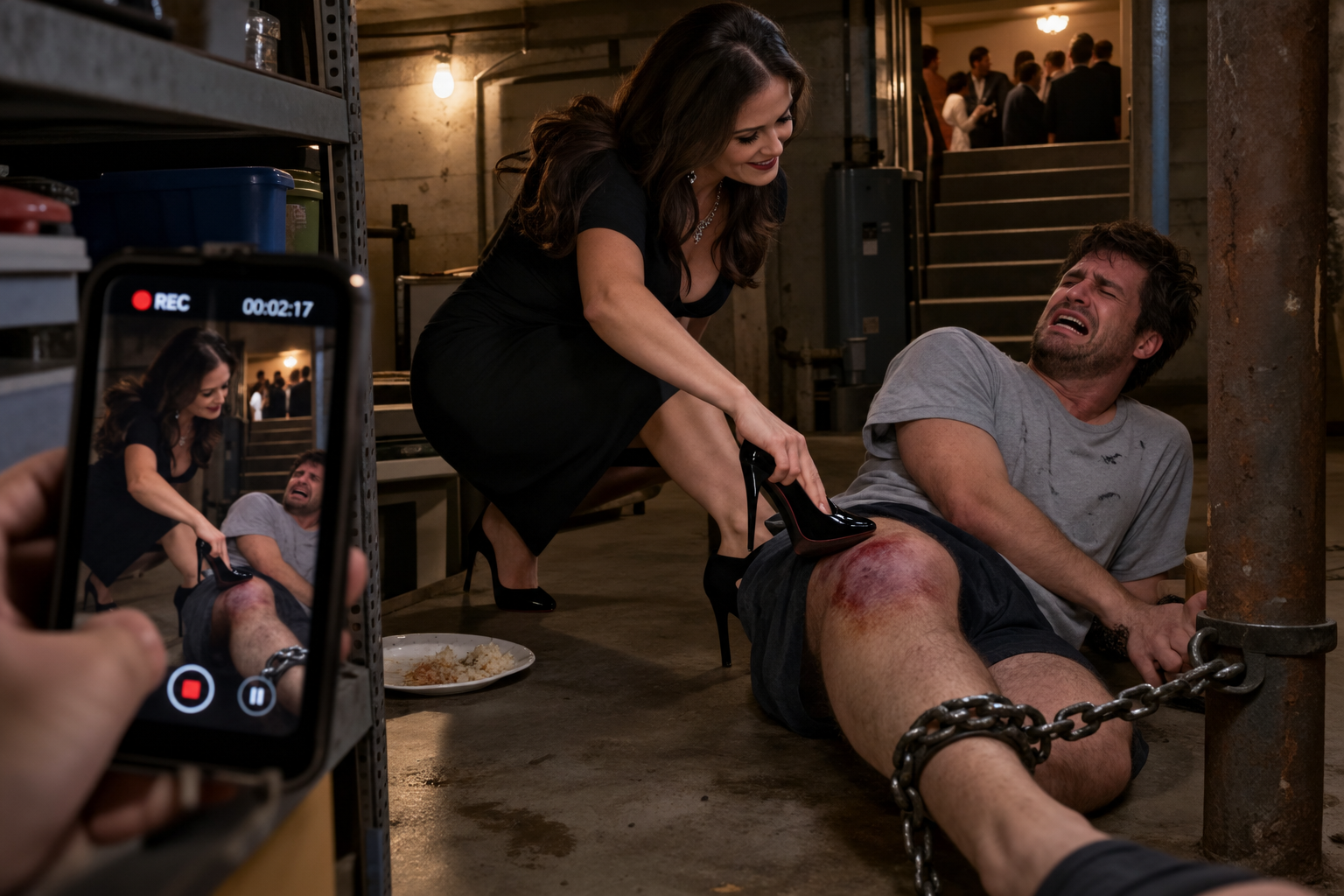
Then I noticed the chain.
It ran from a steel ring bolted into the concrete wall to a heavy restraint around my son's ankle.
Wyatt was sitting on the floor beneath an old workbench.
His face was bruised.
His shirt was torn.
One eye was swollen.
His right knee was grotesquely enlarged.
I stopped breathing for a moment.
He looked at me.
Then his expression changed from relief to terror.
"No."
I crossed toward him.
He shook his head violently.
"Dad, no. You shouldn't have come."
"I know."
I crouched beside him.
"What did they do?"
He looked toward the stairs.
"Keep your voice down."
"Who?"
His lips trembled.
"Sabrina."
I felt something inside me go very still.
"She did this?"
Wyatt swallowed.
"Not alone."
I looked at the chain.
"How long?"
He closed his eyes.
"I don't know."
"Wyatt."
"Four days. Maybe five."
My stomach tightened.
"Why?"
He laughed once, but there was no humor in it.
"They want me to sign."
"Sign what?"
"Everything."
He looked at me.
"The company."
I stared at him.
"They told me the board documents were ready. They said I had already agreed to transfer control."
"You didn't."
"No."
His voice dropped.
"I wouldn't sign."
A sound came from upstairs.
Both of us froze.
Footsteps.
Wyatt grabbed my sleeve.
"Hide."
I moved behind a tall storage rack just as the basement door opened.
Sabrina came down first.
She wore a dark green dress and heels.
There was champagne on her fingers.
Behind her came Irving Palmer.
I knew him.
Sabrina's uncle.
A corporate attorney who had represented several companies connected to her family.
He carried a leather folder.
Sabrina looked toward Wyatt.
"Did you change your mind?"
Wyatt said nothing.
Irving sighed.
"We don't have all night."
Sabrina walked closer.
"You know what happens if you cooperate."
Wyatt's jaw tightened.
"And if I don't?"
She looked at him for a long moment.
"Then the next few days become very unpleasant."
Irving opened the folder.
"Your father's coming here tomorrow, isn't he?"
Wyatt looked down.
That was answer enough.
Sabrina's expression hardened.
"Then we have less time than I thought."
My pulse began pounding.
She knew I might come.
Perhaps she had expected me.
That meant the message hadn't surprised her.
It had been part of the plan.
Sabrina reached into her pocket and removed a syringe.
Wyatt recoiled.
"Please."
She didn't raise her voice.
"You need to sleep."
Irving stepped closer.
"He'll be easier to control once he's confused."
I raised my phone behind the shelf.
The recording light appeared.
I held it steady.
Sabrina turned away.
"By New Year's Eve, this will all be finished."
Irving nodded.
"And the body?"
She looked at him.
"That depends on whether he signs."
They walked back toward the stairs.
Before leaving, Sabrina stopped.
She glanced at Wyatt.
"Your father always thought he was smarter than everyone else."
Then she smiled.
"Let's see how smart he is when he arrives."
The door closed.
I waited until their footsteps disappeared.
Then I stepped out.
Wyatt stared at me.
"Dad."
"I heard them."
He looked at the phone in my hand.
"You recorded that?"
"Every word."
His shoulders sagged.
For the first time since I had entered the basement, he looked less afraid.
Then I noticed something beside the boiler.
Several empty syringes.
A stack of documents.
And one sheet of paper with a date written across the top.
December 31.
Underneath it were three words.
TRANSFER OF CONTROL.
Wyatt followed my eyes.
"That's why they kept me alive."
I folded the paper.
"No."
He looked at me.
"That's why they think they need you alive."
I heard footsteps upstairs again.
This time there were more of them.
Wyatt's face went pale.
"Dad, you have to leave."
I looked toward the stairs.
Then at the chain.
Then back at my son.
"No."
I put the phone in my coat.
"I'm not leaving you here."
The basement door handle began to turn.
And this time, whoever was coming down wasn't carrying paperwork.
They were carrying something heavy.
Click here to continue reading: PART 2: They Wanted Wyatt Conscious Long Enough to Sign, but They Had No Idea His Father Had Already Started Building a Case
The Message Arrived Before Midnight, and Every Instinct I Had Told Me My Son Was Asking for Help
Part 1 of 20

