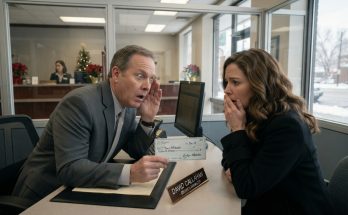
I read the name again.
Then I read the email.
The attorney explained that while reviewing the original trust, she had found a reference to a second beneficiary attached to a separate provision.
The person wasn't entitled to the house.
But they had a limited claim connected to the property.
I called her immediately.
“What does that mean?”
“It means your grandfather anticipated another possible claim.”
“From whom?”
“We're still trying to establish that.”
“Is the person alive?”
“We don't know.”
I stared at the screen.
“What do you know?”
“Only the name.”
She gave it to me.
I had never heard it.
Neither had Claire.
Dad recognized it.
He went pale when I told him.
“Where did you hear that?”
“From the attorney.”
He sat down.
“Daniel, don't go looking for this person.”
“Why?”
“Because your grandfather didn't want you involved.”
“That isn't an answer.”
“It is if you understand what happened.”
I waited.
Dad took a long breath.
“Before you were born, there was another child.”
The room seemed to tilt.
“Whose?”
He looked at Mom.
She was standing in the doorway.
“My sister's,” she said.
I turned.
“You had a sister?”
Mom nodded.
I remembered the photographs.
The woman from the old albums.
The one who had died young.
I had never understood why her name rarely appeared.
“What happened to her child?”
Mom sat down.
“She gave the baby up.”
“Why?”
“She wasn't married. She was nineteen. Our father was furious.”
“Where did the baby go?”
“We were told the child was adopted.”
I looked at Dad.
“Is that the beneficiary?”
“We don't know.”
Mom covered her face.
“What did Grandpa do?”
“He searched for the child,” she said.
“Why?”
“Because he believed the adoption wasn't handled properly.”
The attorney called while we were still talking.
I put her on speaker.
She confirmed that the beneficiary's name matched a record connected to my grandfather's estate.
“But there's something else,” she said.
“What?”
“The provision was never activated.”
“Why?”
“Because your grandfather never received proof that the child was alive.”
Dad looked at Mom.
“What does that mean?”
“It means the beneficiary may not have any enforceable claim.”
I exhaled.
“Then why does this matter?”
“Because the name is attached to another document.”
“What document?”
“The original property transfer.”
I felt the same cold sensation I'd felt in the hospital months earlier.
“What was transferred?”
“Not the house.”
“Then what?”
“An adjacent parcel.”
I stared at Dad.
“What adjacent parcel?”
He didn't answer.
The attorney explained that the parcel had been sold decades ago and developed into commercial property.
“Who owns it now?”
“A holding company.”
“Who owns the holding company?”
“We're checking.”
Dad stood.
“I know.”
Everyone looked at him.
“You know who owns it?”
He nodded.
“It's connected to your mother's family.”
Mom went completely still.
“What?”
Dad turned toward her.
“Your father's old business partner.”
Her face drained.
I suddenly understood why my grandfather had kept so many records.
The construction company collapse hadn't been an isolated disaster.
There had been property transfers.
Companies.
Debts.
Families accusing each other.
And somewhere inside all of it was a child whose identity had apparently been concealed.
I called the attorney back.
“What do you need from us?”
“Your grandfather's complete estate records.”
“We have boxes.”
“Bring everything.”
The next morning, we gathered every document we could find.
Claire helped.
Mom helped.
Even Dad stopped trying to control what we looked at.
By noon, the dining table was covered in papers.
Tax records.
Receipts.
Letters.
Maps.
Property descriptions.
Old photographs.
We found the parcel.
It had once been part of the same land as the house.
My grandfather had transferred it to a company shortly before the construction business collapsed.
The company had later sold it.
The buyer had developed it.
And the proceeds had disappeared.
“That's where the money went,” Dad said.
“Where?”
“To settle the debts.”
“Whose?”
Dad looked at Mom.
“Everyone's.”
Mom shook her head.
“No.”
She picked up a letter.
“This isn't a sale.”
We looked at her.
She pointed to a paragraph.
“The parcel wasn't sold.”
“What?”
“It was held in trust.”
I read the document.
She was right.
The company had been allowed to use the land temporarily, but ownership had remained with a separate trust.
The name on that trust was the same name from the attorney's email.
Claire whispered, “So the stranger owns land.”
“Maybe,” I said.
Dad sat down.
“Your grandfather was trying to protect that person's inheritance.”
“Why?”
“Because he believed the family had stolen it.”
Silence filled the room.
Mom began to cry.
“My father?”
Dad nodded.
“Your father took it?”
“We don't know.”
“But Grandpa did.”
“Yes.”
The attorney reviewed the documents that evening.
Her conclusion was cautious.
The claim was old.
The records were incomplete.
Some signatures were difficult to authenticate.
But the evidence was strong enough that the beneficiary might have a legitimate interest.
The question was whether that person could still be found.
I searched the name.
Nothing useful.
Claire searched old records.
Mom contacted distant relatives.
Dad called people he hadn't spoken to in decades.
For the first time, our family worked on the same problem without anyone trying to save someone else.
Two days later, the attorney called.
“We found an address.”
I sat down.
“Where?”
She told me.
It was in another state.
The person was alive.
They had changed their surname.
They had no idea about the trust.
No idea about the land.
No idea about our family.
I looked at the documents scattered across the table.
The house was mine.
The debt was under control.
My health had improved.
And yet another unfinished piece of my grandfather's life had landed in my hands.
Dad looked at me.
“You don't have to do this.”
“I know.”
“Then don't.”
I considered that.
The old version of me would have taken responsibility automatically.
The new version asked a different question.
“What happens if I don't?”
The attorney answered.
“The claim may disappear with time.”
I looked at Claire.
She understood before I said anything.
“We should tell them,” she said.
Dad sighed.
“Why?”
“Because Grandpa spent his life trying to make it right.”
Dad looked at me.
“And if making it right costs you?”
I folded the documents.
“Then I decide whether I'm willing to pay.”
This time, nobody told me what I should do.
That mattered.
I called the attorney.
“Contact them.”
She paused.
“Are you certain?”
“No.”
I looked around the table.
“But I'm willing to find out.”
Click here to continue reading: PART 12: Finding the Missing Heir Could Cost Me the House I Had Finally Chosen to Keep, Yet I Could No Longer Pretend the Past Wasn’t Mine
The Night My Family Celebrated My Sister, I Was Sitting Alone With a Diagnosis They Never Asked Me About
Part 11 of 24