The account existed outside the main trust.
Northbridge had found it during the forensic review.
It had never been included in the property records.
It had never appeared in Redwood Holdings documents.
It had never been listed among the Winter assets.
Yet five million dollars had sat there untouched for forty years.
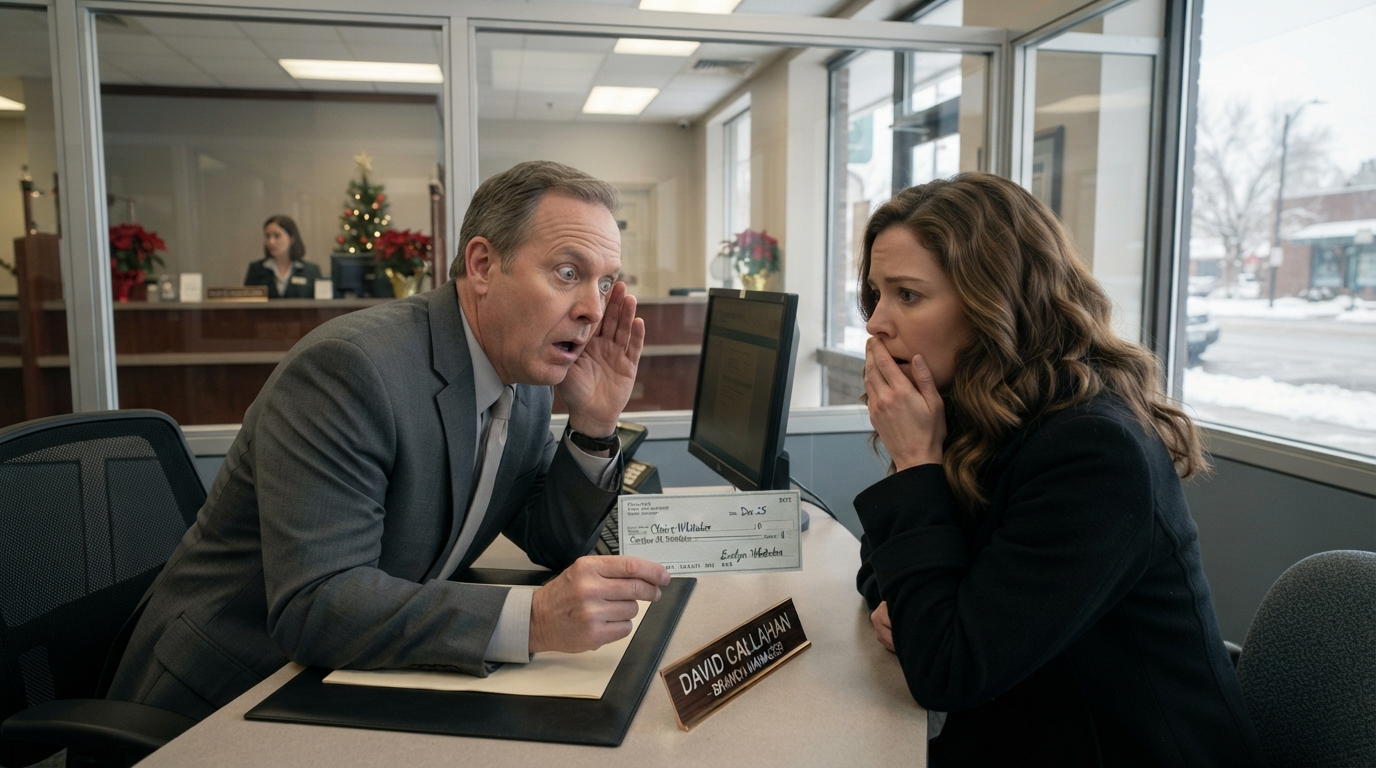
Ruiz met us at the bank that afternoon.
The account was held under a corporate name.
Bennett Family Settlement.
The beneficiary designation listed five unnamed descendants.
The original deposit date was December 21, forty years earlier.
Thomas stared at the screen.
“That's the night of the bank meeting.”
Grandma nodded.
“Samuel must have created it afterward.”
David looked at the records.
“Who funded it?”
The bank investigator pointed to the transaction history.
“One transfer.”
From Redwood Holdings.
“Then it is company money,” Daniel said.
“Not necessarily,” Ruiz replied.
She explained that the source account mattered.
The transfer had originated from an account containing Samuel's original investment.
The money had been moved before Victor's fraudulent activity began.
That made the ownership question different.
The five million could potentially be legitimate.
But Samuel had left no instructions for distributing it.
Only a note.
The bank investigator showed us the scanned document.
I read it aloud.
If this account is discovered, do not distribute it among the beneficiaries until the original source has been established.
Claire looked at Thomas.
“He wanted us to investigate it.”
“Yes.”
“Why?”
“Because he knew the money had a complicated history.”
Ruiz agreed.
“We need to trace every dollar.”
The process took several weeks.
The investigation expanded.
Bank records were subpoenaed.
Old corporate files were retrieved.
Several former employees were interviewed.
Victor's attorneys argued that some of the funds were legitimate.
Prosecutors disputed parts of his account.
The courts would ultimately determine liability.
Meanwhile, our family changed.
Not dramatically.
Quietly.
We stopped talking about the money at every meal.
Daniel returned to work.
Marlene began sorting through old family photographs.
Frank repaired the broken window at Grandma's house.
Claire visited David regularly.
Thomas stayed at Grandma's house for the first time in decades.
One evening, I found him sitting alone in the kitchen.
He was holding Samuel's photograph.
“You miss him,” I said.
Thomas nodded.
“He was difficult.”
I smiled.
“So was Grandma.”
Thomas laughed.
“That family trait survived.”
He looked at the photograph.
“I should have come back sooner.”
“Why didn't you?”
“Fear.”
He said the word without excuses.
“I thought disappearing would protect everyone.”
“Did it?”
“No.”
I sat across from him.
“Then why did Samuel do the same thing?”
Thomas considered it.
“Because people confuse secrecy with control.”
That stayed with me.
The next morning, Ruiz called.
The investigation had reached a conclusion about the secret five-million-dollar account.
Most of it came from Samuel's legitimate inheritance.
But a portion had been mixed with profits from disputed transactions.
The court would separate the amounts.
Some money would return to former property owners.
Some would remain in restitution.
The verified legitimate portion would go to the trust.
Nobody knew exactly how much that would be.
I wasn't disappointed.
For the first time, the number didn't matter.
Then Ruiz added something.
“There's another issue.”
“What?”
“The account's final instruction.”
I remembered Samuel's note.
Do not distribute until the original source has been established.
“What about it?”
“It has a second page.”
She sent us a copy.
The second page contained a list of five organizations.
A children's shelter.
A community clinic.
A scholarship foundation.
A fire department.
And a local legal-aid organization.
Claire read the names.
“He wanted some of it donated.”
Thomas nodded.
“He always said wealth meant responsibility.”
Daniel looked at the page.
“Was that legally binding?”
“No,” Ruiz said.
“It appears to be a personal instruction.”
Frank frowned.
“So we don't have to follow it.”
“No.”
Nobody spoke.
We looked at each other.
The decision belonged to us.
Not Samuel.
Not Grandma.
Not Victor.
Not the trust.
Us.
Claire was the first to speak.
“I think we should honor it.”
Daniel nodded.
“So do I.”
Marlene agreed.
Frank took longer.
Then he said yes.
I looked at Grandma.
She smiled.
“That would have made Samuel happy.”
But I wanted something more.
“What about the disputed money?”
Grandma looked at me.
“We return it.”
Daniel nodded.
“All of it.”
The decision wasn't legally required from us yet.
But we made it anyway.
We would keep only what could be demonstrated as legitimately belonging to the family.
Everything else would go toward restitution or remain under court supervision.
The five-million-dollar checks were never cashed.
Eventually, they were canceled.
The original trust was dissolved and replaced with a transparent structure overseen by independent trustees.
The legitimate family assets were divided according to documented ownership.
Claire retained her role in the new structure because she had been the one who exposed the fraudulent system.
But she refused exclusive control.
“Five people built this problem,” she said.
“Five people can stop pretending one person should control the solution.”
The Winter account was renamed the Restitution Reserve.
Money was returned where ownership could be established.
Some claims remained unresolved.
Those funds stayed frozen.
Victor eventually faced multiple charges.
Martin cooperated with investigators and admitted his involvement.
His testimony helped explain how the identities of dead people had been used.
David's recordings became part of the evidence.
Thomas gave a formal statement about the original bank meeting.
Grandma did the hardest thing.
She told the complete truth.
Not the family version.
Not the version she had spent decades repeating.
Everything.
She admitted where she had lied.
Where she had signed documents.
Where she had remained silent.
Where fear had guided her.
When she finished, Claire hugged her.
Grandma cried.
Not because the past had disappeared.
It hadn't.
But because nobody was carrying it alone anymore.
Months later, I returned to Grandma's house.
The broken window had been replaced.
The dining room table looked ordinary again.
There were no envelopes.
No police.
No ledgers.
Just five cups of coffee.
Grandma placed one in front of me.
“You know,” she said, “you could have been five million dollars richer.”
I laughed.
“I think I'm richer without it.”
She raised an eyebrow.
“Don't become sentimental.”
“I learned from you.”
“That worries me.”
We laughed together.
Then Claire entered carrying a small package.
She placed it on the table.
Inside was the wooden box.
The brass latch was repaired.
The initials remained carved across the lid.
R.M.B.
I looked at her.
“What are you going to do with it?”
“Keep it.”
“Why?”
She closed the lid.
“Because it reminds me what happens when people hide the truth because they think they're protecting someone.”
Grandma nodded.
Outside, wind moved through the trees.
For once, nobody was watching the road.
Nobody was waiting for another car.
Nobody was afraid of a knock at the door.
Then Claire turned to me.
“There is one thing I still don't understand.”
“What?”
She tapped the box.
“Why did Samuel choose Christmas?”
I thought about it.
Then Grandma answered.
“Because Christmas is when people are most willing to believe a gift doesn't come with a price.”
She looked at the five of us.
“He wanted you to learn the difference.”
Click here to continue reading: PART 20: On the Following Christmas, the Five Returned to Grandma’s Table With No Checks, One Empty Chair, and the Truth Finally Set Free
The Christmas Gift Everyone Thought Was a Joke Until One Envelope Made the Room Go Completely Silent
Part 19 of 20