One year later, June stood in the cereal aisle holding two boxes.
“Which one?”
I looked.
Chocolate stars.
Rainbow loops.
“Whichever you want.”
“That’s not helping.”
I smiled.
“Then chocolate.”
She put the rainbow loops in the cart.
“Why did you ask me?”
“I wanted to know what you’d say.”
She was eight now.
Still contrary in ways that reassured me.
Her purple shoes had become too small months earlier.
We donated them.
The replacement pair was green.
Apparently purple had been a phase.
That made me strangely happy.
Children were supposed to change faster than adults could preserve them.
Emmett pushed the cart.
Eleven.
Taller.
New basketball shoes finally on his feet.
He checked the grocery list.
“Milk.”
“We have milk.”
“Not enough.”
“How do you know?”
“I drank most of it.”
“Then get milk.”
He added a gallon.
No one calculated whether milk meant returning apples.
I still watched prices.
Of course I did.
Freedom had not transformed me into someone careless.
I compared chicken.
Bought store-brand pasta.
Skipped strawberries because they were ridiculous that week.
Chose apples instead.
But each decision belonged to the actual problem in front of me.
Price.
Need.
Preference.
Not fear.
At checkout, the total was $143.76.
I paid.
The number disappeared from the screen.
No argument followed.
Outside, Mrs. Weaver waited in her car.
She had refused to stop helping even after we moved.
Our new apartment was six blocks from the old one.
Different building.
Two bedrooms.
Smaller kitchen.
More sunlight.
The lease had one adult name.
Mine.
When I signed it, I read every page.
Then read it again.
The leasing agent became impatient.
I did not care.
The legal cases had moved slowly.
Slower than danger.
Slower than fear.
Slower than headlines.
That turned out to be normal.
Vaughn eventually entered guilty pleas to a combination of federal financial crimes and state charges tied to the attempt on my life.
The evidence surrounding the brakes, sedatives, insurance changes, route planning, and his own recorded admissions left little room for the accident story he once intended to tell.
His sentence meant he would spend many years in prison.
Other proceedings continued.
Ruth’s cases were more complicated because the network stretched across decades.
Some charges survived.
Some old events could not be prosecuted the way investigators initially hoped.
Evidence had disappeared.
Witnesses died.
Statutes differed.
Memory failed.
That frustrated people who wanted one courtroom to settle everything.
I stopped needing that.
The truth did not become less true because every part could not produce a conviction.
Lena’s death was formally reclassified after the reopened investigation.
No longer treated as an ordinary residential accident.
Vaughn’s admissions about the furnace became central.
Ruth continued disputing portions.
Daniel continued bargaining over his role.
None of that changed Lena’s recording.
She had known something was wrong.
She had been isolated financially.
She had tried to leave.
That record now existed where it should have existed twelve years earlier.
Under her own name.
Not as a corporate agent.
Not a stolen identity.
Lena Price Mercer.
A person.
Megan’s case moved separately.
Elaina was prosecuted for her death.
Halpern’s cameras, toxicology, medical supplies, and records created a far more direct chain than the family’s older schemes.
Rachel faced charges connected to identity fraud, abduction, records manipulation, and conspiracy.
Janice testified.
So did Owen.
So did Brielle.
Brielle pleaded guilty to fraud-related offenses.
Her cooperation mattered at sentencing.
So did what she had done before cooperating.
That felt right to me.
She wrote once.
A real letter.
Not asking forgiveness.
Not asking friendship.
She said she was sorry she participated in forging my signature and helping Vaughn hide money.
She said finding the brake photographs was the moment she finally understood what kind of system she had agreed to live inside.
I answered.
Three sentences.
I told her her warning helped save my life.
I told her that did not erase what came before.
I told her I hoped she built whatever came next under her own name.
She never wrote again.
That was enough.
Mallory had her baby.
A girl.
I learned through Denise because Mallory’s attorney sent notice regarding paternity and Vaughn’s financial obligations.
I did not ask for photographs.
Her daughter deserved a life that did not begin as evidence in mine.
Emmett and June knew they had a half-sister.
We would deal with that carefully when circumstances allowed.
No secret identities.
No pretending she did not exist.
But no forced closeness either.
Truth without control.
That had become my rule.
The financial recovery took months.
Our legitimate savings returned.
The fraudulent debts were removed from my name.
The business guaranty disappeared.
My credit recovered enough to qualify for the new apartment without a cosigner.
When the approval email arrived, I read it three times.
Not because the apartment was impressive.
Because nobody dead had guaranteed it.
No Lena.
No forged cousin.
No hidden trust.
Just my income.
My application.
My signature.
The millions scattered through June’s account, Emmett’s disguised trust, the reserve, and the shell companies went into receivership.
Some money returned to estates.
Some to insurers.
Some remained disputed.
Some represented legitimate investment growth whose ownership required judges and accountants to untangle.
The children did not become secret millionaires.
Good.
What eventually remained legally theirs was placed in transparent court-supervised structures.
No hidden successor.
No family foundation.
No dead person’s identity.
I received statements.
I read them.
Emmett sometimes sat beside me.
“What’s that?”
“Your account.”
“How much?”
I told him.
No secrecy.
No mystery.
“What can I use it for?”
“Mostly future things.”
“College?”
“Yes.”
“Car?”
“Maybe.”
“Basketball camp?”
“We’ll discuss it.”
He groaned.
Apparently financial transparency was less exciting than he expected.
June cared even less.
She wanted to know whether the account could buy a pony.
“No.”
“Then why do I have it?”
Mrs. Weaver nearly choked on coffee.
I laughed.
The first anniversary of August eighteenth arrived quietly.
I expected the date to feel enormous.
Instead, I woke before the alarm because rain tapped against the window.
For a moment, I did not remember.
Then I did.
One year earlier, Vaughn expected me to leave work exhausted.
Drive Lower Wacker.
Become sleepy.
Press brakes that would not respond correctly.
Crash.
Die.
At 6:07, someone would begin turning my death into paperwork.
At 6:15, money would move.
Instead, at 6:07 this year, I stood in my kitchen making eggs.
At 6:15, June complained that her toast was too dark.
I looked at the clock.
There it was.
The minute.
Nothing happened.
That was the gift.
Nothing.
No transfer.
No crash.
No official story beginning without me.
Just burnt toast.
I scraped it.
June said, “You can make another one.”
“I know.”
I made another.
After school, Denise came over.
Not as my lawyer exactly.
We had become something close to friends, though neither of us announced it.
She brought a folder.
Mrs. Weaver arrived ten minutes later with cake.
“What’s the folder?” I asked.
“Final order on the old apartment-related financial claims.”
“Good or bad?”
“Read it.”
I did.
The last lien connected to Mercer-Hale Logistics had been released from anything associated with me.
My name was no longer attached to the company.
No guaranty.
No ownership.
No liability.
I set the page down.
“That’s it?”
“For that piece.”
There would always be another piece somewhere.
Tax records.
Victim restitution.
Children’s trust reporting.
Court notices.
But this one was finished.
Mrs. Weaver cut cake.
“To paperwork.”
I looked at her.
“You’re making a toast to paperwork?”
“To accurate paperwork.”
Fair.
We ate.
Later, after the children went to bed, I found the old household budget notebook.
The one I started after moving.
On the first page:
Groceries — $175/week target. Flexible.
Food is not punishment.
I smiled at the sentence.
It still looked slightly ridiculous.
I turned pages.
Actual expenses.
School supplies.
Utilities.
Bus passes.
Car savings.
Emergency fund.
There were mistakes.
Months we overspent.
Months my work hours dropped.
A dental bill that wrecked February.
A school trip I forgot to budget for.
Nothing collapsed.
That had been another lie Vaughn taught me.
One wrong purchase would ruin everything.
One question would destroy the marriage.
One refusal would make me selfish.
One mistake would prove I could not manage money.
Real life was more forgiving than his system.
You adjusted.
You looked at numbers.
You asked for help.
You tried again.
I had bought another car.
Used.
Unremarkable.
Before driving it home, I had a mechanic inspect everything.
Not Owen.
A woman named Teresa whose shop Denise recommended.
I stood beside the lift while she showed me brake lines, pads, fluid, tires.
At first she seemed confused by how closely I watched.
Then I told her enough.
She stopped being confused.
“Want me to explain every item?”
“Yes.”
So she did.
I learned what healthy brake fluid looked like.
What worn pads sounded like.
Where leaks appeared.
Knowledge did not make me paranoid.
It made me harder to deceive.
I still sometimes woke at night remembering Vaughn saying:
You should’ve stayed on your normal route.
The sentence had entered evidence.
It no longer owned the dark.
I would get water.
Check on the children.
Go back to bed.
Healing was less cinematic than people liked to pretend.
No morning arrived when everything stopped hurting.
Instead, fear became less efficient.
It needed more effort to control me.
Eventually, I became inconvenient to it.
One Saturday, Emmett asked whether he could visit Vaughn.
The question did not surprise me.
I had been waiting for it.
“Do you want to?”
“I don’t know.”
“That’s okay.”
“Are you mad?”
“No.”
“Would you be?”
“No.”
He looked suspicious.
“What if I did?”
“I’d help you do it safely.”
“Why?”
“Because he’s your father.”
“That’s why?”
“And because your relationship with him belongs partly to you.”
Emmett looked down.
“He tried to kill you.”
“Yes.”
“So shouldn’t I hate him?”
There it was.
A question no child should need.
“You don’t owe anyone a feeling.”
He looked at me.
“You can be angry. You can miss him. You can love him. You can not want to see him. You can change your mind.”
“All at once?”
“Unfortunately.”
He smiled a little.
He did not visit that month.
Later he decided to exchange letters through a therapist first.
The letters were screened.
Boundaries.
Not punishment.
June did not want contact.
At least not then.
She remembered Vaughn pounding on the door.
She remembered Emmett telling him he stole the college money.
She remembered adults whispering.
Her memories were smaller than the case and therefore, in some ways, sharper.
I did not correct them into a cleaner story.
When she asked questions, I answered what she could carry.
One evening she asked:
“Did Dad love us?”
I had thought about that question for a year.
“Yes,” I said.
She frowned.
“But he did bad things.”
“Yes.”
“How?”
I sat beside her.
“Loving someone doesn’t automatically make you safe for them.”
She considered that.
“So he loved bad?”
Children invent language adults need.
“Maybe.”
“Do you love us good?”
“I try to.”
She leaned against me.
That was enough.
On the anniversary weekend, Mrs. Weaver insisted we go out for breakfast.
At the restaurant, June ordered pancakes.
Emmett ordered enough food for a linebacker.
I ordered coffee and eggs.
The bill came.
I reached for it.
Mrs. Weaver slapped my hand away.
“My treat.”
“You always do that.”
“I’m seventy-three. I’ve earned the right to be irritating.”
“You had that right at seventy-two.”
She smiled.
The waitress returned.
Mrs. Weaver paid.
I left the tip.
Outside, sunlight reflected off windshields.
For a moment, I noticed a brown jacket across the street.
My body tightened.
Then the man turned.
Not Vaughn.
Someone else.
The tension passed.
I did not scold myself for it.
Fear learns through repetition.
So does safety.
We walked home.
June ran ahead.
Emmett bounced a basketball beside her.
Mrs. Weaver complained about the noise.
Neither child listened.
At our building, a package waited.
The return address belonged to the prosecutor’s office.
Inside was one item released from evidence.
Not the grocery sheet.
That remained part of the case archive.
This was the little piece of paper I had written while sitting with Denise during the first days.
I had forgotten it existed.
Three questions.
Where did the savings go?
What did I sign?
Why did Vaughn need me working nights?
Those questions had opened everything.
I held the paper.
Three questions.
No brilliant investigation.
No dramatic intuition.
Just noticing that numbers did not fit.
And refusing to accept an explanation that required me to stop looking.
I put the paper in my desk.
Not framed.
Not displayed.
I did not want our home to become a museum of what Vaughn did.
The children deserved walls that belonged to their own lives.
June had taped drawings beside her bed.
Emmett had basketball posters.
The kitchen refrigerator held school schedules, a dentist reminder, and a coupon Mrs. Weaver insisted I use.
Ordinary paper.
Good paper.
That evening, I went grocery shopping alone.
We needed milk.
Bread.
Eggs.
Apples.
The old list almost made me laugh.
I added chicken.
Coffee.
Cereal.
Strawberries were finally cheap.
I bought two containers.
At the register, a young father ahead of me removed something from his cart after seeing the total.
I looked away.
Not because I did not care.
Because dignity sometimes means not making someone’s calculation public.
I remembered standing in another checkout line deciding between milk and apples.
I remembered Vaughn at Lakecrest.
Gold earrings.
Eight-thousand-dollar deposit.
Pressure works.
For a second, anger rose fresh.
Then passed through.
I paid.
Outside, I loaded the bags into my car.
No one had given me a spending limit.
No one would inspect the receipt.
No one would tell me that feeding my children proved I lacked discipline.
I sat behind the wheel.
Checked mirrors.
Started the engine.
My brakes worked.
I knew because I understood them now.
I drove home by whatever route I wanted.
Not the fastest.
Not the normal one.
I turned down a street because the trees were beautiful in late summer.
Nothing more consequential than that.
At home, Emmett carried the heavy bags.
June searched immediately for strawberries.
“Wash them.”
She groaned.
Mrs. Weaver called from the hallway.
“Did you buy coffee?”
“Yes.”
“Good coffee?”
“Define good.”
“Not the cheap dust Vaughn used to buy.”
I laughed.
“Come inspect it yourself.”
She did.
Of course.
I unpacked groceries.
Milk into the refrigerator.
Eggs on the shelf.
Apples in the bowl.
Bread in the cabinet.
Rice beside pasta.
For years those objects had represented scarcity because Vaughn made scarcity useful.
Now they were simply food.
I took the receipt from the bag.
Total:
$87.63.
I stared at it.
Almost eighty.
A year earlier, that number would have meant returning something.
This time it meant nothing.
I crumpled the receipt.
Then stopped.
Smoothed it again.
Not because I needed evidence.
Because I suddenly wanted to write something.
I turned it over.
On the blank back, I wrote:
Milk.
Eggs.
Bread.
Apples.
Strawberries.
Coffee.
Enough.
No codes.
No routes.
No insurance.
No backup plan.
Just groceries.
June came into the kitchen with red juice already on her fingers.
“Mom?”
“Yes?”
“Can I have more?”
I looked at the strawberries.
Then at her.
“Yes.”
She took three.
Emmett shouted from his room that she was eating all of them.
She shouted back that he had eaten all the cereal yesterday.
Mrs. Weaver told both of them the entire building could hear.
I leaned against the counter.
For a moment, I listened.
The apartment was noisy.
Messy.
Expensive.
Unplanned.
Alive.
Vaughn had believed the person controlling the story controlled the system.
Maybe he had been right about systems.
But a family was not a system.
Not the kind he imagined.
It did not survive because one person controlled every account, route, signature, secret, and choice.
It survived because people could disagree without becoming disposable.
Because questions were allowed.
Because money could be discussed.
Because doors could be locked against someone you once loved.
Because children could choose different cereal.
Because a neighbor could say you were wrong.
Because a woman could discover she had been deceived for eleven years and still trust herself enough to look at one more number.
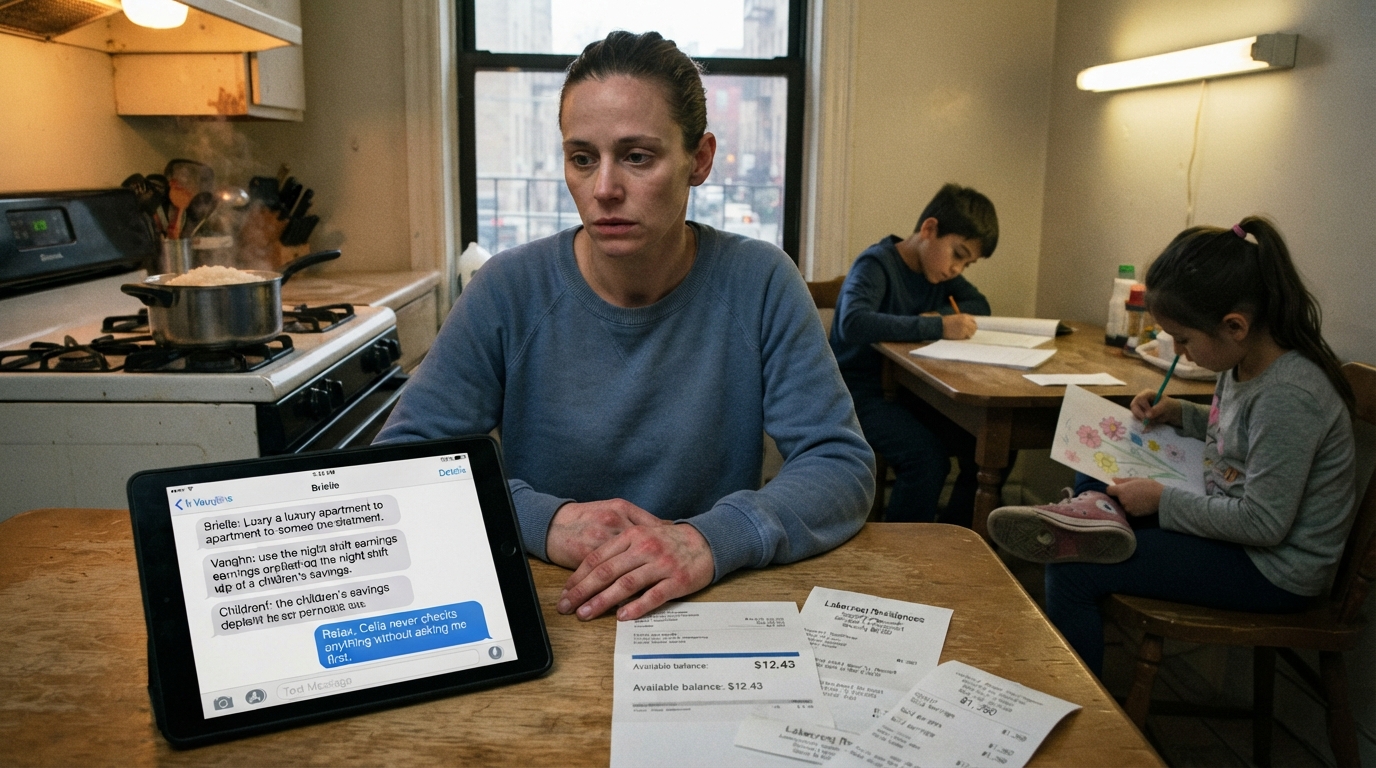
I had once thought the most important moment was seeing Brielle’s message on the tablet.
It was not.
The important moment came earlier.
Vaughn handed me eighty dollars and expected me to adapt.
I did what I had always done.
Calculated.
Cut.
Worked.
Managed.
Then, finally, I asked why.
That question was the thing his entire structure could not survive.
Not because I was unusually brave.
I was terrified most of the time.
Not because I was smarter than everyone involved.
I missed things for years.
Not because I defeated them alone.
I did not.
Mrs. Weaver noticed.
Denise acted.
Brielle warned me.
Mallory spoke.
Megan tried too late but left evidence.
Sarah fought to survive.
Investigators followed documents.
Clerks stopped records.
Analysts froze transfers.
Dozens of ordinary people interrupted a system built on the assumption that ordinary people would not look closely enough.
That was how it ended.
Not with one hero.
With enough people refusing to perform the roles assigned to them.
I put the groceries away.
Closed the refrigerator.
Turned off the kitchen light.
Before bed, I checked on June.
She was asleep sideways across the mattress.
Green shoes on the floor.
Emmett was still awake reading.
“Lights out in ten.”
“Fifteen.”
“Twelve.”
“Deal.”
Negotiation.
Not control.
I went to my room.
My phone charged beside the bed.
My bank app showed the balance I expected.
My lease sat in a drawer with my real signature.
My car keys rested on the dresser.
Nothing about those things was remarkable.
That was precisely why they mattered.
For eleven years, Vaughn had taught me that security came from letting him manage what I supposedly could not.
Money.
Documents.
Insurance.
Decisions.
The truth was less comfortable.
Security was never guaranteed.
Not by marriage.
Not by savings.
Not by paperwork.
Not by love.
What I could have was agency.
Information.
Boundaries.
People I chose to trust because they had earned it.
The right to ask.
The right to leave.
The right to change routes.
The right to spend more than eighty dollars on groceries without defending the existence of apples.
I turned off the lamp.
From the other room, Emmett called:
“Mom?”
“What?”
“June ate the last strawberries.”
Her sleepy voice answered immediately.
“Did not.”
“You did!”
I smiled into the dark.
“I’ll buy more tomorrow.”
And I could.
The End
Read more original stories on Feel Every Story.
My Husband Handed Me an Eighty-Dollar Grocery Limit, but the Numbers in Our Account Told a Much Stranger Story
Part 28 of 28