The receiver did not let us give Maple Street away immediately.
That was the first practical obstacle.
The title was a mess of fraudulent transfers, Laura’s lien, Ward’s invalid ownership, Michael’s transactions and Henry’s old trust interests. Every signature seemed to point toward another document.
Elena Ruiz told us to expect months.
Clare said, “Good.”
I looked at her.
She shrugged. “If we do it fast, somebody will miss something.”
That was Laura in her.
Or perhaps simply Clare.
We stopped calling every good instinct an inheritance.
By spring, the court approved a settlement.
Neither Clare nor I took the house personally.
Instead, title transferred into an independent nonprofit trust created with no Bennett family member as permanent controller.
That part mattered to me.
I would not build another benevolent structure that depended on one person remaining benevolent forever.
The board included an elder-law attorney, a social worker, a forensic accountant, a former patient advocate and Margaret Ellis.
Margaret accepted only after demanding authority to complain loudly.
“Otherwise,” she said, “what’s the point?”
Rose joined by video for the first board meeting and told Margaret they would probably get along.
They did.
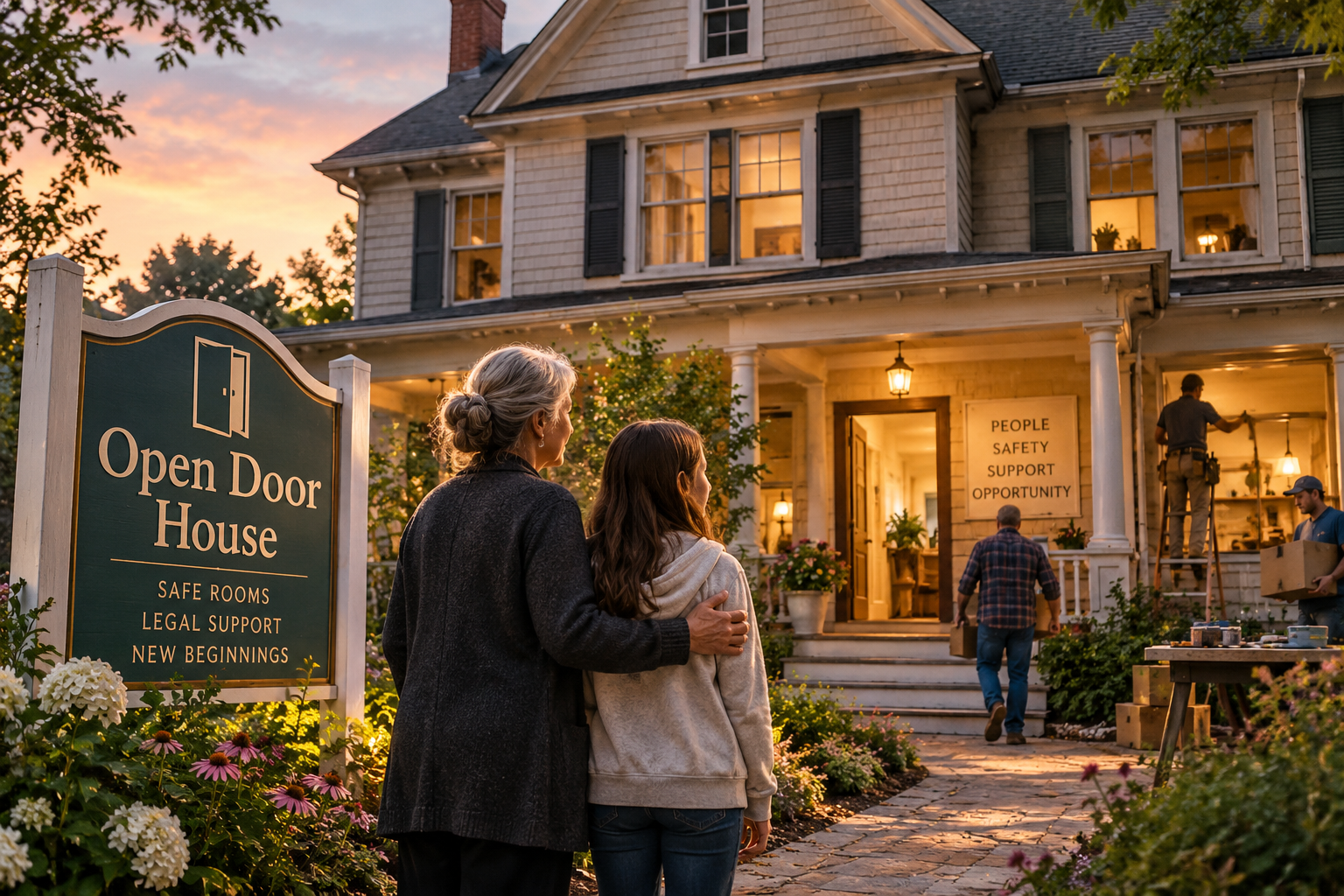
We named the organization Open Door House.
Clare hated the name at first.
“Sounds like a church basement.”
“Suggest something better.”
She tried for three days.
Then admitted it was accurate.
People came because they needed a door that opened outward.
The house itself required more work than I expected.
Investigators had torn sections from walls.
The hidden room behind the dining room needed to remain preserved until every evidence dispute ended.
Henry’s study had floor damage.
The fireplace cavity stood open.
The storage areas held boxes nobody wanted.
Contractors walked through the rooms making notes while I stood in the kitchen and remembered another life.
Sunday roasts.
Clare drawing at the table.
Michael as a boy stealing pieces of pie before dinner.
Henry humming while fixing a cabinet hinge.
Memory did not rearrange itself neatly after truth arrived.
The good years remained.
That was almost offensive.
I sometimes wanted every pleasant memory contaminated enough to discard.
Instead, they persisted.
A marriage could contain laughter and coercion.
A father could teach his child to ride a bicycle and later teach him how to manipulate courts.
A son could love his children and still steal from them.
Truth did not simplify people.
It made simplification impossible.
Clare understood that earlier than I did.
She visited the house after school.
Not every day.
Enough.
She helped design the bedroom that replaced my old storage-room arrangement.
“No one sleeps next to laundry unless they choose to,” she said.
There would be four short-term rooms.
Two emergency rooms.
A private legal-consultation space.
A secure office where residents could make calls nobody else monitored.
That room mattered most to me.
A phone.
A locked door.
A person allowed to speak without permission.
It sounded ordinary.
After everything we learned, ordinary seemed radical.
Funding came partly from Clare’s decision about Henry’s personal inheritance.
The legitimate portion—after forensic review—went into a legal-defense fund for people challenging questionable guardianships.
She kept none of it.
I asked twice whether she might regret that.
She finally said, “Grandma, stop asking like I’m giving away my lunch money.”
Fair.
Owen and Caleb’s legitimate inheritance interests remained protected in independent trusts.
Not managed by me.
Not by Clare.
Not by either parent.
Court-appointed professional trustees with mandatory outside audits.
When the boys were older, they would learn why.
Not yet.
They knew enough already.
They lived with me temporarily in a rented house near Ruth’s neighborhood while custody proceedings moved forward.
Jessica sought supervised contact.
Michael did too from detention.
The boys wanted their mother first.
That hurt Michael when he learned.
Consequences often arrive in small domestic forms.
A child asking for someone else.
Owen had nightmares for months.
Caleb became angry whenever adults whispered.
So we stopped whispering.
Not every detail.
But no more pretending nothing was wrong when everyone could feel it.
A family therapist told me children did better with truthful language sized to their age.
Your parents made serious choices.
They still love you.
They cannot live with you right now.
Adults are responsible for fixing adult problems.
You do not have to choose sides.
The boys accepted some sentences and rejected others.
That was their right.
Clare refused therapy initially.
Then she met a counselor who did not ask how she felt every five minutes.
She stayed.
I never asked what they discussed.
That was another lesson.
Privacy is not secrecy.
Secrecy hides power.
Privacy protects personhood.
I had spent too long confusing the two.
The criminal cases moved slowly.
Stephen Ward pleaded not guilty at first.
Then the operational archive, Rebecca’s recording, Catherine Lawson’s records, Laura’s crash evidence and statements from other women became too much.
His attorneys negotiated.
He pleaded guilty to multiple counts involving falsified medical records, unlawful sedation, conspiracy and obstruction.
Additional assault allegations remained subject to separate proceedings because time and evidence varied across cases.
The plea did not contain every moral truth.
Courts rarely do.
But his medical license was gone.
His records were opened.
Dozens of former patients came forward.
Some said nothing criminal happened to them but described being dismissed, overmedicated or threatened with psychiatric labels when they challenged him.
Patterns emerged.
Not all identical.
Enough.
Robert Harlan resigned any remaining judicial status he possessed and entered a plea to conspiracy, obstruction and fraud-related charges.
His attorneys emphasized that he eventually cooperated.
Prosecutors emphasized decades of judicial abuse.
Both were true.
Nancy’s case was more complicated.
She cooperated extensively.
She also burned records, attempted destruction, participated in financial concealment and knowingly helped sustain fraudulent guardianships.
Her defense argued coercion by Henry.
Prosecutors answered that coercion may explain an entrance but not fifty years of choices.
I agreed with that without needing to decide her sentence.
Anthony’s cooperation changed his case.
He turned over surveillance files, access codes, Voss records and names.
He also admitted intimidation and evidence concealment.
He accepted responsibility without asking me to speak for him.
That mattered.
I would not have.
Graham Voss faced charges tied to surveillance, unlawful confinement, extortion support and obstruction.
His archive became one of the government’s strongest sources.
The man who documented everyone to maintain power ended up documenting himself.
Peter Sloan’s case expanded after Rebecca’s death was reopened.
Forensic reconstruction could not prove every detail of the crash.
But combined with Ward’s statement, Rebecca’s letter and Sloan’s own records, prosecutors brought charges connected to conspiracy, kidnapping-related adoption fraud, obstruction and additional financial crimes.
Samuel Keating.
Victor Ames.
Marianne Cole.
Helen Carver.
Each case developed differently.
Some pleaded.
Some fought.
Some blamed Henry.
Henry was dead.
That made him convenient.
He could carry infinite blame without answering.
I refused to help anyone use him that way.
Henry built much of the system.
Others chose to participate after understanding enough.
Both facts belonged together.
Then there was Michael.
His case was the only one people kept asking me about as if I possessed a special verdict.
Reporters called Open Door House.
Neighbors approached me at the grocery store.
A woman in a parking lot once touched my sleeve and whispered, “I could never testify against my son.”
I did not tell her what she could do.
I only said, “I hope you’re never required to learn.”
Michael’s lawyers pursued a plea.
He faced fraud, conspiracy, theft, obstruction and charges related to Laura and Danner.
The exact legal treatment of Laura’s death remained contested because causation involved Henry’s driving, Ward’s medication, Michael’s delay and multiple intervening actions.
What was not contested anymore was that Michael knowingly withheld emergency help while searching for evidence.
That fact existed independent of the final charge label.
Prosecutors asked whether I would provide a victim-impact statement.
I said yes.
Not yet.
First I visited Michael.
Clare did not come.
The visitation room separated us by thick glass.
My son looked older.
Not dramatically.
Just diminished.
No tailored shirt.
No expensive watch.
No house keys in his pocket.
Nothing to signal the life he once measured himself through.
He picked up the phone.
“Mom.”
“Michael.”
He looked at me for a long time.
“I heard about the house.”
“Open Door.”
“Clare’s idea?”
“Partly.”
“She always notices exits.”
The sentence caught me.
“When she was little,” he said, “she used to ask where the emergency doors were in movie theaters.”
“I remember.”
“I thought she was anxious.”
“Maybe she just liked knowing she could leave.”
Michael closed his eyes.
“Yes.”
We sat with that.
Then he asked about the boys.
I answered carefully.
School.
Therapy.
Soccer.
Owen still hated peas.
Caleb had become obsessed with model airplanes.
Ordinary information.
He cried quietly.
I let him.
“Do they ask about me?”
“Yes.”
“What do you say?”
“The truth they can understand.”
His face tightened.
“Do they hate me?”
“I won’t tell them what to feel.”
He nodded.
“That’s better than what Dad did.”
Henry again.
Always nearby.
Michael looked through the glass.
“I keep wanting to explain.”
“I know.”
“Every time I start, it sounds like an excuse.”
“Sometimes explanation becomes excuse when it is used to move responsibility.”
He thought about that.
“Dad did that.”
“So did you.”
“Yes.”
Then he said the thing I had waited months to hear without knowing I wanted it.
“I knew Meadowridge would frighten you.”
No euphemism.
No temporary care.
No good facility.
He knew.
“I told myself you’d be safe.”
“You told yourself many things.”
“I knew the diagnosis was false.”
“Yes.”
“I knew the medication could make you look confused.”
“Yes.”
“I knew taking your money was theft.”
“Yes.”
“I knew Clare’s trust wasn’t mine.”
“Yes.”
He stopped.
“Why didn’t you stop me?”
The question startled me.
“Me?”
“I don’t mean at the end.”
He rubbed his forehead.
“When I was younger. When I lied. When I borrowed money. When Dad covered things. You always believed whatever explanation kept the family calm.”
Anger rose.
Carefully.
“You are not putting your choices on me.”
“No.”
He shook his head quickly.
“No. I’m asking something uglier.”
“What?”
“Did I learn that you would forgive anything?”
The answer hurt.
“Yes.”
He looked down.
“I think I did.”
“That does not make me responsible for what you became.”
“I know.”
“Do you?”
“Yes.”
He pressed his palm against the glass.
Not asking me to mirror it.
Just resting it there.
“I used your love as a resource.”
That sentence was more accurate than any apology.
Money.
Childcare.
Housing.
Forgiveness.
Reputation.
Silence.
My love had become another asset he assumed remained available.
I did not touch the glass.
“What happens now?” he asked.
“You accept the sentence the court gives you.”
“And after?”
“That belongs to later.”
“Will you ever visit again?”
“I don’t know.”
He nodded.
“Fair.”
The visit ended without reconciliation.
Without disowning.
That felt truthful.
Outside, Clare waited in the car.
Not because she wanted to see him.
Because she wanted to drive me home.
“How was it?”
“Sad.”
“Did he apologize?”
“Yes.”
“Did it help?”
“Some.”
She accepted that.
Open Door House opened eight months after Sunday dinner.
The first resident was not elderly.
A thirty-nine-year-old woman named Tessa arrived with her father.
Her husband had used a psychiatric hospitalization to gain control of joint accounts.
Different facts.
Same shape.
She needed a place for two weeks while an attorney challenged emergency orders.
The second resident was eighty-one.
Her nephew had convinced a doctor she could no longer manage medication.
She probably did need some help.
What she did not need was losing the right to choose who provided it.
Open Door was not built around proving every family wrong.
It was built around slowing things down long enough for the person at the center to be heard.
The former hidden dining-room archive became a documentation room.
Every resident could receive copies of every paper concerning them.
No secret files.
No inaccessible assessments.
No family-only instructions.
Margaret insisted on a sign above the printer.
IF IT HAS YOUR NAME ON IT, YOU GET A COPY.
Rose approved.
Miriam laughed when she saw it over video.
Ruth did not join the board.
She offered.
I said no.
Not forever necessarily.
But trust requires more than remorse.
We still spoke.
Sometimes weekly.
Sometimes not.
She attended the opening and stood near the back.
When we were alone later, she said, “I don’t expect you to forgive me.”
“Good.”
She smiled sadly.
“I deserved that.”
“This isn’t about deserving.”
“What is it?”
“Not letting forgiveness become another thing somebody waits to receive from me.”
Ruth nodded.
We were learning different kinds of boundaries.
Then, one afternoon, a package arrived at Open Door.
No return address.
Inside was a photograph of Henry and me on our wedding day.
I almost threw it away.
Then I turned it over.
Rose’s handwriting.
Found this among the papers Henry took from me.
You looked happy.
You were allowed to be.
I sat with the photograph for a long time.
That was something I had struggled to permit.
If Henry later hurt me, did that make my earlier happiness foolish?
No.
I had loved honestly.
The deception belonged to him.
Not to the woman in the photograph.
I placed the picture in a drawer.
Not displayed.
Not destroyed.
A record.
Nothing more.
That evening Clare came home from school holding an acceptance letter.
College.
Early admission.
Two states away.
Her face was terrified.
“You’re smiling,” I said.
“I might throw up.”
“Both can happen.”
She laughed.
Then her expression changed.
“I don’t know if I can leave the boys.”
There it was.
The family trap trying to reproduce through responsibility.
“You can.”
“What if they need me?”
“They have adults.”
“What if you need me?”
“I have adults too.”
She gave me a look.
“Do you?”
“Some.”
That earned another laugh.
Then I said, “Clare, loving people does not require standing where they left you.”
She looked down at the letter.
“You want me to go?”
“I want you to choose.”
The word mattered.
Her choice.
Not Laura’s.
Not Michael’s.
Not mine.
She stared at the acceptance again.
Then whispered, “I think I want to.”
“Then we start there.”
That night, after everyone slept, I walked through Open Door House alone.
The floors creaked the same way they had when Henry was alive.
The kitchen window still caught moonlight across the counter.
The hidden room remained behind the dining wall, but its door stayed open now.
No secret mechanism.
No key.
I stood where Laura once recorded her message.
For months, every discovery had created another question.
Now answers had begun creating space.
Not peace exactly.
Space.
Enough to breathe.
Enough to decide what to do next.
Then Elena called.
The prosecutor had set Michael’s plea hearing.
He had agreed to testify against remaining participants and accept a long prison sentence.
No trial.
No years of fighting every fact.
One condition remained.
Not a legal condition.
A request.
Michael wanted me to read my victim-impact statement in court.
Not send it.
Not let the prosecutor read it.
He wanted to hear it from me.
I stood in the open doorway of the room where so much truth had once been hidden.
“Tell him I’ll be there.”
Click here to continue reading: PART 34: When I Finally Spoke in Court, Michael Heard What His Choices Cost Without Henry, Ward, or Anyone Else Standing Between Us
At Sunday Dinner, My Son Pointed Toward the Door and Finally Told Me What He Thought I Was Worth
Part 33 of 35