The question came almost a year after the Christmas invitation.
Not on an anniversary.
Not after a court date.
Not during some dramatic family gathering.
Addison asked while standing in my kitchen with flour on one sleeve and a half-finished pie crust stuck to the rolling pin.
"What are we eventually doing with Maple Drive?"
I looked up from the apples I was slicing.
"Eventually when?"
"You know."
"I don't."
"When Mom doesn't live there anymore."
The wording was careful.
Not when Mom dies.
Not when she leaves.
When she doesn't live there anymore.
Maybe that meant something.
Maybe we had both become careful around futures we could not control.
"I haven't thought about it lately."
"Really?"
"Really."
Addison looked suspicious.
"You used to think about everything."
"I still do."
"Then you've thought about it."
"Fine. I've avoided deciding."
She smiled.
"Better."
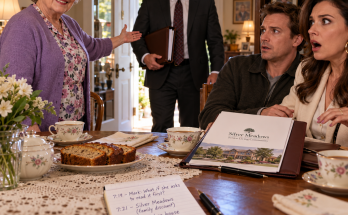
We were making pie because Claire had invited us to a holiday dinner the following weekend and Addison claimed homemade dessert would prove we were functional adults.
So far, the crust suggested otherwise.
"What do you want?" I asked.
She stopped rolling.
"I don't want to live there."
"Same."
"I don't think I want to keep it either."
"Same."
She looked relieved.
"Sell eventually?"
"Probably."
"And split through the trust?"
"That's what the documents say."
"Okay."
I went back to the apples.
Addison didn't.
"That's all?"
"What else should there be?"
"I don't know."
She rested both hands on the counter.
"Dad cared so much about that house."
"He cared about what he thought it would provide."
"Security."
"Yes."
"But neither of us wants it."
"That doesn't mean he was wrong to protect it."
She thought about that.
For years, the house had been treated like an answer.
Proof of belonging.
Inheritance.
Control.
Home.
Dad had tried to make it a shield.
Mom had turned it into authority.
I had once seen it as the symbol of everything withheld.
Now it was bricks, mortgage-free walls, plumbing, taxes, memories.
Property.
Valuable.
Not sacred.
"I think Dad would hate that we're going to sell it," Addison said.
"No messenger."
She pointed the rolling pin at me.
"I know."
"Then don't turn him into one."
"Fine. I personally suspect the dead man would be annoyed."
"Better."
She laughed.
Then flour went everywhere.
We ruined the first crust.
The second was acceptable.
That evening, after Addison left, I thought about Maple Drive longer than I expected.
Not the trust.
The rooms.
The hallway where Mom had blocked my coat.
The kitchen where Dad argued with her.
The living room where neighbors watched.
The bedroom desk where Marianne's letter sat hidden for eleven years.
The sewing cabinet.
Dad's study.
Ordinary furniture made heavy by what people concealed inside it.
I wondered if selling the house would feel like losing him again.
Then I remembered the watch on my shelf.
The crooked mug.
The photograph.
Dad's notebook.
No building held him all by itself.
A few weeks later, the independent trustee scheduled an annual beneficiary meeting.
Addison and I attended together but sat across from each other.
An accidental detail.
Still, I noticed.
We received identical packets.
Income.
Expenses.
Restitution payments.
Property maintenance.
Mom's occupancy costs.
The house needed a new roof within two years.
Addison groaned.
"So that's what inheritance means."
The trustee smiled.
"Often."
"Can we vote for Dad to have left us a beach condo?"
"No."
"Terrible administration."
I laughed.
Then the trustee raised one issue.
Mom had asked whether the trust would fund an accessibility renovation in the downstairs bathroom.
Nothing urgent.
Planning.
She was getting older.
The request was reasonable.
The old family pattern immediately stirred inside me.
Mom needs something.
You have resources.
Decide now.
Then I noticed the difference.
There was documentation.
Estimates.
Alternatives.
Both beneficiaries informed equally.
No emergency.
No emotional pressure.
The trustee asked for our views.
Addison looked at me.
I almost answered first.
Then stopped.
"What do you think?" I asked her.
She smiled faintly.
"I think it's reasonable."
"Me too."
The trustee made a note.
No sacrifice.
No resentment.
No secret redistribution.
A family decision made boring by transparency.
Dad would have loved that.
Or maybe complained about the contractor's estimate.
Probably both.
Mom and I continued speaking.
Not often.
Once every two weeks, sometimes less.
We did not revisit the crimes every time.
That would have turned accountability into another cage.
But we did not pretend they disappeared either.
One afternoon she called because a letter from the bank arrived and she didn't understand a trust-related fee.
Old Mom would have interpreted confusion as insult.
Newer Mom said:
"I don't understand this. Can you?"
I looked at the statement.
"I think so."
"Am I being charged twice?"
"No."
"Are you sure?"
"I can ask the trustee."
A pause.
Then Mom said, "Please do."
No defensiveness.
No assumption.
I emailed.
The trustee clarified.
I forwarded the answer to Mom.
She replied:
Thank you.
That was all.
I realized later that helping her had not made me feel trapped.
Because she asked.
Choice changed the emotional weight of the same act.
That lesson kept repeating.
Addison's life changed more visibly.
She moved.
Not far.
Just out of the townhouse tied emotionally to the condo money and years of dependence.
She sold it voluntarily.
Paid off the remaining mortgage.
Invested part of the equity.
Bought a smaller place she chose because she liked the light in the living room.
Mom did not contribute.
Neither did I.
On move-in day, Addison stood in the empty space turning in a slow circle.
"No one can say I needed this."
I set down a box.
"That's not the goal."
She frowned.
"What?"
"The goal isn't never needing anyone."
"I know."
"Do you?"
She sighed.
"I'm allowed to need people without making it my identity."
"Better."
"Therapy is ruining my dramatic statements."
"Good."
We assembled bookshelves.
Incorrectly.
Again.
Apparently personal growth did not improve our furniture skills.
Mom visited Addison's new place two weeks later.
I was not there.
I did not ask for a report.
That was difficult.
I wanted to know whether Mom criticized the size.
Whether she offered money.
Whether Addison felt guilty.
Then I remembered the rule.
Ask her only if it concerns your relationship.
Not because curiosity entitles you to someone else's experience.
So I waited.
Addison called the next day.
"Mom came."
"How was it?"
"Good."
"Okay."
She paused.
"That's all?"
"You'll tell me if you want."
"You are becoming unbearable."
"So I've heard."
She told me anyway.
Mom brought a plant.
No money.
No household advice.
She asked before opening a closet.
That detail made Addison laugh so hard she cried.
"She asked if she could look in a closet."
"Progress is strange."
"Very."
Mom did say one thing that bothered her.
She said, "I'm glad you're finally independent."
Addison immediately reacted.
"Finally?"
Mom froze.
Then apologized.
Not for Addison's reaction.
For the sentence.
"I still think in old categories," she said.
That mattered more than never making mistakes.
Recognition.
Correction.
No defensive spiral.
People did not change by becoming flawless.
They changed by interrupting their own old patterns sooner.
I was learning the same.
A month later, I had an argument with Claire.
Nothing family-related.
She canceled plans twice.
I finally snapped and said she clearly did not value my time.
The moment the words left my mouth, I heard Mom.
Not literally.
The structure.
You did one thing, therefore I know your motive.
Claire stared at me.
"That's not fair."
She was right.
I apologized.
Not because conflict frightened me.
Because I had overreached.
That night I realized something uncomfortable.
I had spent so much time studying Mom's control that I sometimes treated my own certainty as safer simply because it belonged to me.
Dad had warned me.
Do not become the opposite version of your mother.
Certainty can become control from any direction.
That realization stayed with me.
I wrote Mom about it.
Not as confession.
As conversation.
She called.
"You heard me in yourself?"
"A little."
"Terrifying, isn't it?"
"Deeply."
She laughed.
Then became serious.
"You got good things from me too."
The sentence could have irritated me.
Instead I thought.
"I know."
"Do you?"
"Yes."
Mom taught me to cook.
To show up at hospitals.
To notice when someone had not eaten.
To remember birthdays.
To write thank-you notes.
To bring extra blankets on road trips.
Care was not the problem.
Control disguised as care was.
That distinction allowed me to keep parts of her without excusing the rest.
"I got your stubbornness," I said.
"You got that from your father."
"You two can fight over it."
She laughed.
"Fair."
As the second Christmas approached, Mom asked whether Addison and I wanted to come to Maple Drive.
The message arrived in a group text.
Directly to both of us.
Not one daughter tasked with delivering the invitation.
Mom wrote:
I would like to have dinner on Christmas Eve. No neighbors. No surprises. No obligation. Please answer separately whenever you decide.
I stared at the text.
Almost laughed.
No neighbors.
She knew.
Addison texted me privately.
What are you doing?
I replied:
Dad's rule.
She responded:
Right. Sorry.
Then:
Ignore me.
I did not answer for two days.
Not to create suspense.
Because I genuinely didn't know.
Christmas at Maple Drive carried history.
But refusing only because history existed would give the past too much authority too.
Finally I replied to Mom.
Yes. Dinner only. I'm staying at a hotel.
Mom answered:
Okay. Thank you.
Addison decided yes too.
Separately.
Christmas Eve came cold and bright.
I drove the familiar streets.
No crowd outside Maple Drive.
No neighbors pretending not to watch.
No phones.
No staged presents.
Mom opened the door.
She wore a green sweater instead of pearls.
"Hi."
"Hi."
Addison arrived five minutes later.
She carried pie.
Homemade.
The crust looked suspiciously competent.
"You practiced."
"Growth."
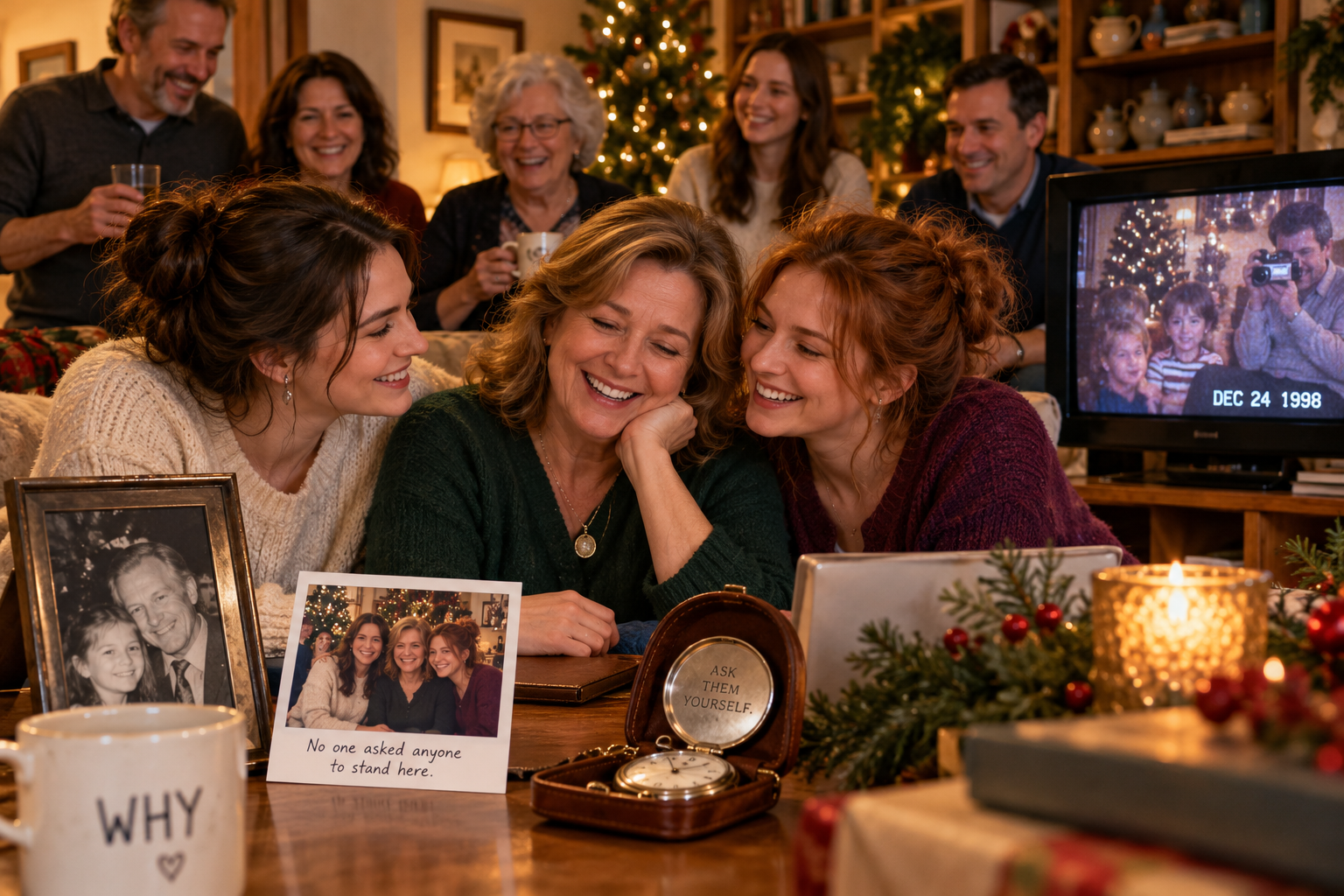
We ate at the kitchen table.
Three people.
Dad's chair had been moved to the study.
Mom said she could not keep living around an empty place setting.
I understood.
Dinner was imperfect.
Mom overcooked the vegetables.
Addison complained about work.
I corrected a detail in one of Mom's stories and then wondered whether I was being obnoxious.
Probably.
No one cried.
No one opened legal documents.
No one performed family.
After dessert, Mom brought out three small boxes.
I immediately looked at her.
She laughed.
"Real gifts."
"That's exactly what someone with fake gifts would say."
Addison nearly choked laughing.
Mom laughed too.
Inside mine was a simple leather case for Dad's pocket watch.
No symbolic key.
No hidden condition.
Just a case.
"For traveling," Mom said.
"Thank you."
And I meant it.
Addison received pottery tools.
Good ones.
She cried a little.
Mom asked before hugging her.
I noticed.
So did Addison.
Later, Mom brought out one final envelope.
My body tightened automatically.
She held up a hand.
"Not a secret."
"What is it?"
"A copy."
"Of?"
"The deed history for Maple Drive."
I groaned.
"Christmas paperwork."
"Sorry."
She smiled.
"The trustee suggested I discuss something with both of you."
Addison looked at me.
We both waited.
Mom said she wanted to amend her occupancy arrangement voluntarily.
Not give up the house immediately.
But create a clear plan.
When she reached a certain age or could no longer reasonably maintain the property, she would move somewhere smaller.
The house could then be sold.
No fight.
No waiting for crisis.
"Why now?" I asked.
Mom looked around the kitchen.
"Because I've spent too much of my life treating this house like proof I kept the family together."
No one spoke.
"It isn't."
She touched the table.
"It's a house."
The same conclusion I had reached.
"Are you sure?" Addison asked.
"No."
That made me smile.
Mom noticed.
"What?"
"Good answer."
She laughed.
"I'm learning from you."
"Expensive education."
"Very."
We did not sign anything that night.
We agreed to discuss it with the trustee later.
No urgency.
No emotional deadline.
When I left, Mom stood on the porch.
No request for me to stay.
No speech about Dad.
Just:
"Drive safely."
"I will."
Halfway to the hotel, I realized I had spent the entire evening inside Maple Drive without once wanting to escape.
That did not mean the house was healed.
Buildings do not heal.
People change what happens inside them.
Sometimes that is enough.
Click here to continue reading: PART 34: Mom Chose to Let Maple Drive Go Before She Had To, and the Last Box We Packed Held the One Thing None of Us Wanted Sold
Five Years After My Family Stopped Calling, a Christmas Invitation Arrived With One Sentence That Made Me Drive Home
Part 33 of 35