Three years after the night I returned to Maple Drive, Christmas looked nothing like the one that began all of this.
There was no Maple Drive anymore.
No trust dispute.
No hidden phone.
No staged audience.
No shed key.
We met at Addison's house.
Her choice.
She had the largest dining table now.
Pottery occupied half the shelves and threatened to consume the rest.
My crooked mug still leaked.
She insisted it had character.
Mom arrived carrying a pie.
Purchased.
She had finally accepted that Addison's pie was better.
Claire came too.
So did Ruth.
Denny stopped by in the afternoon with a bottle of sparkling cider and stayed forty minutes.
No tension worth narrating.
Just people.
Marianne arrived late and claimed retirement gave her the right to ignore schedules.
Nobody believed she was retired.
There were absences.
Dad most of all.
But his absence did not control the room.
We talked about him.
Sometimes fondly.
Sometimes critically.
No one had to protect his reputation anymore.
That was a strange form of respect.
Mom told a story about Dad getting lost on a family vacation because he refused to ask directions.
I laughed.
"Appropriate."
"He hated asking."
"Which makes all the 'ask them yourself' messages slightly hypocritical."
Mom smiled.
"People often teach lessons they learned late."
That was Dad.
That was Mom.
Probably all of us.
Before dinner, Addison handed everyone small ceramic ornaments.
Mine said WHY.
I stared.
"Really?"
"Your family title."
"Terrible."
"You love it."
I did.
Mom's said ASK.
She looked at it for a long time.
Then smiled.
"Fair."
Addison kept one saying CHOOSE.
I understood.
No explanation needed.
Dinner went wrong in several normal ways.
The potatoes were late.
Ruth spilled water.
Marianne argued with Denny about a local zoning issue nobody else cared about.
Mom started telling Addison how long to cook something, stopped herself, and asked:
"Do you want advice?"
Addison stared.
Then grinned.
"Yes."
Mom gave it.
Small moment.
Huge history.
No one applauded.
That mattered too.
Healthy behavior should eventually become too ordinary to celebrate.
After dinner, we exchanged gifts.
Real gifts.
I had given Mom a new sewing lamp.
Addison gave me a case for Dad's watch made from one of her pottery experiments.
It was impractical.
Heavy.
Beautiful.
Mom gave both of us books.
Different books.
Chosen for different people.
No effort to make gifts equal in price.
No hidden calculation.
Fairness did not require identical things.
Dad's letter had been right.
Fairness required truth.
Knowledge.
Choice.
That distinction had finally become normal.
Later, when everyone else moved into the living room, Mom and I stayed behind to clear plates.
She handed me one.
"Can I ask you something?"
"Yes."
"Are you happy?"
The question startled me.
Not because it was complicated.
Because she had not added a preferred answer.
"I think so."
Mom smiled.
"Good."
"What about you?"
She considered.
"Sometimes."
"That's probably normal."
"I used to think happy meant nobody was upset with me."
I laughed softly.
"Impossible standard."
"Very."
She dried a plate.
"I also thought family meant people stayed."
I waited.
"Now I think maybe it means people are allowed to leave and can still choose to come back."
That sentence almost made me cry.
Not because it absolved anything.
Because she understood something about the original Christmas invitation.
She had tried to force me back into position.
Now she understood arrival only mattered when departure remained possible.
"That's closer," I said.
She looked at me.
"Closer?"
"I'm not giving you the final definition."
She laughed.
"Of course not."
We finished the dishes.
No confession.
No climax.
Just plates.
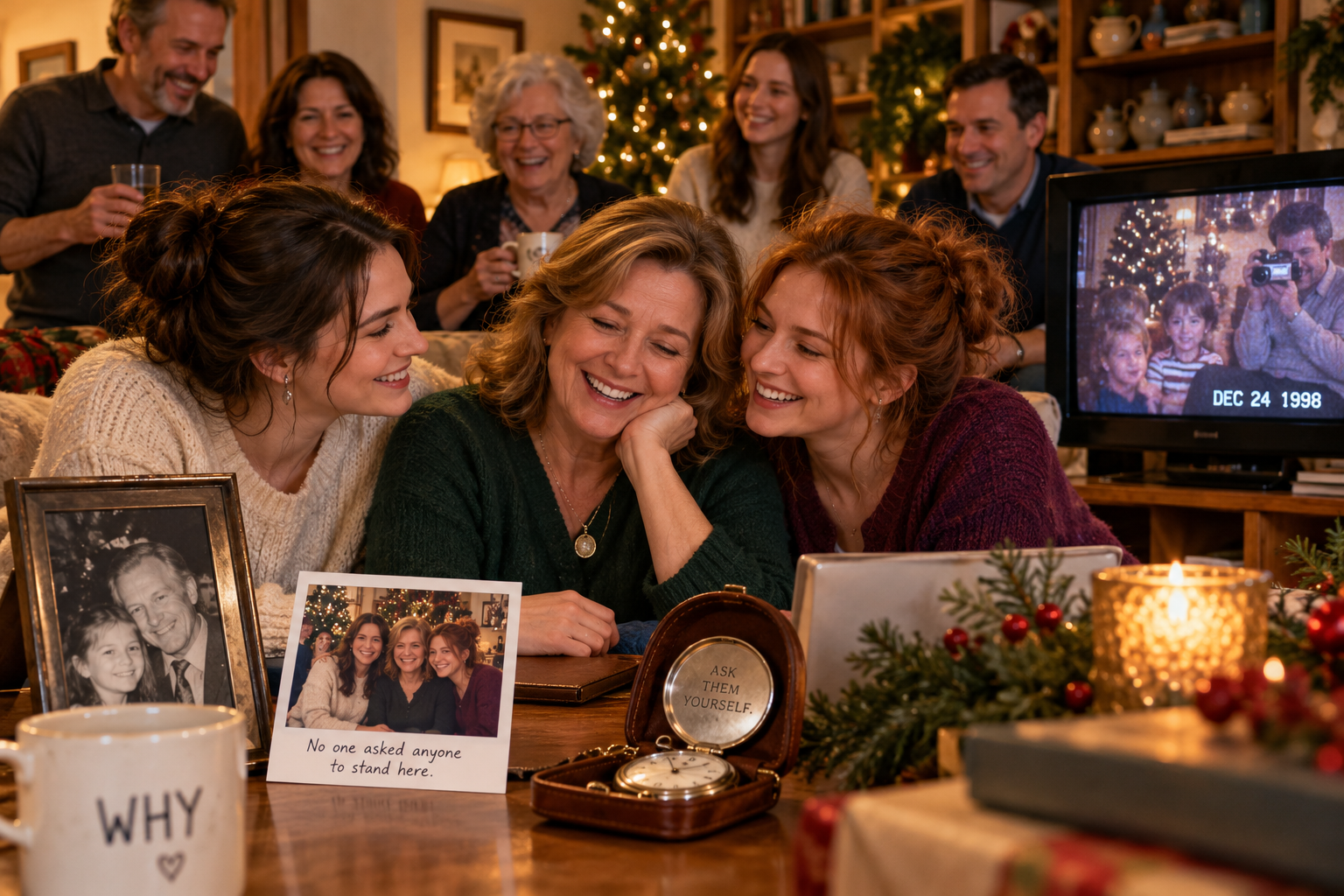
In the living room, Addison had found the Christmas 1998 video.
She threatened to play it.
I objected.
Democracy failed.
Soon teenage versions of us appeared on screen.
Bad hair.
Old furniture.
Dad's shaky camera.
Mom looked at her younger self.
Addison looked at hers.
I watched teenage me unwrap the CD player.
The scene with the expensive art set followed.
Mom did not apologize this time.
She already had.
Instead, she asked:
"What camera did you want?"
I looked at her.
"What?"
"Back then."
I thought.
"A little silver Canon."
"You remember?"
"Of course."
Mom nodded.
"I should have asked."
"Yes."
No need for more.
The video continued.
Dad accidentally filmed half his face.
Everyone laughed.
Even Marianne, who had never seen it.
Then the screen went black.
For a few seconds, nobody spoke.
Ruth said, "He would've loved tonight."
I felt the old reflex.
No messenger.
Then I smiled.
"Maybe."
Ruth caught herself.
"Right."
She laughed.
"Sorry."
"It's okay."
Dad was allowed to remain partly unknowable.
That was another thing grief taught me.
The dead leave evidence.
Not certainty.
Letters.
Videos.
Habits.
Regrets.
You still cannot ask every question.
At some point, you live with what remains.
Later, Addison and I stood outside on her porch.
Cold air.
Streetlights.
Neighbors' Christmas decorations.
No snow.
Again.
"Three years," she said.
"Yes."
"Feels longer."
"Feels shorter."
She leaned against the railing.
"Do you ever wish you hadn't gone that Christmas?"
I thought about it.
The question deserved an honest answer.
"Sometimes."
She looked surprised.
"Really?"
"Sometimes I wish I'd thrown the card away and never learned any of it."
"The money?"
"The whole thing."
Dad's failures.
Mom's fraud.
Your condo.
The missed call.
The lies.
The recordings.
All of it.
Not knowing had been painful.
Knowing was painful too.
Addison nodded.
"Me too."
Then I continued.
"But wishing something had been easier isn't the same as wishing it stayed false."
She looked at me.
"That's disgustingly wise."
"I'm older."
"By three years."
"Still older."
She smiled.
"What do you think Dad would've said if he actually called that Sunday?"
I stared into the yard.
For three years, that question had lived beside everything else.
Once, I needed the answer.
Now I knew I could not have it.
"I think he would've apologized."
"Probably."
"I think I would've been angry."
"Definitely."
"I might have hung up."
Addison laughed.
"Also definitely."
"And then called back."
"Yes."
I smiled.
"Probably."
That was enough.
We did not need to create the perfect lost conversation.
Dad had left what he could.
The notebook.
The letters.
The recordings.
The check.
The watch.
Most importantly, the evidence that he had changed his mind about the system he helped build.
He had tried to restore choice.
Late.
But genuinely.
Inside, Mom laughed at something Claire said.
Addison listened.
"She sounds different."
"Mom?"
"Yes."
"Maybe."
"No. I mean her laugh."
I understood.
For years, Mom's emotions had dominated rooms because everyone monitored them.
Was she upset?
Offended?
Hurt?
Angry?
Now her laugh was simply one sound among others.
Not a command.
Not weather.
"Do you forgive her?" Addison asked.
We had asked that question many times.
This time my answer was different.
"Some days."
She frowned.
"That's allowed?"
"I decided it is."
"What does it mean?"
"Some days I feel tenderness without needing to review the whole case."
"And other days?"
"I remember Dad asking for me."
Her face softened.
"Yeah."
"Forgiveness isn't amnesia."
"I know."
"And it isn't access."
"I know."
"And I don't think it's one decision."
Addison looked through the window at Mom.
"That helps."
"What about you?"
"I forgave her for some things faster than you."
"That's okay."
"And other things maybe never."
"Also okay."
No scoring.
No moral ranking.
Different daughters.
Different harms.
Different relationships.
We went back inside.
Before leaving, Mom handed me a small envelope.
I gave her a look.
She laughed.
"It's not evidence."
"Famous last words."
"I found it in my new desk."
"How?"
"I put it there."
"That's different."
She handed it to me.
Inside was a photograph.
Three women standing outside Addison's house earlier that afternoon.
Mom.
Addison.
Me.
Claire had taken it without telling us.
Nobody looked prepared.
Mom's eyes were half closed.
Addison was laughing.
I was turning toward her.
It was not flattering.
It was perfect.
On the back, Mom had written:
No one asked anyone to stand here.
I stared at the sentence.
Then laughed.
"That's terrible."
"I thought it was funny."
"It is."
I put the photograph in my bag.
At home, I placed it beside the old picture of Dad and me.
Two photographs.
Two versions of family.
Neither complete.
No picture ever is.
I took out Dad's watch.
Opened the back.
ASK THEM YOURSELF.
The scratched words were small enough to miss.
I thought about how many lives could be altered by something that simple.
Ask.
Listen.
Accept the answer.
Not because the answer will always be fair.
Not because people will always agree.
Because without an answer, someone else will eventually invent one.
That had been the original wound.
Mom speaking for me.
Dad accepting reports instead of calling.
Addison believing messages that weren't mine.
Me assuming her silence meant she didn't care.
Colin turning supposed consent into paperwork.
An entire system built from answers given by the wrong people.
What finally ended it was not one courtroom.
Not one confession.
Not one recovered account.
It was direct contact returning piece by piece.
Ruth calling me.
Marianne answering.
Addison saying no.
Dad's actual words surviving.
Mom eventually speaking plainly.
Sisters asking each other.
Truth became possible when nobody got exclusive control over translation.
A month after Christmas, I received the final trust report.
Maple Drive sale complete.
Restitution allocations finalized.
No outstanding ownership disputes.
Administrative matters substantially concluded.
The packet was ordinary.
I read every page anyway.
Then I called Addison.
"Did you get yours?"
"Yes."
"Page twelve?"
"What?"
"Nothing. Just checking."
She laughed.
"You're ridiculous."
"Direct communication."
"Go away."
"Love you."
A pause.
Then:
"Love you too."
I hung up.
The next call I made was Mom.
Not because a lawyer told me.
Not because Dad would've wanted it.
Not because she needed something.
Because I wanted to.
She answered.
"Hi."
"Hi."
"Everything okay?"
"Yes."
I looked at the final trust statement.
"The estate stuff is basically finished."
Mom went quiet.
"How does that feel?"
I considered.
"Smaller than I expected."
She understood.
"Most endings are."
We talked for twenty minutes.
Nothing historic.
Then, before hanging up, Mom said:
"Thank you for calling."
I smiled.
"You didn't ask."
"No."
That was exactly why I called.
When the conversation ended, I put Dad's watch back in its case.
The house was gone.
The money had been accounted for as well as money could be.
The court cases ended.
Colin served his consequences.
Mom served hers.
Addison built a life not organized around rescue.
I built one where capability did not require surrender.
Dad remained complicated.
Loved.
Missed.
Responsible for his silence.
Honored for trying to break it.
No one got a perfect ending.
That would have been another lie.
We got something harder.
A true one.
And after everything our family had done to avoid the truth, that was enough.
The End
Read more original stories on Feel Every Story.
Five Years After My Family Stopped Calling, a Christmas Invitation Arrived With One Sentence That Made Me Drive Home
Part 35 of 35