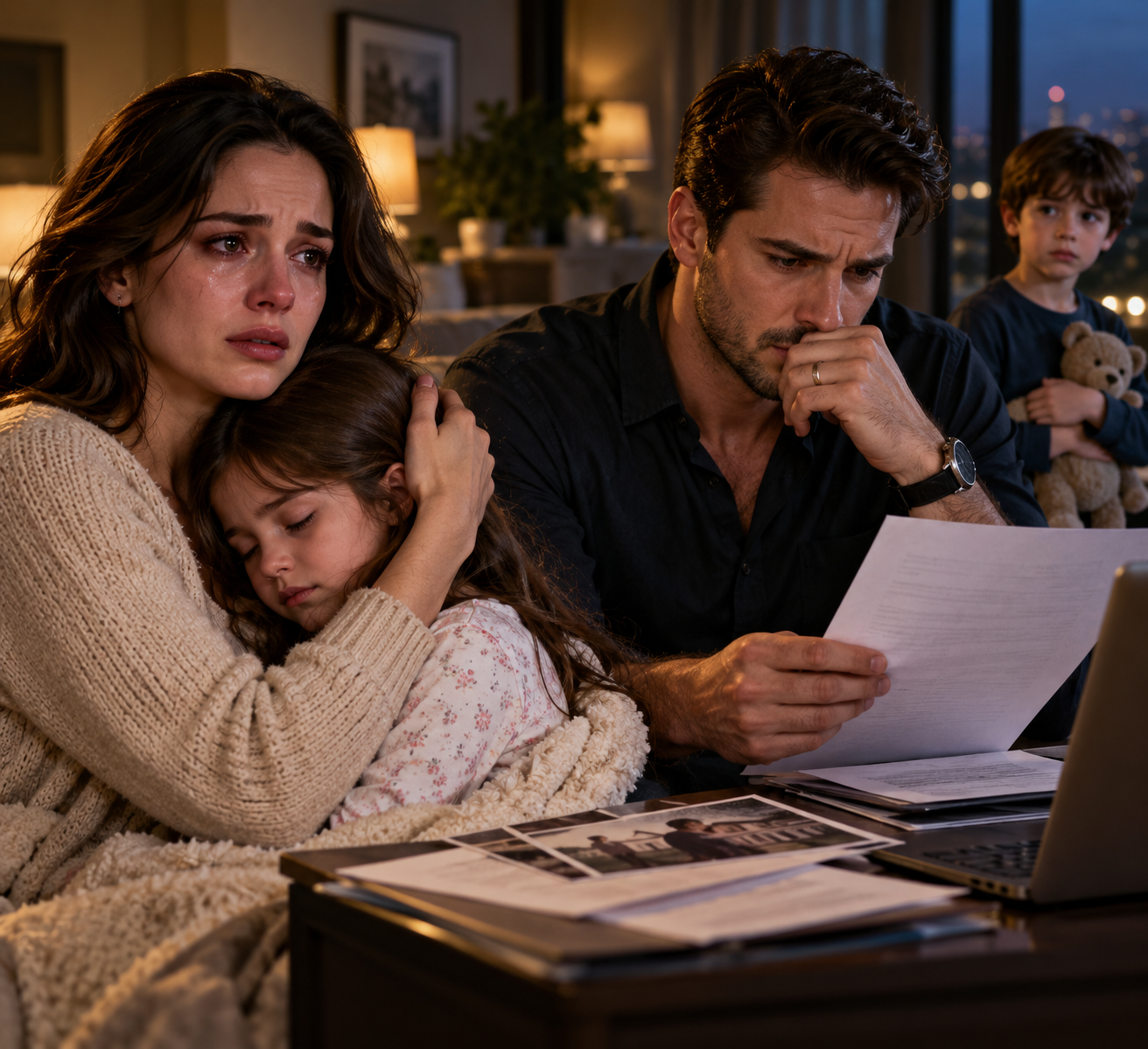
Laura arranged a meeting with the family-law attorney as soon as the court letter arrived. Daniel and I sat together while she explained what the document meant. Charles Whitcomb had informed the court that Leo’s biological father was unavailable and unlikely to assert parental rights. He had not identified Daniel by name.
The statement was carefully phrased.
It did not say Daniel was dead.
It did not say he had surrendered his rights.
It created an impression that no father would come forward.
I looked at the letter.
“He knew Daniel was alive.”
“Yes,” Laura answered.
“And he knew Daniel wanted the baby.”
“The other evidence strongly supports that.”
Daniel leaned forward.
“Then why did he write this?”
Laura explained that the letter appeared intended to influence how the court viewed the need to identify or notify Leo’s father. She cautioned that its legal significance would depend on the proceedings, the court’s reliance on it, and the full record.
I thought about the day I first went to court to secure guardianship.
Leo had been only a few months old. I had worn my best blouse and carried a folder filled with documents I barely understood. I remembered being frightened that I would make a mistake and someone would decide I was not capable of caring for him.
I had told the truth.
I did not know who his father was.
I had no idea that people outside the courtroom were working to keep it that way.
The family-law attorney reviewed the guardianship file and explained that the original order remained in effect. The court had recognized my role as Leo’s caregiver, and nothing in the newly discovered letter automatically changed that.
Still, Daniel’s parentage needed to be formally established.
The attorney recommended filing the appropriate petition and presenting the evidence showing why Daniel had not been identified earlier.
Daniel agreed.
“I want my name on the record,” he said.
I looked at him.
“And I want Leo to know no one can erase you from his life again.”
Daniel nodded.
The legal process moved more slowly than I wanted. There were forms, notices, and appointments. Daniel provided the information requested to establish his parentage, and we worked with the attorney to prepare a plan that preserved Leo’s home and routines.
Throughout it all, we kept Leo informed in simple language.
I told him the court needed to update its records because we now knew who his father was.
Leo looked at Daniel.
“Does that mean you're officially my dad?”
Daniel smiled.
“I've always been your father. This helps make the paperwork match the truth.”
Leo considered that.
“Will I have to move?”
“No,” I answered.
Daniel nodded.
“Not because of this.”
Leo seemed satisfied.
Then he asked whether he could have both of us listed as emergency contacts at school.
We told him yes.
The request made me smile. To Leo, the legal process mattered mainly because it might change who could pick him up when he felt sick.
I wished the adults who had controlled his early life had understood things so simply.
A few weeks later, we attended a court hearing. The room was smaller than I expected, with plain wooden benches and a clock that ticked loudly above the door.
Daniel sat beside me.
Leo did not attend the initial proceedings. His counselor and the attorney agreed that he did not need to be present for discussions involving adult misconduct.
The judge reviewed the petition and asked questions about the circumstances surrounding Daniel’s absence from Leo’s life.
Daniel answered carefully.
He described the accident, the false information his father gave him, the forged letter, and his unsuccessful attempt to find us.
He did not blame Leo.
He did not pretend he had done everything possible.
He acknowledged that he stopped searching and regretted it.
I watched the judge listen.
Then I explained how I had raised Leo after Sarah died, how Ruth had misled Daniel, and how I had only recently learned his identity.
The judge asked whether Daniel and I agreed on Leo’s living arrangements.
We said we did.
The plan provided for Leo to remain in my home while Daniel gradually assumed greater parental responsibilities through regular visits, shared decisions, and financial support.
The judge emphasized that any future changes should serve Leo’s welfare.
I felt my shoulders relax.
The hearing did not resolve every issue. Additional steps remained, and the court would need to complete the formal process.
But for the first time, Daniel’s place in Leo’s life was being recognized through a lawful process rather than controlled by private decisions.
Afterward, we stood outside the courthouse.
Daniel looked at me.
“Thank you.”
I shook my head.
“You don't have to thank me for telling the truth.”
He smiled faintly.
“Maybe not. But I still want to.”
We drove to a small café and ordered lunch.
For once, we did not discuss the hospital investigation.
Daniel asked whether Leo would enjoy a weekend trip to a nearby nature reserve. I said he probably would, especially if there were insects to examine.
Daniel laughed.
“He's going to make me look at every beetle.”
“Yes.”
“Even the ugly ones?”
“Especially those.”
We spent the afternoon planning a simple outing.
That evening, Leo asked how the court meeting had gone.
I told him it had been a good step.
Daniel explained that the paperwork was moving forward and that nothing about Leo’s home would change suddenly.
Leo nodded.
Then he asked whether Daniel could help him with a school assignment about fathers.
Daniel looked surprised.
“What kind of assignment?”
Leo explained that the class had been asked to interview a parent or caregiver about their childhood.
Daniel smiled.
“I'd be honored.”
They sat at the kitchen table while Leo asked questions.
What was your favorite game?
Did you ever get in trouble at school?
Were you afraid of the dark?
Daniel answered honestly.
He told Leo about playing with toy cars, breaking a window, and being frightened of thunderstorms when he was little.
Leo laughed.
Then he asked a question that made Daniel pause.
“Did your dad love you?”
Daniel looked down.
I waited.
After a moment, he said, “I think he did, but he made choices that hurt me and other people.”
Leo considered that.
“Can someone love you and still do bad things?”
“Yes,” Daniel answered. “But love doesn't make those things right.”
I watched Leo absorb the answer.
He did not ask another question.
Instead, he wrote it down in his notebook.
The following morning, Laura called with news about the hospital case.
The institution had agreed to provide a written acknowledgment that Sarah’s emergency care had not been escalated promptly and that the subsequent internal review had failed to inform her family of serious concerns.
The proposed statement did not resolve every medical question, but it represented a significant change from the hospital’s earlier position.
Laura wanted us to review the wording carefully.
I read the draft that afternoon.
It acknowledged the delay, the documentation failures, and the mishandling of the review. It expressed regret for the distress caused by the hospital’s failure to communicate with Sarah’s family.
I felt tears gather.
For ten years, I had been told there was nothing more to know.
Now the hospital was finally acknowledging that there had been questions it should have shared with me.
Daniel read the statement beside me.
“It's not enough,” he said.
“No.”
“But it's something.”
“Yes.”
Laura explained that negotiations would continue concerning compensation, confidentiality, and the hospital’s commitments to improving care and record preservation.
She also told us that Dr. Bell’s professional conduct had been referred for appropriate review.
I asked whether the hospital would cooperate.
Its representatives had agreed to preserve and provide relevant records as required.
I nodded.
That evening, I placed the draft acknowledgment beside Sarah’s photograph.
I did not know whether we would ever reach a resolution that felt adequate.
No amount of money could bring her back.
No apology could give Leo the mother he had never known.
But the truth was beginning to appear in places where silence had once been treated as the final answer.
The next morning, Laura called again.
Charles Whitcomb’s attorney had provided a new statement concerning the guardianship letter.
Charles admitted he knew Daniel was alive when he described the father as unavailable.
He claimed the wording was technically accurate because Daniel was recovering from his accident and had been told the baby died.
Laura asked whether Charles would acknowledge that he had helped create the circumstances that made Daniel unavailable.
He refused.
But the statement contained another admission.
Charles acknowledged that Daniel’s father had instructed him to prevent contact between Daniel and Leo until the family’s financial arrangements were settled.
I looked toward the kitchen window.
Leo was outside with Daniel, practicing baseball.
For ten years, a child had been kept from his father because powerful adults wanted time to arrange money and control.
I watched Daniel throw the ball.
Leo caught it cleanly and laughed.
Whatever Charles had intended, that control was ending.