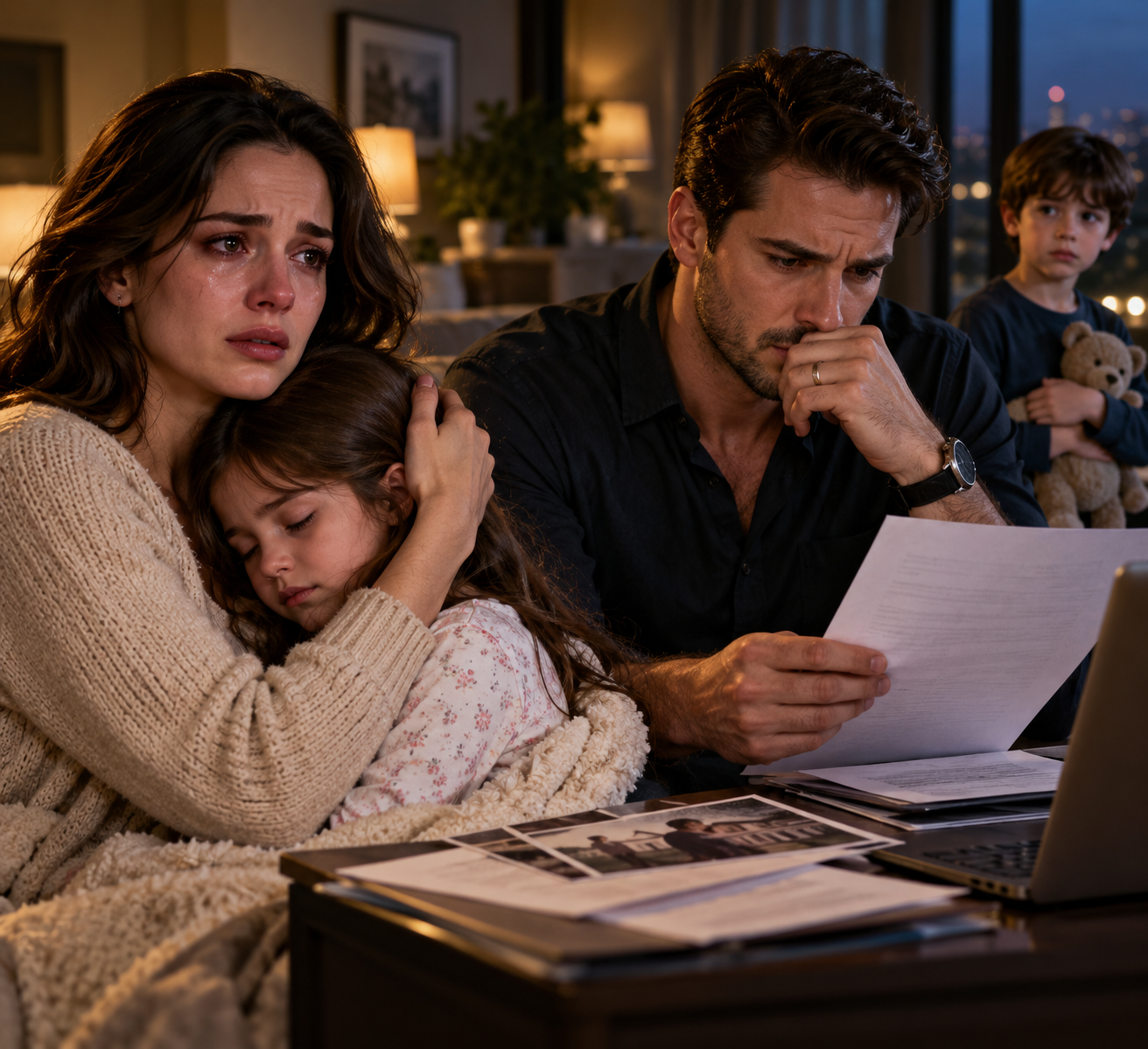
The hospital’s revised acknowledgment arrived on a rainy morning. Laura had negotiated changes to the language, removing phrases that minimized the delay and clarifying that the internal review had failed to communicate serious concerns to Sarah’s family.
I read the document at the kitchen table while rain tapped against the windows.
Daniel sat beside me.
Neither of us spoke for several minutes.
The statement acknowledged that Sarah’s hemorrhage care had not been escalated as promptly as it should have been. It recognized that the medical record contained inaccuracies and that the hospital’s review process had failed to provide her family with information they should have received.
It did not claim that earlier treatment would certainly have saved her.
Dr. Price had never said that.
But it acknowledged failures that mattered.
I placed the paper beside Sarah’s photograph.
For ten years, I had carried the belief that her death was an unavoidable tragedy, something no one could explain beyond the words severe bleeding.
Now I knew there had been warning signs, a delay, and decisions that deserved scrutiny.
I also knew that people had altered records and withheld information afterward.
The truth was painful, but it was no longer entirely hidden.
Laura called later that morning to discuss the next steps. The hospital had proposed a revised settlement that included compensation, a written acknowledgment, and commitments concerning emergency response procedures and documentation practices.
The confidentiality language had been narrowed substantially.
Laura explained that we would still need to examine every provision before making a decision.
I asked whether accepting a settlement would prevent us from discussing Sarah’s life with Leo.
“No,” she answered. “Not under the revised language as drafted. But we need to ensure the final agreement preserves your ability to speak truthfully about your family's experience and cooperate with appropriate authorities.”
I felt relieved.
Daniel asked whether the hospital’s commitments would be independently verified.
Laura said that was one of the issues still under discussion.
I looked at the document again.
“I don't want them to promise changes and then forget.”
“Neither do I,” Laura answered.
The negotiation continued over the following weeks.
Meanwhile, Leo’s life moved forward.
He had begun spending more time with Daniel, including regular Saturday outings and Friday dinners. The family-law attorney helped us establish a clear schedule, and Leo’s counselor encouraged us to keep it predictable.
One Saturday, Daniel took Leo to the nature reserve they had discussed after the court hearing.
They returned carrying photographs of insects, a muddy pair of shoes, and an extraordinary amount of enthusiasm.
Leo spent nearly an hour explaining the difference between two kinds of beetles.
Daniel listened patiently.
I suspected he had already heard the explanation several times.
That evening, Leo asked whether he could stay overnight at Daniel’s home sometime.
The question made me pause.
Daniel looked at me.
We had discussed the possibility with the counselor, but Leo had not raised it himself before.
I asked what made him want to try.
Leo shrugged.
“I want to see what it's like.”
I nodded.
“That makes sense.”
He looked worried.
“Would you be sad?”
I took his hand.
“I might miss you. But missing someone doesn't mean they shouldn't have new experiences.”
Leo considered that.
“Would you still be here when I came back?”
“Of course.”
He smiled.
Daniel suggested we begin with a longer daytime visit and discuss an overnight stay after Leo had become comfortable with the routine.
Leo agreed.
I appreciated that Daniel did not rush to claim more time simply because he wanted it. He was learning to consider Leo’s needs before his own.
Later, after Leo went to bed, Daniel stayed to talk.
“I don't want you to feel I'm taking him away,” he said.
I looked at him.
“I know.”
“But I do want to be part of his everyday life.”
“You are.”
He smiled faintly.
“I'm trying.”
I thought about the years I had spent making every decision alone. There had been nights when Leo was sick and I wished someone else could sit beside his bed while I slept. There had been school meetings, birthday parties, and ordinary worries I carried without help.
Now Daniel was offering to share those responsibilities.
I wanted that.
But accepting help also meant learning to loosen my grip.
It was harder than I expected.
The following week, I attended a counseling session of my own. Leo’s counselor had suggested that I might benefit from speaking with someone about the changes in our family.
I had resisted at first.
I was accustomed to being the person who kept everything together.
But sitting in a quiet office, I found myself talking about Sarah, Leo, and the fear that had lived beneath my routines for ten years.
I admitted that I sometimes felt guilty when Leo enjoyed time with Daniel.
The counselor asked why.
“Because part of me is afraid he'll need me less.”
She nodded.
“And what would that mean to you?”
I thought for a long time.
“I don't know who I am when I'm not the person he needs most.”
The words surprised me.
I had been Sarah’s mother before I became Leo’s guardian. I had been a sister, a friend, and a woman with interests that had gradually disappeared beneath responsibility.
For ten years, caring for Leo had given my life purpose after Sarah’s death.
Now that he was growing and gaining another parent, I would have to discover what else my life could hold.
The counselor did not offer an easy answer.
She encouraged me to see Daniel’s involvement as an expansion of Leo’s support rather than a replacement for my love.
I understood the idea.
Living it would take time.
That Friday, Daniel arrived with ingredients for tacos.
Leo greeted him at the door and immediately announced that he had a new rule: no one was allowed to put mushrooms in dinner.
Daniel raised both hands.
“I surrender.”
I laughed from the kitchen.
Sarah had hated mushrooms too.
We cooked together, and Leo insisted on arranging the plates.
After dinner, he brought out his family tree.
He had added new branches, including Daniel’s mother Evelyn.
I studied the drawing.
“Have you been talking to Evelyn?” I asked.
Leo nodded.
“She sent me a letter.”
Daniel looked surprised.
“What did she say?”
Leo explained that Evelyn had written about Daniel as a child and included a photograph of him holding a toy train.
“She said she'd like to meet me properly,” Leo said.
I looked at Daniel.
We had discussed Evelyn’s role in the deception, but Leo had only met her briefly.
Daniel asked whether Leo wanted to see her.
“Maybe,” he answered.
Then he looked at me.
“Is she safe?”
The question struck me.
I had spent so much time thinking about whether Evelyn deserved another chance that I had almost forgotten Leo’s simpler concern.
I told him Evelyn had made mistakes and had been slow to tell the truth, but she had not tried to hurt him. We would arrange any visit carefully and make sure he felt comfortable.
Leo nodded.
“Can you both come?”
“Yes,” Daniel answered.
I agreed.
The first proper visit took place at a small café near the library.
Evelyn arrived carrying a photograph album and a small box of cookies.
She looked nervous.
Leo sat between Daniel and me.
At first, he asked only a few questions.
Then Evelyn showed him a photograph of Daniel at ten years old.
Leo laughed.
“He looks like me.”
Daniel smiled.
“I've been told.”
Evelyn began telling stories about Daniel’s childhood. She described his fascination with trains, his habit of taking apart clocks, and the time he tried to build a treehouse using kitchen chairs.
Leo listened with growing interest.
After a while, he asked whether Evelyn had known Sarah.
She nodded.
“Yes.”
“Did you like her?”
Evelyn’s eyes filled.
“I did.”
“Then why didn't you help her?”
The question silenced the table.
Evelyn looked at Daniel, then at me.
I waited.
She took a breath.
“Because I was afraid of making your grandfather angry,” she said. “I should have been braver.”
Leo considered that.
“Grandma says being scared doesn't make lying okay.”
Evelyn nodded.
“She's right.”
I watched her accept the answer without defending herself.
It did not erase the years of silence, but it was a beginning.
After the visit, Leo said he liked Evelyn’s stories but did not want to spend time alone with her yet.
Daniel told him that was fine.
I agreed.
Leo seemed relieved that his answer was enough.
The following Monday, Laura called with news about the hospital settlement.
The institution had accepted several of our requested changes. It would provide a written acknowledgment, preserve the relevant records, and cooperate with the appropriate professional review processes.
The proposed agreement also included a commitment to examine and strengthen procedures for recognizing and responding to severe maternal bleeding.
Laura explained that the financial terms remained under negotiation, but the nonfinancial provisions were much closer to what we had requested.
I felt a cautious sense of relief.
Then she told me something else.
The hospital’s current leadership had identified an additional patient-safety review conducted several years after Sarah’s death. That review had found weaknesses in the same emergency escalation procedures involved in her case.
The hospital had made changes afterward, but the report did not mention Sarah by name.
I asked whether her case had contributed to those changes.
Laura said the documents suggested it might have, but the connection needed verification.
I sat quietly.
For years, I had believed Sarah’s death had disappeared into hospital files.
Now it appeared that some of the problems identified in her care had eventually been recognized, even though no one had told us.
Daniel came over that evening.
I showed him the update.
He read it carefully.
“Do you think this means something good came from what happened?” he asked.
I looked at Sarah’s photograph.
“I don't know if I can say that.”
He nodded.
“Neither can I.”
We sat together for a while.
Then Leo came downstairs carrying his model airplane.
“Dad,” he said, “can you help me fix the wing?”
Daniel smiled.
“Of course.”
They moved to the kitchen table, where Leo spread out the pieces.
I watched them work.
Sarah had wanted Daniel to know their son. She had wanted Leo to grow up loved. She had trusted me to protect him.
For ten years, those wishes had been interrupted by lies.
Now, slowly, we were building a life that honored them.
The following morning, Laura called with an unexpected development concerning Charles Whitcomb.
The accounting of the special reserve had uncovered another payment, made shortly after Daniel’s father died.
It had gone to a former hospital employee.
The payment description referred to records preservation and confidential assistance.
Laura had identified the recipient.
It was Martin Hales.
I stared at the telephone.
Hales had been the administrator who recommended an independent review of Sarah’s death. He had provided us with documents and admitted that he failed to follow through.
Now the financial records showed that Charles had paid him years later.
I asked Laura whether Hales had explained the payment.
“Not yet,” she answered.
Then she added that Hales had contacted her that morning.
He wanted to make another statement.
And he said the money had not been paid to keep him silent.
According to Hales, it had been paid because he possessed something Charles Whitcomb desperately wanted back.