
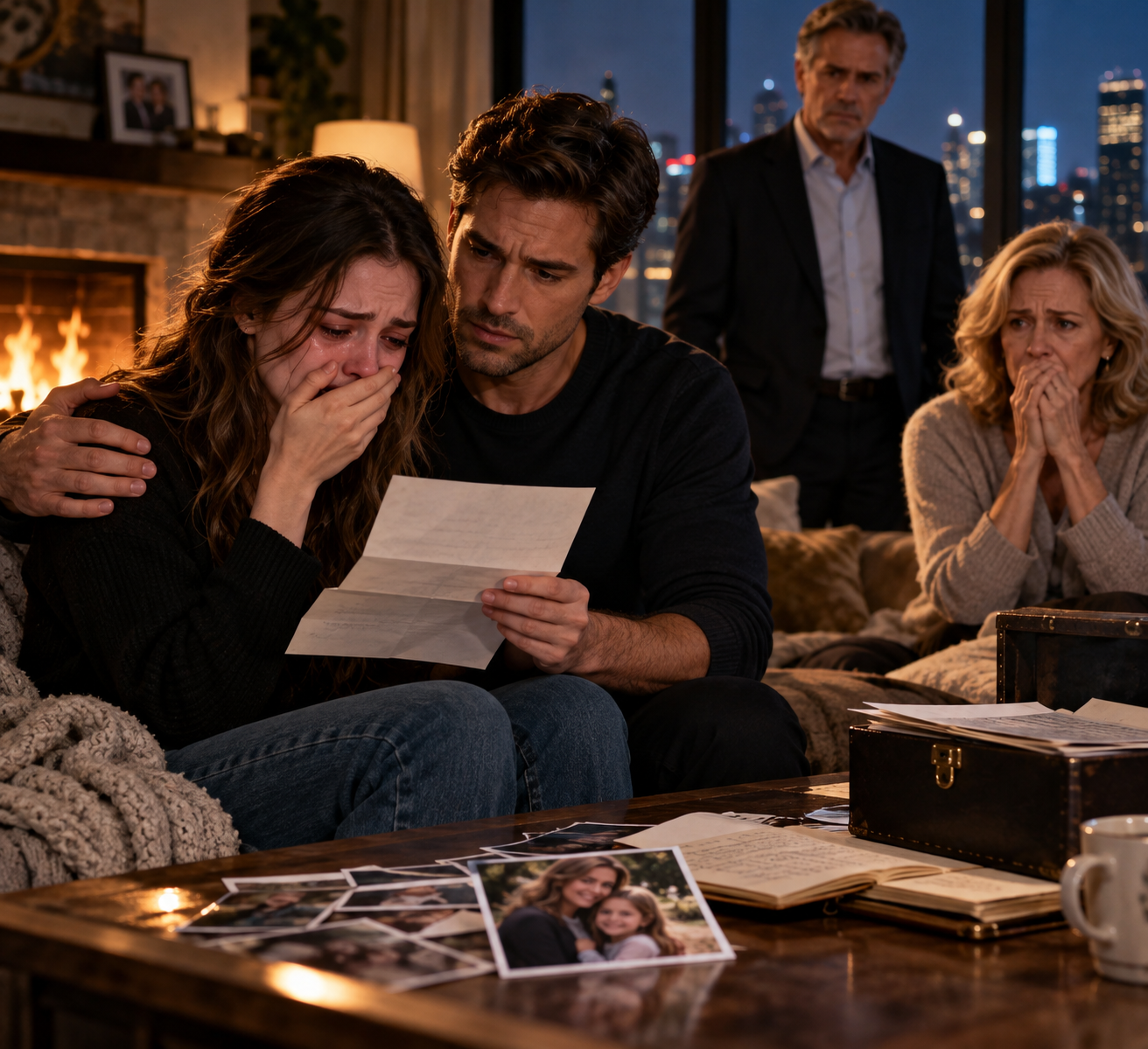
My father's study had remained almost untouched since his death.
I had cleaned it before selling the house we lived in as children, but the desk, bookshelves, and old leather chair had all been moved into our current home. The room was small, with a window facing the garden and a narrow closet where my father had kept his work clothes.
Daniel switched on the lamp beside the desk while I opened the curtains.
Dust floated through the beam of sunlight. On the shelves, books about watchmaking stood beside gardening manuals and folders of household receipts. My father had never been a man who threw anything away, and I had often teased him about keeping bills from appliances we no longer owned.
Now that habit seemed less amusing.
“Where should we start?” Daniel asked.
“The desk.”
We pulled out the drawers one at a time. The top drawer contained pens, spare batteries, and a packet of rubber bands. The second held old photographs, envelopes, and a small notebook with several pages missing. The bottom drawer was locked.
I tried the brass key marked 204, although I already suspected it wouldn't fit. It didn't.
Daniel crouched beside the desk and examined the lock.
“Dad had another key,” he said. “A little silver one. He kept it on his watch chain.”
“Do you know where it is?”
“No.”
We searched the desk, the closet, and the boxes stored beneath the window. After twenty minutes, I found a small metal tin behind a stack of gardening magazines. Inside were spare buttons, two old coins, and a silver key attached to a broken chain.
Daniel took it from me.
“That's the one.”
The lock clicked open.
Inside the drawer lay a folded handkerchief, several photographs, and a brown envelope bearing my father's handwriting. My name appeared across the front.
Mara.
I sat down before opening it.
The letter inside was dated eight years earlier, only a few months before my father died. Its paper had yellowed at the edges, and the writing grew less steady toward the bottom.
My dearest Mara,
If you are reading this, then something has happened that I hoped to prevent. I have spent too many years believing that silence could protect the people I love. I am no longer certain that it can.
I stopped reading.
Daniel stood beside me, his face tense.
“Keep going,” he said.
The letter continued with a reference to Evelyn, followed by a warning that certain records had been moved from their original location. My father wrote that he had trusted someone who later betrayed him, but he didn't identify that person.
The final paragraph was the most troubling.
If anyone asks you about the three days I was away in June, do not accept the first explanation you hear. I returned because I made a promise, and I kept that promise at a cost I have never been able to explain to you.
There was no signature, only his initials.
I read the letter twice, searching for a name or a clue that might tell me what he meant. Nothing else was written on the page.
Daniel sat opposite me.
“He knew this might happen.”
“He knew someone might ask about June,” I replied. “That doesn't mean he knew it would be us.”
I checked the envelope. It had been sealed once, then carefully opened along the edge. Inside was a small photograph of my father standing beside a car I didn't recognize. He looked younger, perhaps in his thirties, and wore a dark coat with one hand resting on the roof.
A second person stood in the background, partly obscured by a tree.
I enlarged the image on my phone.
The person appeared to be a woman.
Her face was turned away from the camera, but I could see the shape of her hair and the outline of her shoulders. The date stamped along the bottom matched the year written on the photograph of Evelyn.
“Could that be her?” I asked.
Daniel leaned closer.
“Maybe.”
I turned the photograph over. There was no caption, only a series of numbers written in pencil: 6-14-94.
June fourteenth, 1994.
I looked at the letter again. My father had referred to three days away in June, but he hadn't specified the dates.
“Do you remember when he left?” I asked.
Daniel shook his head.
“Not exactly.”
I called my mother into the study.
She entered reluctantly and stopped when she saw the open desk drawer. Her eyes moved from the letter to the photograph, and she seemed to shrink inside her cardigan.
“You found it,” she said.
“You knew it was here?”
“I knew he had written something.”
“Did you read it?”
“No.”
I held up the letter. “Dad says he returned because he made a promise. What promise?”
My mother sat in the leather chair.
“He never told me.”
“Do you believe that?”
She looked at me with tired eyes. “I know what I saw, Mara. I know what I don't know. I cannot give you an answer just because you need one.”
It was the first time she had acknowledged the limits of her own knowledge, and for a moment I believed her.
Then Daniel placed the photograph on the desk.
“Do you recognize this car?”
My mother stared at it.
“Yes.”
“Whose was it?”
She pressed her hands together.
“Your father's friend.”
“What friend?”
She hesitated.
“Arthur Bell.”
The name meant nothing to me, but Daniel reacted immediately.
“Arthur Bell? The man who owned the repair shop before Dad?”
My mother nodded.
“He helped your father when the family was having difficulties.”
“What difficulties?” I asked.
“Money. Legal problems. Things I thought had been settled.”
“Were they?”
My mother looked at the letter.
“I don't know anymore.”
I put the photograph and letter into a folder. There were still more drawers to search, more boxes to open, and too many questions for one afternoon.
Then Daniel found a thin notebook wedged behind the bottom panel of the desk.
Its cover was plain black leather, and the first several pages contained dates and short entries in my father's handwriting. Some referred to ordinary appointments. Others mentioned telephone calls and meetings with initials instead of names.
Near the middle, a single entry had been underlined twice.
June 16. Evelyn says the boy cannot stay here. We must decide before they come looking.
Daniel read the words over my shoulder.
“The boy,” he whispered.
I thought of the child in the photograph, standing beside Evelyn with one hand resting against her shoulder.
“What happened to him?”
My mother covered her face.
“I never saw that child again.”
I turned another page.
A final entry, written several weeks later, contained a location and a short instruction.
Bell's workshop. Ask for the blue ledger.
The notebook ended there.
I looked at Daniel.
“We're going to the workshop.”
He nodded, but our mother stood abruptly.
“No,” she said. “You mustn't go there.”
“Why?”
Her gaze moved between us.
“Because Arthur Bell died six years ago.”
“Then who would be there?”
My mother swallowed.
“The person who bought his business.”
Click here to continue reading: PART 7: The New Owner Recognized My Father’s Handwriting and Told Us Someone Had Already Been Asking About Evelyn
The Moment My Daughter Began Crying, I Realized There Was Something She Had Been Afraid to Tell Me
Part 6 of 35

