
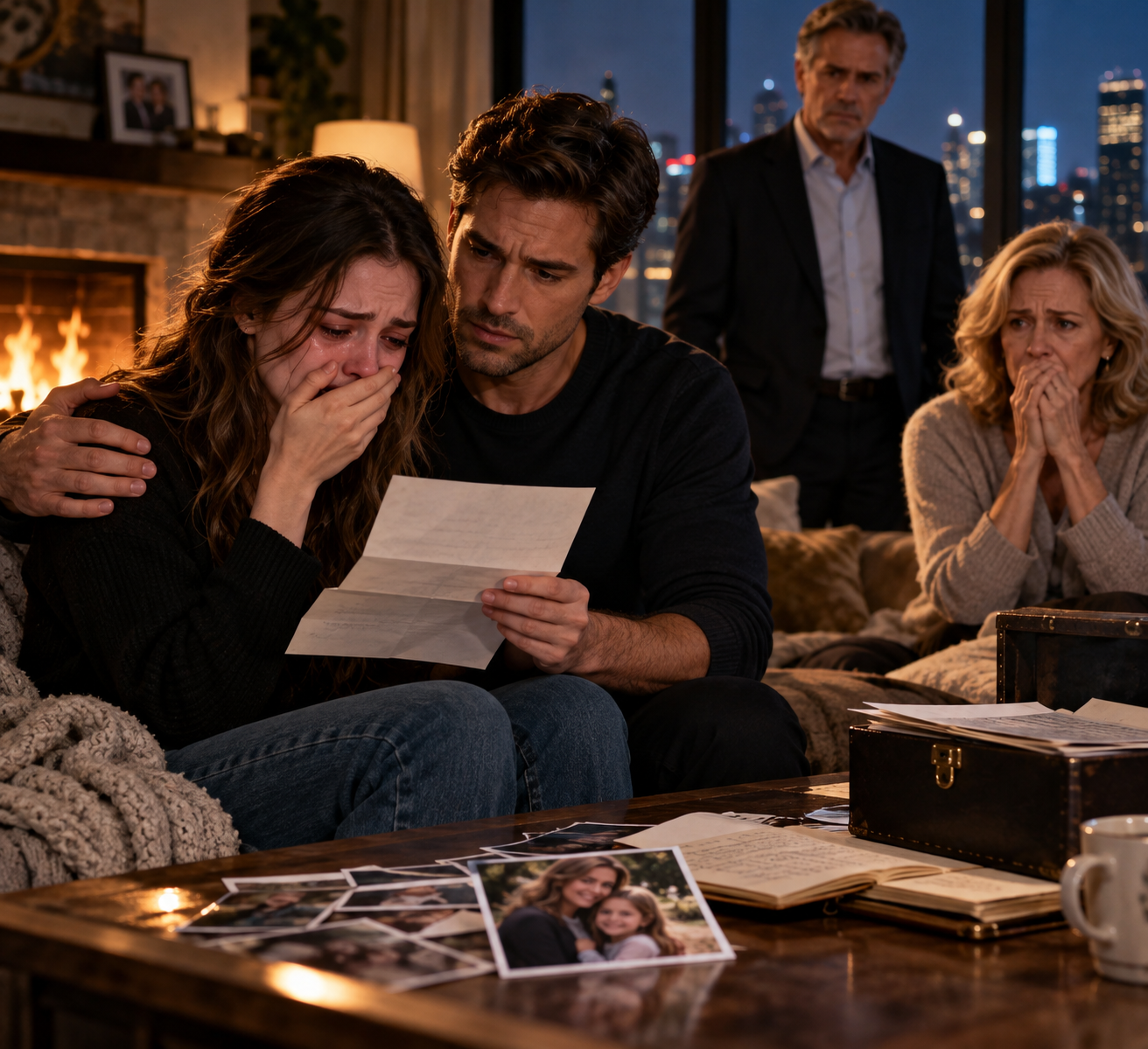
Helen returned less than half an hour later. She came through the front door carrying no shopping bag and wearing the same coat she had left in. Her face was pale, and she looked older than she had that morning. When she saw the folder in my hands, she stopped in the hallway and closed her eyes.
“You found the room,” she said.
“We found the records you kept there,” I answered. “And we read your letter.”
She did not ask which letter. Instead, she hung her coat carefully, as if the familiar movement could give her time to choose the words she had avoided for years. Thomas stood beside the staircase. Daniel waited near the living-room doorway, giving Helen space but making it clear that we would not let the conversation be postponed again.
Helen asked us to sit. She remained standing until I told her I would rather hear the truth before we settled into the comfortable arrangement of a family conversation. That hurt her, I could see, but she nodded and took the chair opposite me.
She began with Evelyn. They had known each other through Robert, who had brought Evelyn to the house when they were young. Evelyn was frightened of Edward Morgan long before the property dispute became public. She believed he had been changing documents to take control of land that had been placed in trust for a child. When she became pregnant, she tried to keep the pregnancy private because she feared Edward would use the baby to gain leverage over the family.
Helen said she had not known the details at first. Robert told her only that Evelyn needed help and that the child might have to be placed with another family temporarily. He promised that the arrangement would be legal, that Evelyn would remain involved, and that the baby would be returned when the danger passed.
“Did Evelyn agree to give me up?” I asked.
Helen looked directly at me. “She agreed to let me care for you while Robert found a safe way to correct the records. She did not agree to disappear from your life forever. She believed she would come back.”
The answer brought relief and anger together so tightly that I could not separate them. I had spent decades believing my identity was settled, only to discover that my birth mother had been kept from me by a chain of decisions made before I could speak. I wanted to ask why Helen had not fought harder, but I also knew that she had raised me through every ordinary difficulty and every important milestone. The woman before me was both the mother who loved me and the person who had kept a life-changing secret.
Helen explained that the hospital placement had been presented as a temporary guardianship. She signed documents believing the original birth record would remain intact. Robert handled the legal papers because he was already dealing with Samuel Price and the trust. Several months later, he discovered that the record had been changed. The official file now listed Helen and Robert as the child’s original parents, while the transfer record had been removed from the family’s copy.
“Who changed it?” Daniel asked.
Helen said she did not know at the time. Robert suspected Edward, but the alteration could not be traced to a single person without the original hospital register. The hospital had been undergoing an administrative reorganization, and several files had been transferred to a county archive. Robert began searching for the register, but every request was delayed or redirected.
When Evelyn learned that the records had been changed, she was furious. She came to the house late one evening and demanded to see the papers. Helen remembered her standing in the kitchen, still wearing the blue scarf, holding a letter in one hand and shaking so badly that the paper rattled. She said Edward had discovered the child’s identity and was threatening to challenge the trust unless Evelyn stopped asking questions.
Evelyn wanted to take her daughter and leave. Robert warned that doing so without correcting the documents would make it easier for Edward to accuse her of kidnapping or fraud. They argued for hours. Helen could hear them from the hallway, but she did not know the full content of the conversation until much later.
“Did she know where I was?” I asked.
“Yes,” Helen said. “She knew you were with us. She saw you more than once when you were little, though not often enough. Robert arranged those visits when he believed it was safe. She watched you from a distance, and she sent letters that he kept rather than delivered.”
My stomach tightened. “Why would he do that?”
“Because one of the letters had been intercepted. Someone knew where she was staying and what she had written. Robert thought that if the letters stopped moving, the person watching her would have no way to follow the trail to you.”
It was the same logic that had shaped Thomas’s childhood. Robert had hidden the truth from both of us, believing that the absence of information would keep us safe. But the people who controlled the records had benefited from that silence. We had been protected from some dangers and left exposed to others.
Helen admitted that she had received one letter directly from Evelyn. It arrived years after Evelyn left the coastal town. The letter contained no return address and asked Helen to tell the child that her mother had not abandoned her. Helen had wanted to answer, but Robert insisted that any reply could reveal the house’s location. He promised to find Evelyn and bring her home when he had proof that Edward could no longer threaten her.
“He never managed it,” Helen said. “He kept thinking he needed one more document, one more signature, one more piece of evidence. By the time he understood how much time had passed, Evelyn had moved again.”
Thomas leaned forward. “What about me? Why did he take me from Northfield?”
Helen’s eyes filled with tears. She told him that Evelyn had continued trying to contact him through letters sent to Robert. When the school began intercepting correspondence, Robert believed someone there was helping Edward track the family. Michael had tried to assist Thomas, but his own access to the school records was limited. Robert took Thomas away because he feared the next letter would reveal where Evelyn was hiding.
“He told me it was temporary,” Thomas said. “He said I would see her when things were settled.”
“I know,” Helen replied. “He told me the same thing.”
For a moment, no one spoke. Thomas looked away, and I felt the weight of the years he had spent believing his mother had chosen to leave him. Helen could not restore those years, and neither could Robert’s letter. The truth explained their decisions, but explanation was not the same as repair.
I asked Helen about the hospital marked on the map. She said Robert had visited the county archive several times and believed the original register was stored in a restricted collection. The public file contained the altered certificate, but the archive copy had been transferred from the hospital’s maternity department before the records were reorganized. A clerk had once told Robert that the original pages might still exist, though access required a formal request.
“Did he ever get them?” Daniel asked.
“No. He found a reference number, but not the register itself. He thought the file had been moved again. Before he died, he told me that if anyone ever found the blue ledger, they would need the hospital record to prove who had been hidden behind the false trust.”
Helen rose and went to the small desk near the living-room window. From its lowest drawer, she took a paper envelope held closed with an old elastic band. Inside was a typed archive request with a reference number, a date, and the name of the clerk who had handled Robert’s inquiry. The request had been stamped Pending—Location Verification Required.
“This is the last copy he kept,” she said. “I didn’t know what else to do with it.”
Daniel photographed the document and searched the county archive’s contact information. The reference number was old, but the collection code matched the hospital records mentioned on the map. He said we could submit a formal request, although the archive might require proof of identity and a reason for access.
Helen added that Robert had kept another clue inside the storage room: a list of names associated with the original trust. She had seen it years ago but never understood why one name was circled. She thought it belonged to a hospital administrator, though Robert had refused to explain.
We returned upstairs. In the drawer beneath the wardrobe, Daniel found the list tucked inside a folded map. Most names were familiar: Samuel Price, Arthur Bell, Edward Morgan, and a hospital clerk named Miriam Shaw. One name had been circled twice: Dr. Peter Lawson.
Rebecca Lawson’s father.
The discovery connected the hospital to the same family whose signature had been forged on the trust documents. Helen stared at the name, then shook her head. She said Peter Lawson had treated Evelyn during her pregnancy and had later helped arrange the temporary placement. He had been trusted by both Robert and Evelyn, but he died before the family understood how thoroughly the records had been altered.
Daniel contacted Rebecca immediately. She promised to search her father’s old papers and look for any connection to the hospital archive. She warned us that the family records were incomplete and that someone had recently removed documents from a locked cabinet.
When we ended the call, Helen sat on the edge of the bed and covered her face. She admitted that she had feared this day for years. She had hoped the truth would remain buried until the danger passed, but the danger had never truly passed. It had only changed shape, moving from threats against Evelyn to hidden documents, false records, and now warnings aimed at Lily.
I knelt beside her, though I was not ready to offer forgiveness. I asked one final question: whether she believed Evelyn was alive.
Helen looked at the blue scarf folded in Thomas’s hands. “I never stopped believing she might be,” she said. “Robert received a message from her not long before he died. He didn’t tell me what it said, but he kept the envelope in his study. He said it was proof that the light was still on.”
We searched Robert’s study again, this time looking specifically for an envelope bearing Evelyn’s handwriting. Behind a row of old reference books, Daniel found a thin file with the words June correspondence written on the tab. It contained copies of several letters and a note in Robert’s hand: “If the hospital record is recovered, contact the person who signed the last letter.”
The final letter had no full signature, only the initial E and a date from ten years earlier. Its last sentence read: I cannot return while the wrong person controls the record.
Evelyn had been alive when she wrote it. We could not yet prove where she was or whether she survived after that date, but the letter made her disappearance more than a historical mystery. Somewhere, she had continued to watch the same secret unfold, and she had believed that the person controlling the record was still powerful enough to keep her away.
Click here to continue reading: PART 28: Rebecca Found the Hospital File Someone Had Tried to Erase
The Moment My Daughter Began Crying, I Realized There Was Something She Had Been Afraid to Tell Me
Part 27 of 35


One Comment on “PART 27 – Helen Finally Confessed What She Had Promised Evelyn”