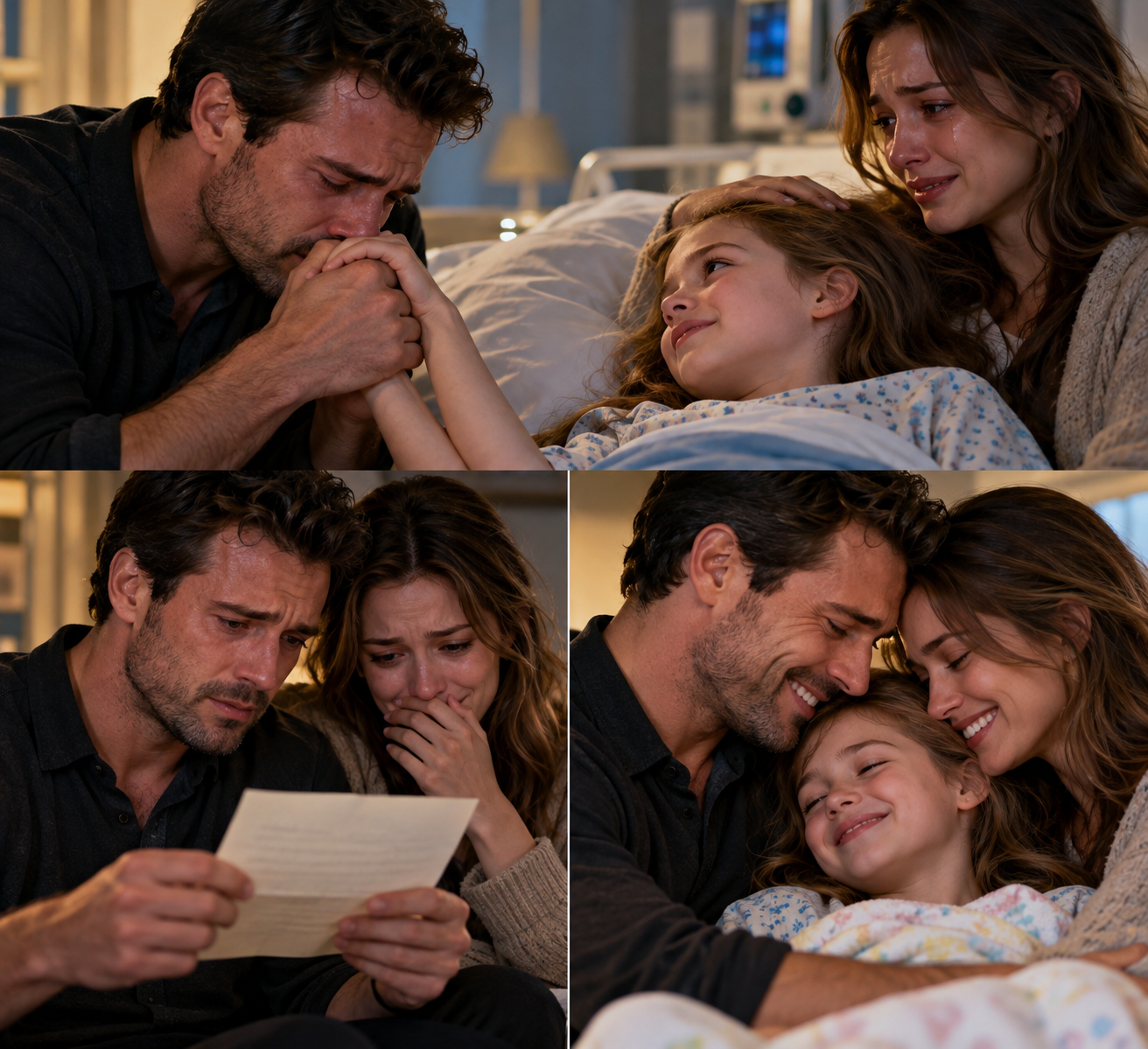
Evelyn Shaw arrived at Helen’s office the following morning carrying a slim folder secured with a faded elastic band. She had asked to meet Rebecca Ward before discussing the original order, and Helen had arranged a private room away from the investigators and legal staff. Daniel waited in the adjoining office with Laura, watching the clock while the sound of muted voices occasionally carried through the wall. He had spent the previous day learning that his mother had never stopped looking for him. Now he was waiting to learn whether another woman would discover that the daughter she had mourned was alive.
Rebecca arrived ten minutes later. She wore plain navy scrubs beneath a gray coat and carried a small notebook in one hand. She had come directly from an overnight shift at the hospital where she worked as a nurse. She knew only that an old investigation might involve her birth records and that a woman named Evelyn Shaw had asked to speak with her. Helen had warned Evelyn not to overwhelm her with unverified claims, but no one could make the first meeting easy.
When Rebecca entered the room, Evelyn stood.
For a moment, neither woman moved. Evelyn had brought a photograph of a baby taken shortly after birth, its edges worn from being handled over many years. Rebecca had brought no photograph, no childhood keepsake, and no reason to believe that a stranger’s grief had anything to do with her own life. She looked from Evelyn to the photograph and then back again.
“I was told you might have information about my birth,” Rebecca said.
“I do,” Evelyn answered. “But I want you to know that you can stop this conversation at any time. You owe me nothing.”
Rebecca sat down slowly. “Why would I owe you anything?”
“Because I may be the person who gave birth to you.”
The words seemed to settle between them without immediately becoming real. Rebecca looked at Evelyn’s face, searching for some familiar feature that might make the statement less impossible. Evelyn placed the photograph on the table and slid it toward her. The baby was wrapped in a white blanket, one tiny hand visible near the edge. On the back, in Evelyn’s handwriting, was a date from March 1988 and a name: Rebecca.
“I was told you had been placed under protection after a medical emergency,” Evelyn said. “Later, I was told that the records had been sealed and that pursuing them could endanger you. I believed some of it because I was frightened. I believed the rest because the people telling me were in positions of authority.”
Rebecca did not touch the photograph. “Are you saying I was kidnapped?”
“I am saying I do not yet know every part of what happened. I know that my daughter’s identity was changed, that the records were altered, and that I was prevented from seeing her. I have evidence that the same people involved in those changes falsified other children’s records. I cannot tell you what your childhood was like, or what your family knew, until we establish the facts.”
Rebecca’s expression tightened. “My parents adopted me legally. They raised me. They loved me. If you’re telling me that my whole life was built on a lie, I need you to understand what that means.”
“I do not want to take anything away from you,” Evelyn said. “I want to tell you what was taken from me, and let you decide what you want to do with that information.”
The meeting continued behind the closed door for nearly an hour. Daniel could hear occasional pauses, the scrape of a chair, and once the sound of Rebecca crying. He did not ask Helen whether he should go inside. Some moments belonged to people whose lives had been changed by the same scheme but who had never met before. He knew how much it mattered to be allowed to ask questions without an audience waiting for a dramatic answer.
When the door finally opened, Rebecca emerged first. Her eyes were red, but she was composed. Evelyn followed, holding the old photograph against her chest. Neither woman announced that everything had been resolved. Rebecca had asked for time, and Evelyn had agreed. They had exchanged contact details, and Rebecca had requested copies of the documents before making any decisions about further meetings.
“I need to speak to my parents,” Rebecca told Helen. “I need to know what they were told and whether they have any papers from the adoption. I’m not agreeing to anything beyond learning the truth.”
“That is entirely your choice,” Helen said.
Rebecca looked toward Daniel. “You’re the one whose death certificate started this investigation?”
“Yes.”
“Then I hope you understand that finding out who you are doesn’t automatically make you feel better.”
“I do,” Daniel said. “Sometimes it just gives you better questions.”
Rebecca gave a faint, tired smile. “That sounds about right.”
After she left, Evelyn sat with Daniel, Helen, and Laura. She did not claim that the meeting had healed her. She said it had made the past real in a way that years of preserving documents never had. She had finally seen her daughter alive, heard her voice, and learned the name she had been given. It was not the reunion Evelyn had imagined when she first began searching, but it was a beginning that could not be erased by a corrected entry in a registry.
Then she opened the folder she had brought.
Inside were copies of hospital routing sheets, a typed incident report, and a carbon copy of a document marked with the number 4172. The pages were fragile, but the text was legible. Evelyn explained that she had preserved them after she was removed from her administrative position. She had kept the originals for a time, then made copies when she learned that her access to the hospital archive was being terminated.
“This is the first order,” she said, pointing to the carbon copy. “Or at least the first version I saw. It directed the hospital to hold the records pending a review of the child’s legal status. It did not authorize anyone to declare the child dead.”
Laura leaned closer. “Is this the document Samuel referred to?”
“I believe so. I cannot prove that without comparing the file number and the routing information with the archive copy. But the language matches what I remember.”
The investigator photographed the pages and recorded their source. Evelyn signed a statement explaining when and how she had preserved them. She also agreed to identify the handwriting and initials on the routing sheets if an independent examiner determined that the copies were suitable for comparison.
Daniel studied the document. The first order directed the hospital to preserve the original registration and prevent any transfer until the dispute had been reviewed. A later notation, written in a different hand, changed the status of the child’s record. Another line referred to a supplemental order bearing Judge Bell’s name. The difference between the two documents was not a minor correction. The first protected the record; the second appeared to authorize the very action that erased it.
“The routing initials,” Laura said.
Near the bottom of the sheet were three sets of initials and a handwritten time. The first belonged to a hospital records clerk. The second appeared to be Evelyn’s. The third was unfamiliar to Daniel, but Laura recognized the pattern from her old index.
“C.R.,” she said. “Charles Rusk.”
Helen looked up. “Haldane’s former partner?”
“Yes. His initials appear on a transfer authorization from 1991 and on a receipt for a sealed envelope delivered to the county administrator’s office. I thought he had reviewed the file afterward. If these initials are his, he may have handled the original order before it was changed.”
Evelyn nodded slowly. “I remember a lawyer visiting the hospital office. He was not Haldane. He said he had been sent to verify that the records were secure. He asked me to bring him the first order and the hospital log. I refused to let him take the originals without a signed receipt, so he made copies and left.”
“Did you know his name then?” Daniel asked.
“I knew he worked with Haldane. I did not know how deeply he was involved.”
The new evidence changed the question surrounding Rusk. Until then, the concern had been that his old professional relationship with Haldane might compromise his neutrality as a records examiner. Now there was a possibility that he had personally handled a document central to the alleged alteration. That did not establish that he had changed it, but it made his participation in the investigation unacceptable until his role was independently assessed.
Helen called the investigator and asked him to secure Rusk’s written account of every document he had handled in connection with the trust structure. She also requested that he be excluded from examining the original order. The investigator agreed and said the court would be notified before the hearing.
Daniel felt a flicker of frustration. Each answer seemed to reveal another person whose actions had to be examined. Thomas Wren had directed the scheme. Haldane had used legal authority to conceal it. Martin was now connected to the current transfers. Rusk’s initials appeared on the route the original order had taken. But the chain still contained a missing link: who had changed the order from a preservation instruction into the basis for a false death certificate?
Laura examined the remaining sheets. One was a receipt showing that a sealed packet had been delivered to the county administrator’s office on November 6, 1990. The signature was difficult to read, but the printed designation beneath it was clear: Deputy Records Liaison. The name field had been crossed out and replaced with a personnel number.
“Why remove the name?” Daniel asked.
“Because a personnel number can be reassigned, concealed, or treated as an internal administrative detail,” Laura replied. “A name gives investigators a person to question. A number gives them another filing cabinet.”
She compared the personnel number with the copy of the bound index. It appeared in a section that listed temporary county employees assigned to records transfers. Beside it was a date of appointment and a department code. The final line had been partially obscured by a black mark, but enough remained to identify the department as County Administration.
“The person was assigned to Thomas Wren’s office,” Laura said. “Not the hospital. Not the court. The county office that received the amended order.”
The investigator requested the historical personnel register and the payroll records associated with the number. The current county records custodian confirmed that some material had survived, although several files had been transferred to an off-site archive. The request was added to the evidence schedule for the hearing. With so little time remaining, they could not assume the files would arrive before November 4.
Helen looked at the clock. “We have to prepare for the possibility that the judge will not have the full personnel record in time. We can show the court the original version Evelyn preserved, the later version, the recording, Margaret’s statement, and the records tying the number to the county office. We should ask for an order compelling the missing files and preventing the transfer until the discrepancy is resolved.”
“And if the judge refuses?” Daniel asked.
“Then we need to know exactly why,” Helen said. “We need a clear ruling we can challenge. We cannot let a refusal to produce evidence become an excuse to abandon the case.”
Evelyn touched the corner of the first order. “I should have taken these documents to someone outside the county years ago.”
“You tried to report what you saw,” Daniel replied. “You were told the records were settled, and you were threatened with consequences if you kept asking. That is part of the evidence, not a reason to blame yourself.”
Evelyn lowered her eyes. “I still wonder whether I could have done more.”
“So do I,” Daniel said. “I wonder what my life would have been like if my mother had been allowed to see me. But wondering what we could have done differently doesn’t tell us who made the decisions. That is what we have to establish now.”
The words seemed to comfort her, though they did not erase her regret. She placed the first order back in its protective sleeve and asked the investigator to make sure that the court received a complete copy. She would testify about the hospital’s handling of the record and her attempts to preserve it. If Rebecca chose to participate later, she could do so on her own terms.
That afternoon, the investigator received a preliminary response about the personnel number. The original payroll register had been transferred to an archive maintained by an independent county contractor. The file was scheduled for retrieval, but the earliest expected delivery was the morning of November 4—the same day as the hearing. The custodian warned that the register might contain only the employee’s assigned number and dates of service, with no record of the specific packet delivered to the county office.
It was a narrow lead, but it was the first that pointed toward a living person who might have carried the amended order from the hospital to Thomas Wren’s office. If the number could be connected to an individual, the investigators might finally identify the person who had physically moved the document that transformed Daniel’s status.
Martin Wren’s attorney sent a notice that evening challenging the reliability of the recording and the handwritten statement. He argued that the materials had been assembled decades after the alleged events and that the court should not allow an emergency order to interfere with the trust’s scheduled administration. The notice also demanded that Daniel disclose every copy of the documents in his possession.
Helen read the filing twice. “They are preparing to argue that the records are too old to trust, while asking for access to every copy that could help them determine what we have.”
“Can they force me to hand everything over?” Daniel asked.
“That depends on the court’s orders and the rules governing the evidence. We will disclose what is required, but we will not surrender originals informally or allow the material to be examined by someone with a potential conflict. The preservation order exists to prevent exactly that kind of uncontrolled handling.”
Daniel looked at the six account numbers listed in the transfer schedule. Each one represented assets that might be moved beyond easy recovery if the transfer went through. The documents suggested that some of the property had been held in trust for decades, but the beneficiaries had been hidden behind false identities. Even if the court accepted that the original records were altered, they would still need a process to identify the people entitled to make claims.
The November 4 hearing was no longer simply about whether Daniel’s death certificate should be corrected. It was about whether the court would preserve the evidence long enough to uncover the people who had profited from the false identities—and whether the system that had once accepted those lies would now allow them to be challenged.
Before leaving the office, Daniel returned to the photograph of Samuel and Evelyn. On the back, Samuel had written, Ask her what happened to the first order. The question had seemed straightforward when Daniel first read it. Now he understood that Samuel had been pointing not only toward Evelyn’s memory, but toward a document that had traveled through several hands before reaching the county administrator’s office.
The original order had not vanished entirely. Its first version survived in Evelyn’s folder, its number appeared in the index, and its later alteration was described in Samuel’s recording. The routing initials implicated a lawyer who had worked with Haldane, while the personnel number led to a county employee whose identity had been removed from the receipt.
Someone had carried the order into the office where Thomas Wren could control its fate.
The question was whether that person had merely delivered it—or had helped change it.
Daniel shut the folder and stood. The next day, they would enter the hearing with more evidence than they had possessed when the investigation began, but they would still be asking the judge to act before every piece of the chain was complete. The accounts were scheduled to move two days later. The original payroll register might arrive only hours before the hearing, and Martin’s lawyers were already preparing to argue that uncertainty should favor the trust.
Daniel had spent thirty-two years living under an identity that had been built to conceal a crime.
He was no longer willing to let the absence of a complete answer become the reason the people responsible escaped scrutiny.
Click here to continue reading: PART 21: The Personnel Register Arrived Before the Hearing and Exposed the County Employee Who Had Carried Daniel’s False Death Order
The Stranger at the Door Knew a Name Daniel Had Been Forbidden to Remember
Part 20 of 35