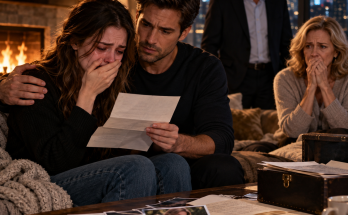
Dr. Adrian Vale’s response arrived nine days after the review office sent him the preliminary findings. The letter was several pages long, carefully formatted, and written in a tone that sounded more like a professional submission than a personal explanation. He acknowledged that the records showed an unresolved identifier discrepancy and accepted that the clinic should have ensured the case was followed through to a documented conclusion.
He did not, however, accept that the available evidence proved a deliberate decision to conceal information from Elena. He stated that he had overseen many cases during the period in question and could not reconstruct every conversation from memory. He had reviewed the archived memorandum and believed it reflected an attempt to prevent staff from treating an unverified laboratory finding as final while the clinic determined how to proceed.
Elena read the letter in silence. When she reached the paragraph discussing the family representative, she stopped and returned to the beginning of the page.
“What does he say about that instruction?” she asked.
Paul, who had forwarded the response, explained that Dr. Vale did not recall personally issuing a direction to contact Rebecca Coleman instead of Elena. He said the phrase “family representative” might have been used by staff to describe a preferred contact or an assumption made during administrative handling. He could not identify the person who wrote the note or confirm that a valid authorization had existed.
“So he’s saying he doesn’t know who decided that,” Elena said.
“Yes,” Paul replied. “That is what his response says.”
“Does he explain why the appointment was canceled?”
Dr. Vale stated that he could not remember authorizing the cancellation personally. He acknowledged that the fax cover sheet from the director’s office had instructed scheduling to hold the appointment until his review was complete. He said he would ordinarily expect the responsible office to ensure that the hold was lifted or that a new appointment was arranged once the review had concluded.
“But the register says the review was completed,” I said. “And the case stayed on hold.”
“Dr. Vale acknowledges that inconsistency,” Paul replied. “He says the surviving records do not show who was responsible for closing the loop.”
The phrase irritated me. Closing the loop sounded like a minor administrative task, something that could be forgotten while more important work demanded attention. Yet the missing follow-up had affected the decisions Elena and I made about treatment and about our future. What the clinic described as an incomplete process had become a defining part of our lives.
Elena kept her voice steady. “Does he say whether the result was ever confirmed?”
“No,” Paul said. “He says he has not located a final laboratory report or evidence that the identifier discrepancy was resolved. He does not claim the original result was correct.”
I felt my shoulders loosen slightly, followed by a wave of anger that made the relief seem almost shameful. Dr. Vale’s response did not give us a definitive answer, but it confirmed that the original finding could not be supported by the records he had reviewed. The certainty I had once defended was no longer even the clinic’s position.
Elena set the letter down. “I want him to answer one more question.”
Paul asked what she wanted added.
“Why did nobody tell me that the result was still unresolved? Not why the file was delayed, not why the appointment was held. Why was I left to believe that the original report was final when the clinic had evidence that it could not be relied upon?”
Paul said he would forward the question to the reviewer. He cautioned that Dr. Vale might not remember the specific decision, and the records might not reveal who had been responsible. Elena accepted that possibility but insisted that the question be included in the formal record.
Over the next several days, we reviewed the response alongside the original documents. Dr. Vale’s explanation was consistent with some of the evidence. He said the memorandum was intended to prevent the disputed result from being treated as conclusive. That matched the written instruction. He said the appointment should have been rescheduled or the hold reviewed. That matched the absence of a documented follow-up. He said he could not identify who had restricted communication or why the case had not been closed properly. The archive could not contradict him, but it could not verify his account either.
The review office asked Martin Shaw to comment on Dr. Vale’s response. Martin reiterated that operations had been responsible for routing the case and that a hold should have had an assigned owner and review date. He said he could not remember who had received the final instruction or whether the relevant action had been completed. He accepted that the records did not demonstrate that the clinic had contacted Elena after the discrepancy was identified.
His statement did not establish that he had knowingly blocked communication. It did establish that the process under his area of responsibility had not produced a documented outcome. The reviewer noted the distinction, and so did Elena.
“I don’t want them to blame him just because his initials are on the paper,” she said. “But I also don’t want his lack of memory to mean nobody is responsible.”
That became the principle guiding our final submissions. We asked the reviewer to distinguish between individual intent, which remained unproven, and procedural responsibility, which the records could evaluate. A failure did not need to be deliberate to be serious. A patient could be left without essential information because every person involved believed someone else was handling it.
The reviewer arranged one final meeting with us before issuing the findings. She explained that the office had examined the laboratory attachment, the clinic’s internal memorandum, the scheduling records, the correspondence index, Rebecca’s notes, and the written responses from Dr. Vale and Martin Shaw. It had also searched the available archive for the missing authorization page and any final laboratory report.
Neither document had been located.
The reviewer said the office could not determine whether the sample had been mislabeled, whether the original result would have differed from a properly verified result, or whether a new collection would have produced a different outcome. The missing specimen tracking sheet prevented the laboratory process from being reconstructed completely. The absence of a final report meant there was no reliable basis for claiming that the original finding had ever been confirmed.
However, the reviewer found that the clinic’s own documents demonstrated that the original finding was not to be treated as final while the identifier discrepancy remained unresolved. The clinic had received an external laboratory response recommending clarification or a new collection, and its internal memorandum instructed staff to keep the case open. Despite that, the surviving records did not show that a new collection was arranged, the discrepancy was reconciled, or Elena was given a final explanation.
The reviewer also found that the clinic’s communication process had been inadequately documented. The instruction referring to a family representative was not supported by a surviving authorization, and the file did not show a clear basis for delaying direct communication with Elena. The review did not conclude that anyone had intentionally concealed the discrepancy, but it found that the clinic had failed to demonstrate that its communication decisions were properly authorized and followed through.
Elena listened without interrupting. When the reviewer finished, she asked whether the findings meant the clinic had treated an unverified result as final.
“The documents show that the clinic recognized the result was not reliable enough to be used as a final clinical conclusion,” the reviewer said. “The surviving records do not establish that the clinic formally confirmed it afterward. The problem is that the patient-facing communication and follow-up were not completed or documented adequately.”
“So the answer is that they should not have left me believing the question was settled.”
“That is a fair description of the communication failure identified by the review.”
Elena lowered her head for a moment. I could see her trying to absorb an answer that confirmed her experience without providing the medical certainty she had once hoped to find. She had not imagined the discrepancy. She had not been unreasonable to ask for clarification. But we still could not say what the correct laboratory result would have been.
After the meeting, the reviewer issued the final report. It recommended that the former clinic’s responsible organization preserve all remaining records, correct any summary that described the original finding as confirmed, and provide Elena with a written statement explaining the limits of the surviving evidence. It also recommended a review of record-transfer procedures and a process for identifying unresolved clinical cases when a facility closed or transferred its files.
The report did not impose a finding of deliberate deception on any named individual. It stated that the evidence did not establish intent. It did identify failures in follow-up, communication, and recordkeeping, and it made clear that the clinic had not substantiated a final result in Elena’s case.
Elena read the report twice. Then she asked me to meet her at the café where we had first discussed the missing letter. We sat at the same small table, but neither of us brought the old folder. She had printed the final report and placed it inside a plain envelope.
“I wanted a document that told me I wasn’t wrong to keep asking,” she said. “I have that now.”
“I’m glad.”
“But I don’t have the answer to the medical question.”
“No.”
“And I don’t have the years back.”
I did not tell her that we could still build something new together. The report did not promise that, and neither did she. Instead, I acknowledged what I had avoided for too long.
“I helped turn an unresolved report into a final answer because I wanted the uncertainty to stop. When you questioned it, I made you feel as if the problem was your inability to accept the truth. I’m sorry for that.”
Elena held my gaze. “I believe you’re sorry. I also need you to understand that I may never know what I would have chosen if we had been given the right information.”
“I understand.”
“And I can’t promise that knowing this changes what I feel about us.”
“I’m not asking you to.”
She nodded. There was pain in her expression, but also a kind of relief. We were no longer arguing about whether she had been right to question the report. We were finally able to acknowledge what the records showed and what they could not restore.
We stayed at the café for another half hour, talking about the hospital appointment and the next steps Elena wanted to take for her own health. She told me she planned to keep a copy of the final report with her medical records, not because it could answer the old question, but because she did not want another clinician to mistake the disputed finding for a confirmed conclusion.
I offered to help organize the documents if she wanted. She said she could manage the file herself but appreciated the offer. Then we walked outside and parted at the corner without making plans for another meeting.
That evening, I opened the first message Elena had sent me from the hospital, the one in which she had said the old records contained something the clinic had never explained. I had read it originally as a request to revisit our past. I understood now that it had been a request to stop treating uncertainty as her personal failure.
I replied with a short message: “Thank you for asking me to look at the records with you. I’m sorry I didn’t listen the first time.”
She responded a little later.
“I’m glad we found out what we could. I need time to decide what I want next.”
I told her I would respect that. For once, I did not ask how much time she needed or whether she still cared about me. Her future was not a question I had the right to force into a deadline.
The next morning, Paul sent us confirmation that the final report had been filed and that the clinic’s organization had acknowledged receipt of the recommendations. The records would remain preserved, and the disputed finding would be described as unverified in the corrected summary. No one could recreate the missing specimen tracking sheet or produce a final result that the archive did not contain.
The formal investigation was nearing its end, but the personal consequences were not so easily filed away. Elena still had current medical questions to address, and I still had to confront the ways I had used certainty to avoid fear. The clinic’s failure was real. So was the damage between us. Neither fact canceled the other.
Before closing the archive folder, I read the reviewer’s final sentence again. It said the available evidence did not permit a reliable conclusion about the original result, but it did permit a conclusion about the process: the uncertainty should have been communicated, the follow-up should have been completed, and the patient should not have been left to infer that an unresolved finding was final.
For the first time, I could accept an answer that did not pretend to know everything. It was not the ending Elena and I had once imagined, and it did not give us back the life we had lost. But it gave us something the old report had taken away: the right to distinguish what had been proven from what had merely been believed.
Click here to continue reading: PART 21: The Corrected Statement Arrived With an Apology, but One Sentence Made Elena Question Whether the Clinic Had Told Us Everything
Three Years After Our Divorce, One Midnight Phone Call Forced Me to Face the Woman I Had Never Truly Forgotten
Part 20 of 35