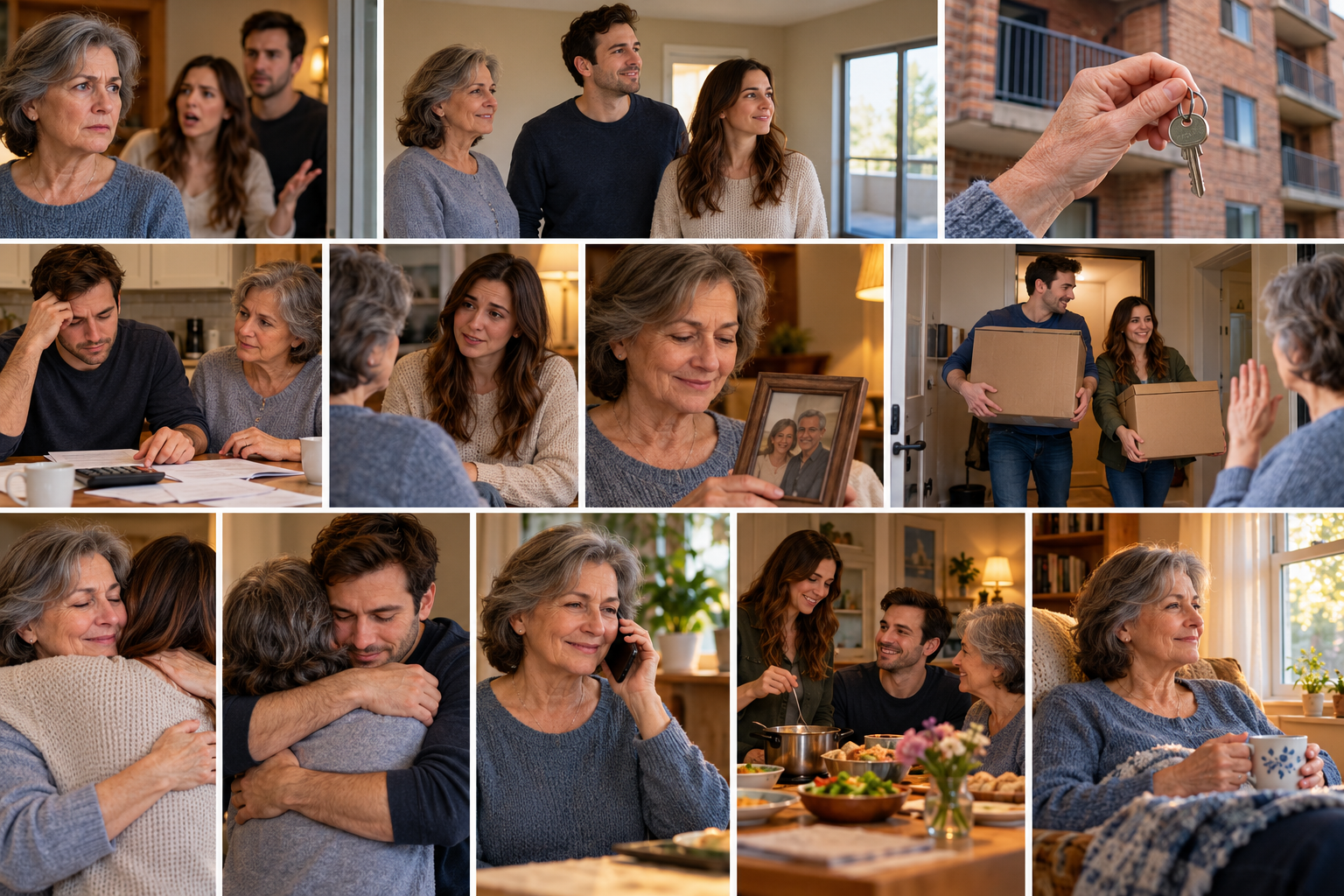
The house settled into an uneasy quiet after noon.
I could hear movement downstairs, but neither David nor Sarah came to speak to me again for a while.
I was grateful for the silence.
Not because I wanted them to feel uncomfortable.
Because I needed a little distance from the way they had treated me.
I had spent most of the morning trying to understand how an offer of help had turned into a demand.
I still didn't have an answer.
Perhaps Sarah had become accustomed to getting her way.
Perhaps David had grown so worried about keeping his marriage peaceful that he had stopped considering what was fair to anyone else.
Perhaps both things were true.
But guessing at their reasons didn't change the facts.
They had asked me for a place to stay.
I had given them one.
They had decided the room wasn't good enough.
And instead of discussing their concerns respectfully, they had expected me to give up the bedroom I had shared with my husband.
I sat at the kitchen table with a glass of water.
The ice had melted.
I watched it turn slowly in the glass when I moved it.
It reminded me of Sarah's drink that morning, the way she had stood there looking so comfortable while she told me to rearrange my life.
I wondered whether she had realized how insulting her request sounded.
I wondered whether David had understood the moment he told me to respect their situation.
Then I stopped wondering.
I couldn't spend the rest of my day trying to make sense of choices they had made themselves.
I had to decide what I was willing to accept.
I began with the simplest truth.
This was my house.
I had bought it with my husband.
I had paid for it, maintained it, and continued living in it after he died.
The fact that David was my son did not make the house his.
The fact that Sarah was his wife did not give her the right to choose which room I occupied.
And the fact that they needed help did not mean I had to agree with every demand they made.
I had known all of that before.
Somehow, I had needed to remind myself.
I rose from the table and carried my glass to the sink.
Then I rinsed it and placed it on the rack.
I was not going to pack my belongings.
I was not going to move into the guest room.
And I was not going to spend another morning pretending that I had done something wrong by saying no.
The thought brought me a little peace.
Not happiness.
Not yet.
Just peace.
I went into the living room and sat in my husband's chair.
The cushion dipped slightly beneath me.
For years, I had avoided sitting there for too long because it reminded me of the evenings when he would be reading while I worked on something nearby.
At first, the empty chair had been unbearable.
Later, it had become familiar.
Now it was simply part of my home.
I looked around the room.
The photographs on the shelves showed different stages of our lives.
There were family gatherings, holidays, and ordinary days that had seemed too unimportant to remember until they were gone.
David appeared in several of them.
In one, he was standing beside his father with a wide grin.
In another, he was younger, holding a birthday cake while everyone laughed at something outside the frame.
I remembered the boy in those pictures.
I remembered the man he had become.
Both were my son.
Neither memory erased the other.
I could love the child I had raised and still be disappointed in the adult who had stood beside his wife that morning.
That was a difficult truth to accept.
For years, I had believed that if I loved my children enough, I could always find a way to smooth over whatever went wrong between us.
I had tried to be patient.
I had tried to understand.
I had tried not to make small disagreements larger than they needed to be.
But sometimes, avoiding an argument only allowed the problem to grow.
I had mistaken silence for kindness more than once.
I wasn't going to make that mistake again.
A door opened upstairs.
Footsteps crossed the hallway.
Then Sarah appeared near the living room entrance.
She had changed out of the clothes she wore earlier and was holding her phone.
She glanced at me in the chair.
"Are you staying in there all afternoon?"
I looked at her.
"I live here."
She pressed her lips together.
"That's not what I meant."
"Then what did you mean?"
She seemed irritated that I had asked.
"I just thought we could settle things."
I waited.
She glanced toward the kitchen.
"David and I need to feel comfortable here."
"I want you to feel comfortable."
"Then why can't you work with us?"
I rested my hands on the arms of the chair.
"Because being comfortable doesn't mean getting everything you want."
She looked at me for a moment.
Then she shook her head.
"I don't think you understand how difficult things have been for us."
I felt a familiar urge to reassure her.
I wanted to tell her that I knew they were struggling, that I wasn't judging them for needing help, that I had invited them into the house because I cared about them.
But I had already explained those things.
Repeating them would not make my answer clearer.
"I understand that you're having financial problems," I said. "That's why you're here."
She looked away.
"We didn't expect this to become such a big deal."
"Neither did I."
She shifted her phone from one hand to the other.
For a moment, I thought she might say something more.
Instead, she turned and walked back toward the hallway.
I watched her leave.
I felt sad.
There was no satisfaction in standing my ground while someone else remained angry.
I had hoped our relationship would be easier than this.
I had hoped Sarah would see my offer as an act of trust rather than an opportunity to rearrange my home.
I had hoped David would remember that helping him was something I chose to do, not something he was entitled to receive.
Those hopes had not disappeared.
But I was no longer willing to protect them at my own expense.
Later that afternoon, David came into the living room alone.
He stopped beside the sofa instead of sitting down.
"Mom, can I ask you something?"
I nodded.
He looked uncomfortable again.
"Do you really think we're trying to take advantage of you?"
I considered the question.
I could have answered immediately.
I could have told him that his behavior that morning had made me feel exactly that way.
But I wanted to be fair.
"I think you asked me for help, and I gave it to you," I said. "Then you asked me to give up something that wasn't yours to ask for."
He stared at the floor.
"Sarah didn't mean it like that."
"Then she should have said something different."
He sighed.
I could see how badly he wanted the conversation to end.
I understood the feeling.
I wanted it to end too.
But I had learned that an uncomfortable conversation could not always be solved by walking away from it.
"David," I said, "I am happy to give you a place to stay while you work things out. I am not willing to be treated as though I have to surrender my own home to make you comfortable."
He looked at me.
For a moment, I thought he might argue.
Instead, he sat down on the edge of the sofa.
"I didn't think you'd be this upset."
I felt something inside me soften, then settle again.
"That's part of the problem," I told him. "You didn't think about how I would feel."
He rubbed his hands together.
I waited.
He didn't apologize.
He didn't tell me that he understood.
He simply looked tired.
And I realized that I could not make him understand something he wasn't ready to face.
I wasn't going to force him to say the right words.
I wasn't going to pretend that the right words had already been spoken.
I let the silence remain between us.
After a while, David stood.
"I'll talk to Sarah."
"All right."
He walked toward the hallway.
I watched him go.
I wanted to call him back.
I wanted to tell him that I missed the days when he would sit beside me and tell me everything that was bothering him.
I wanted to remind him that he didn't have to turn every disagreement into a choice between his wife and his mother.
But those were conversations for another time, if we could ever have them honestly.
For now, I needed to let my answer stand.
That evening, I went upstairs and changed into comfortable clothes.
I made a simple dinner and ate at the kitchen table.
David and Sarah ate later.
We exchanged a few words, but nobody mentioned the bedroom.
I didn't take the silence as a resolution.
I knew better than that.
A problem could disappear from a conversation without disappearing from a person's mind.
Still, I was grateful that the evening passed without another argument.
When I finished eating, I washed my plate and turned off the kitchen light.
I stood for a moment in the dim hallway.
The house was mine.
That had been true when my husband was alive.
It had been true during the years I lived here alone.
And it remained true now that I had opened the door to my son and his wife.
Helping them had not changed that.
I went into my bedroom and closed the door.
The photograph beside my bed caught my attention as I reached for the lamp.
My husband was smiling in it.
I touched the frame lightly.
"I hope I'm doing the right thing," I whispered.
The room gave me no answer.
I didn't expect one.
I turned off the light and lay down in my own bed.
For the first time that day, I allowed myself to stop thinking about what David and Sarah wanted.
I thought instead about what I needed.
Respect.
Honesty.
A home where I did not have to defend my place in it.
Those were not unreasonable things to ask for.
I had spent twenty years building a life inside those walls.
I wasn't going to surrender it simply because the people I loved had forgotten what my kindness meant.
And whatever happened next, I knew I would have to face it with my eyes open.
Click here to continue reading: PART 5: The Next Morning, I Tried to Return to My Ordinary Routine, but the Silence Between My Son and Me Made Every Room Feel Different
My Son and His Wife Had Been Living Under My Roof for Only Three Days When They Decided My Bedroom Belonged to Them
Part 4 of 20