
The next morning, I made a decision about the paperwork.
I would stop trying to interpret it alone.
I had spent several days reading the same pages, hoping something would become obvious if I looked long enough.
It hadn't.
All I had managed to do was worry about possibilities I couldn't confirm.
I made another cup of coffee and brought the folder to the kitchen table.
The papers looked ordinary in the morning light.
That almost bothered me.
Something that had changed how I thought about my son, my money, and my future was sitting inside a plain folder beside a grocery receipt.
I had expected a decision this important to feel different.
Instead, I was just a woman at her kitchen table, trying to understand what she had agreed to.
I wrote down the amount I had contributed.
Then I wrote down the questions I needed answered.
I wanted to know what the documents established about the house.
I wanted to understand whether the money had been given outright and whether any agreement protected my interests.
I also wanted to know what options existed if the arrangement had been different from what I thought it was.
I did not write down a plan to take the house away from my son.
I was not there yet.
I needed facts before I could decide what to do.
That was the first thing I had done differently since receiving his message.
For years, I had acted first and trusted that the details would work themselves out.
This time, I wanted the details first.
I gathered the relevant papers and put them into a smaller folder.
I made sure I had the records connected to the transaction rather than every unrelated document I had collected over the years.
Then I put the folder beside my purse.
I was going to seek qualified advice.
I did not need anyone to tell me that my son had hurt my feelings.
I already knew that.
What I needed was a clear explanation of where I stood financially and what the law allowed me to do.
I wanted someone to look at the actual arrangement instead of relying on my memory of the conversations that had led to it.
I had learned that a person's understanding of a deal could be very different from what the paperwork established.
I did not want to discover that difference after making another mistake.
Before leaving the house, I checked my phone.
Still nothing from my son.
I stared at the screen for a moment.
Then I put the phone away.
I was beginning to understand that I could not make him explain himself by waiting harder.
If he wanted to talk, he knew how to reach me.
I drove out with the folder on the passenger seat.
At a red light, I glanced over at it.
The corners of the papers were slightly bent from all the times I had taken them out and put them back.
I smoothed the top page with my hand.
I felt nervous.
Not because I was afraid of losing an argument with my son, but because I was finally allowing myself to consider that I might have misunderstood the consequences of giving him so much money.
I had wanted to be generous.
I had also wanted to be a good mother.
Somewhere along the way, I had treated those two things as if they required me to ask nothing in return and question nothing afterward.
I knew better now.
Being a good mother did not mean refusing to understand my own financial position.
It did not mean pretending that a large transaction was too sensitive to discuss.
And it did not mean allowing my son's disappointment to become the price I paid for having boundaries.
When I arrived, I kept the conversation focused on the facts.
I explained the amount I had contributed.
I explained that I had helped my son purchase a house because I wanted him and Sarah to have a secure place to live.
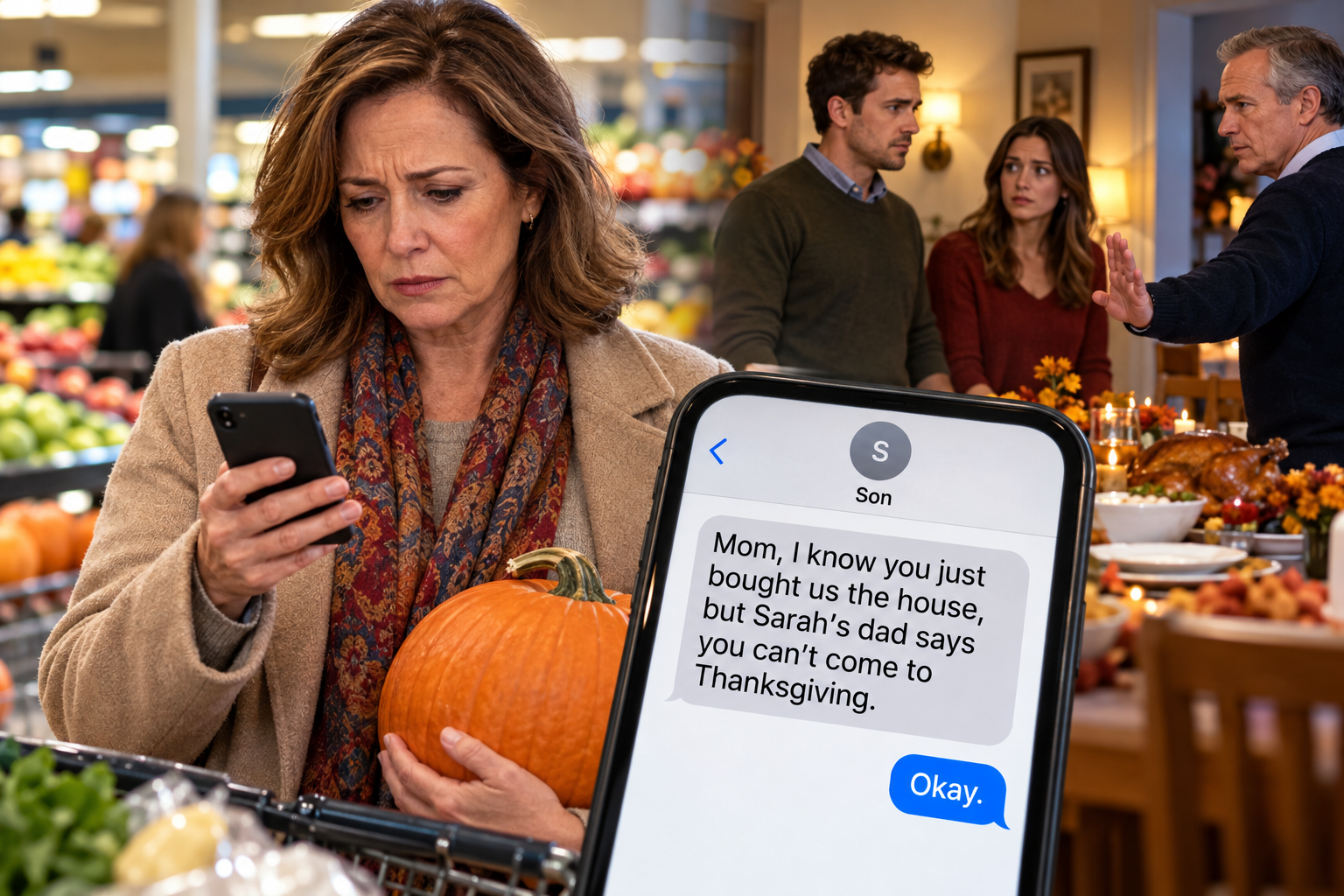
Then I described the message I had received.
I did not exaggerate it.
I did not need to.
My son had told me that Sarah's father did not want me at Thanksgiving.
I had accepted the message without arguing, but it had made me question the arrangement surrounding the house.
I wanted to understand what I could and could not do.
The documents needed to be examined carefully.
I understood that.
I also understood that my feelings about the situation did not automatically create a legal right to reverse a financial transaction.
That was why I had come for answers instead of making threats.
I listened and took notes.
I asked questions when something was unclear.
I made sure I understood which details depended on the actual documents and which depended on the law and the circumstances surrounding the purchase.
I did not leave with a magical solution.
There was no simple sentence that made the entire situation disappear.
But I had done something useful.
I had stopped guessing.
I had started gathering the information I needed to make a responsible decision.
On the drive home, I felt quieter than I had expected.
The hurt was still there, but it was no longer tangled up with every possible financial outcome.
I could separate the two things.
My son had treated me in a way that hurt.
The legal and financial consequences of my contribution were a separate question.
Both mattered.
Neither one could be solved by pretending the other did not exist.
When I returned home, I placed the folder on the table and removed my coat.
The pumpkin was still sitting on the counter.
I had nearly forgotten about it.
I looked at it for a few seconds, then carried it to the windowsill where the afternoon light could reach it.
I was not trying to preserve the memory of Thanksgiving.
I simply did not want to spend the rest of the week rearranging my entire house around one painful message.
There were more important things to do.
I needed to keep my records organized.
I needed to understand the consequences of the financial arrangement.
And I needed to decide what kind of relationship I was willing to continue having with my son.
I could not make that final decision in one afternoon.
I had loved him for too long to turn my feelings off like a light.
But I could begin changing the way I responded to him.
I could stop offering help automatically.
I could stop treating every request as something I needed to satisfy before he became disappointed.
And I could stop confusing his comfort with my responsibility.
That evening, I made a simple dinner.
I ate without the television on.
For once, I let the house remain quiet.
I did not keep checking my phone between bites.
I did not imagine the conversation I might have with my son if he suddenly called.
I finished eating, washed my plate, and dried it with the towel hanging beside the sink.
Then I put the paperwork away.
The next step would depend on what I learned, not on what I feared.
I had spent years believing that love meant making things easier for everyone else.
Now I was beginning to see that love also required honesty.
And honesty had to include me.
Click here to continue reading: PART 6: The Silence From My Son Hurt More Than His Message, Until I Realized How Much of My Life Had Been Spent Waiting for His Approval
The Message That Made Me Rethink Every Dollar I Had Spent Trying to Make My Son Happy
Part 5 of 20


One Comment on “PART 5 – I Finally Looked for Answers About the House Instead of Waiting for My Son to Remember What His Mother Had Done”