As Thanksgiving drew closer, I began to think about what the day would look like without my son.
I had spent years making plans around family gatherings.
I knew which foods I usually prepared.
I knew what I liked to bring when someone else hosted.
I knew how much time I needed to shop, cook, and get ready.
The holiday had always given me something to look forward to.
This year, every ordinary detail reminded me of the message.
I would see a recipe and wonder whether Sarah would make it.
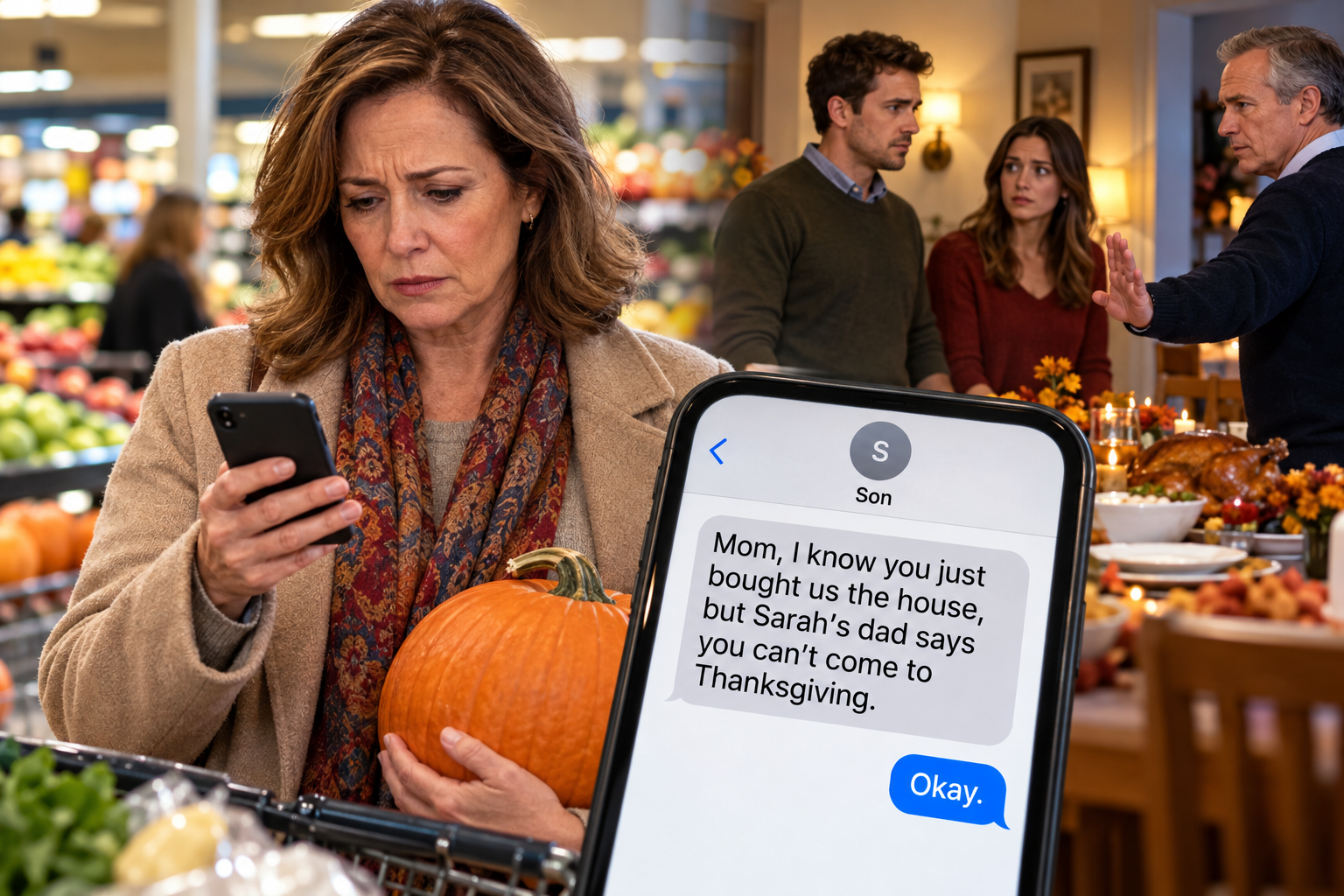
I would pass a display of holiday decorations and remember the pumpkin I had bought before I knew I was unwelcome.
I would think about the house and picture the rooms filled with people.
Then I would remember that I had been told to stay away.
I tried not to turn those thoughts into a story about my entire relationship with my son.
One message could not erase every good thing that had happened between us.
But one message could reveal a problem that I had been avoiding.
I had been so focused on being helpful that I had not paid enough attention to whether the relationship felt mutual.
I had measured my success as a mother by how much I could do for my son.
I had not asked myself often enough whether he considered what his choices meant for me.
The question was uncomfortable.
It was also necessary.
One morning, I opened the refrigerator and checked what I had bought during my earlier shopping trip.
There were still a few things I had purchased with Thanksgiving in mind.
I stood there looking at them, trying to decide what to do.
I could keep the food for myself.
I could cook a smaller meal.
I could make something ordinary and let the holiday pass without trying to recreate the dinner I had imagined.
I did not have to throw everything away simply because the plans had changed.
I took out the vegetables and set them on the counter.
Then I closed the refrigerator.
I would decide what to cook when the time came.
For now, I had more important things to settle.
I still needed to finish understanding the financial arrangement surrounding the house.
I wanted to be sure I had not overlooked any relevant document.
I wanted to know what my contribution meant in practical terms.
And I wanted to make decisions that would protect my own future without acting out of anger.
Those questions had not disappeared simply because the holiday was approaching.
If anything, the approaching date made it more important that I keep my thoughts clear.
I did not want to send my son an angry message the night before Thanksgiving.
I did not want to threaten him with consequences I had not confirmed were available.
I did not want to use the holiday as an excuse to demand an apology.
If we were going to repair our relationship, I wanted the repair to mean something.
I wanted him to understand that excluding me had hurt.
I wanted him to consider why he had accepted someone else's decision without first speaking to me.
And I wanted him to recognize that the money I had contributed did not make me entitled to control his household, but neither did it make me someone he could dismiss without consideration.
I was not asking to run his life.
I was asking to be treated like a person whose feelings mattered.
There was a difference.
I thought about calling him.
I even picked up the phone once and opened his contact.
My thumb hovered over the call button.
Then I put the phone down.
I did not want to call simply because the silence had become uncomfortable.
I wanted to call when I could speak honestly without trying to force a particular response from him.
I was still too hurt to know whether I could do that.
So I waited.
Not for an apology that might never come.
Not for a promise that everything would be different.
I waited until I could separate what I wanted to say from what I hoped he would say back.
That distinction mattered to me.
For years, I had entered difficult conversations with a private wish that the other person would reassure me.
I wanted to hear that I had not been foolish to help.
I wanted to hear that I was appreciated.
I wanted to hear that my place in the family was secure.
Those were understandable wishes.
But if I needed another person's reassurance before I could decide what was right for me, I would always be vulnerable to silence.
I had to learn to make some decisions without waiting for anyone to make me feel better first.
The day before Thanksgiving, I cleaned the kitchen.
I wiped the counters and washed the dishes that had been drying beside the sink.
I checked the pantry and moved a few cans to the front so I could see what I had.
The ordinary work gave my mind something simple to follow.
I did not need to plan a feast.
I did not need to prepare a meal that would impress anyone.
I could make enough food for myself and enjoy a quiet day.
That thought felt strange.
For so long, I had treated a holiday spent alone as evidence that something had gone wrong.
I had imagined that if my family was not gathered around a table, I had somehow failed to keep us together.
Now I was beginning to understand that a gathering was not the same thing as a healthy relationship.
People could sit around a beautiful table and still treat one another carelessly.
People could spend a holiday apart and still love each other.
The important question was not how the day looked.
It was how we treated each other before, during, and after it.
I went to the window and looked at the pumpkin.
It had become part of the room now.
I had set it on the small table beside a folded cloth.
There was nothing special about the arrangement.
It was simple and a little uneven.
I liked it anyway.
I thought about how I had carried the pumpkin through the grocery store while reading my son's message.
I remembered the way I had stood still among the other shoppers, feeling as though everyone else knew something about my life that I had not understood.
I had been embarrassed.
I had felt foolish.
But I no longer wanted to punish myself for having trusted my son.
Trust was not the mistake.
The mistake would be refusing to learn anything after that trust had been shaken.
I had helped him because I loved him.
That was still true.
I did not need to rewrite my own intentions to make sense of his behavior.
I also did not need to keep giving simply because I had given before.
The money was part of the past.
My choices were still part of the present.
I could not undo the purchase with a feeling.
I could not make my son invite me by proving how much I had sacrificed.
I could not make Sarah's father respect me by arguing about the amount I had contributed.
But I could stop acting as if I needed to earn basic consideration.
That was something I could do immediately.
I made a list of the things I needed for my own Thanksgiving meal.
It was a short list.
I crossed off the items I already had.
Then I folded the paper and placed it beside my purse.
The next morning, I would cook for myself.
I would not pretend that the situation had not hurt me.
I would not spend the day imagining every conversation taking place without me.
And I would not send another message just to remind my son that I existed.
If he wanted to talk, he could reach out.
If he wanted to understand what had happened between us, I would be willing to have that conversation when I was ready.
But I would no longer chase an invitation.
I had spent too much of my life trying to make sure everyone else had what they needed.
For once, I wanted to enter a holiday without feeling that my worth depended on what I could provide.
That evening, I set the kitchen table for one.
I placed a plate near the center and folded a napkin beside it.
I did not make the arrangement sadder than it was.
It was simply a table prepared for a person who needed to eat.
I turned off the kitchen light and walked toward my bedroom.
My phone was on the dresser.
I glanced at it but did not pick it up.
There was still no word from my son.
The silence hurt.
I would not pretend otherwise.
But I was no longer willing to fill that silence with another offer of money, another favor, or another explanation of why I deserved to be included.
I had already helped him build a home.
Now I needed to make sure I had not given away my ability to stand on my own.
Thanksgiving would come whether I was invited or not.
And when it arrived, I would face the day as myself, not as someone waiting for permission to matter.
Click here to continue reading: PART 9: I Made Thanksgiving Dinner for One, and for the First Time I Stopped Pretending That Being Needed Was the Same as Being Loved
The Message That Made Me Rethink Every Dollar I Had Spent Trying to Make My Son Happy
Part 8 of 20