
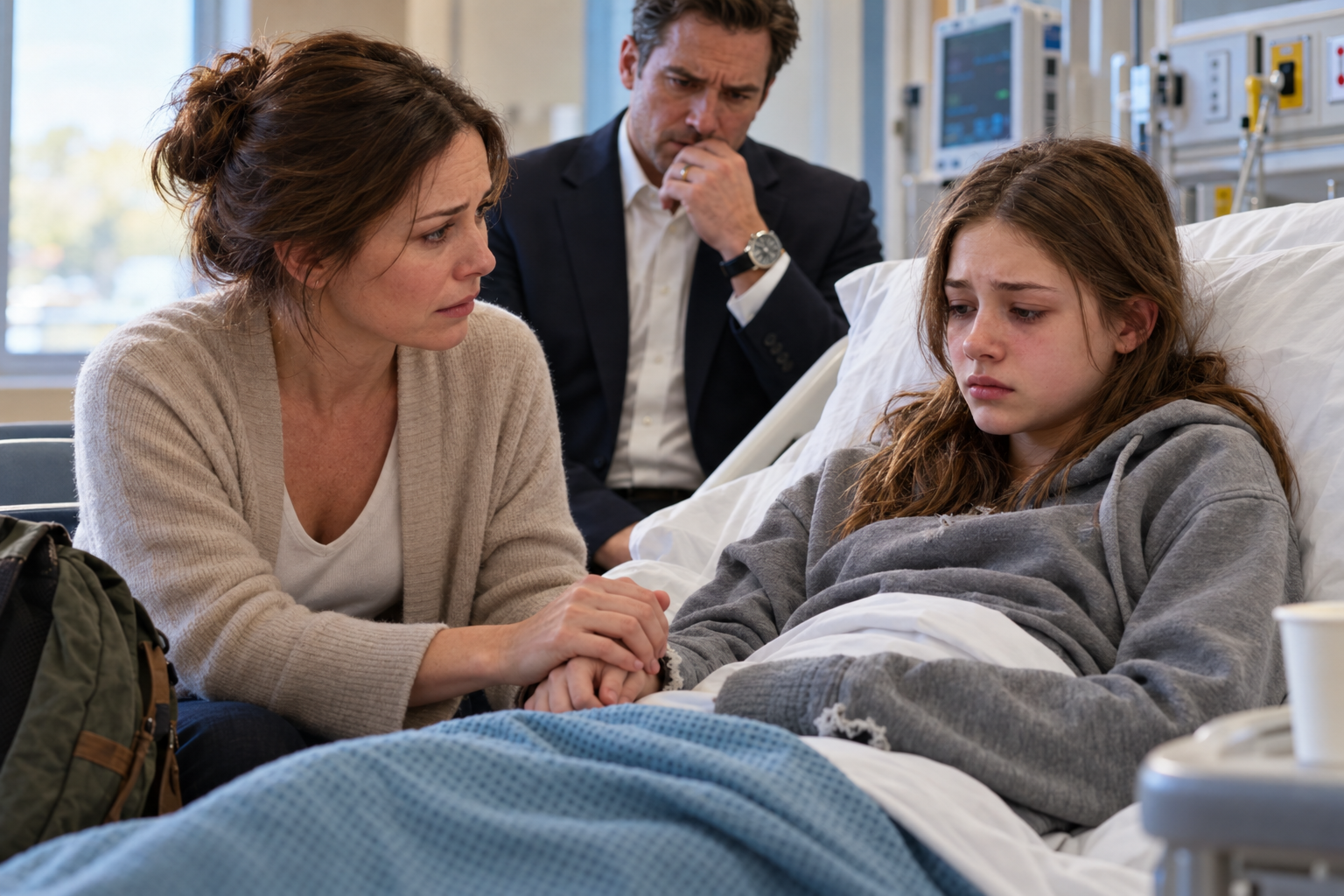
I stayed beside Grace while the hospital staff continued checking her file.
Every few minutes, I looked toward the desk.
I wanted someone to come back with an answer, but I was afraid of what that answer might be.
Grace shifted in her chair.
"Mom, can I have some water?"
I reached for the bottle in my purse and handed it to her.
She took a small sip, then held the bottle between both hands.
I watched her carefully.
"Does drinking make your stomach hurt?"
"Not really."
"All right. Don't force yourself."
She nodded and rested her head against the wall.
I hated seeing her so tired.
I hated even more that I couldn't tell her exactly what was happening.
A staff member approached and asked me to come back to the desk.
I squeezed Grace's shoulder before standing.
"I'll be right here."
She caught my wrist.
"Promise?"
I looked at her fingers wrapped around my arm.
"Promise."
Then I followed the staff member.
She explained that the information in Grace's file needed further review because the authorization for her care had been canceled.
I asked whether the hospital could still examine my daughter.
She said they were working to clarify the administrative issue and determine the appropriate next steps.
I took a breath.
"I need you to understand something. She has been in pain for days. I didn't bring her here over a disagreement with her father."
The woman nodded.
"I understand that you're concerned about her health."
"I'm more than concerned."
My voice shook.
I lowered it before I continued.
"I'm frightened that I've waited too long."
The staff member looked at me for a moment.
She didn't offer empty reassurance.
Instead, she explained that I should tell the clinical team about any changes in Grace's symptoms while they continued reviewing the record.
That was something I could do.
I returned to my daughter and told her what I knew.
The details were limited.
The authorization had been canceled, and the hospital was checking what that meant for her care.
Grace stared at the floor.
Then she asked, "Did Dad do that?"
I sat beside her.
"The record has his information connected to the change."
She swallowed.
"Why?"
I didn't have an answer.
I wanted to tell her that there must be a mistake.
I wanted to protect her from the possibility that her father had made a decision that could interfere with her receiving medical attention.
But I had already spent too much time using explanations I couldn't prove.
"I don't know why," I said.
She nodded slowly.
Then she turned her face away.
I could tell she was trying not to cry.
I put my arm around her.
For several minutes, we sat without speaking.
Eventually, she leaned closer.
"Are you mad at me?"
I pulled back enough to look at her.
"No."
"You looked mad when you talked to the lady."
"I'm not mad at you, sweetheart."
She rubbed her sleeve across her cheek.
"I thought maybe I did something."
I felt my throat tighten.
"You didn't do anything wrong."
She looked at me, searching my face.
I wished I could reach back through every morning, every dinner, every time I had asked her to be patient, and replace my old answers with better ones.
I wished I could give her a childhood in which telling her mother about pain did not require courage.
All I could do was hold her hand and tell her the truth.
"This isn't your fault."
A little later, another staff member came to speak with us.
She asked Grace a few questions about her symptoms and how long she had been experiencing them.
Grace answered quietly.
When she struggled to explain the pain, I helped clarify what I had observed at home.
I mentioned the meals she had been unable to finish.
I described how she had been holding her lower abdomen.
I told them that she had become increasingly reluctant to talk about the pain.
Nobody accused her of exaggerating.
Nobody suggested that she was trying to avoid school or dinner.
They simply listened.
I found myself wishing that I had demanded this kind of attention at home.
When the staff member finished, she explained that the clinical team would need to assess Grace and that the administrative question was being reviewed separately.
I asked whether the cancellation meant that all care had to stop.
She told me she couldn't make that determination herself, but she would continue checking with the appropriate people.
I thanked her.
Then I returned to Grace.
She had taken off her backpack and placed it on the floor beside her feet.
The worn canvas looked ordinary beneath the bright lights.
I remembered seeing her carry it down the stairs that morning, her hand pressed against her stomach, and thinking that perhaps she simply needed more sleep.
I had mistaken the familiar for the harmless.
That was becoming a pattern I could no longer ignore.
My phone vibrated.
Daniel's name appeared on the screen.
For several seconds, I only looked at it.
Then I answered.
"Where are you?"
His voice sounded impatient.
"At the hospital with Grace."
"I know that. Why are you still there?"
I looked at my daughter.
"Because she needs to be checked."
There was a pause.
"What exactly have you told them?"
I felt my stomach tighten.
"They know she's been in pain."
"Rebecca, I already told you that this was unnecessary."
I closed my eyes briefly.
"I brought her here because she couldn't eat dinner without hurting."
"That doesn't mean you should turn it into a hospital visit."
I lowered my voice.
"Daniel, the hospital has found a problem with her care authorization."
He said nothing for a moment.
Then his voice changed.
"What problem?"
"They told me it had been canceled, and your information is connected to the change."
The silence that followed felt different from his usual pauses.
It was longer.
When he finally spoke, he sounded controlled again.
"You're misunderstanding something."
"Then explain it to me."
"I can't explain anything when you're standing there making accusations."
"I'm asking you a question."
"And I'm telling you that you don't have the full information."
I looked toward the desk.
The staff were still working.
"Then give me the information."
He exhaled sharply.
"Bring her home, Rebecca. We'll sort this out tomorrow."
I stared at the floor.
I had heard those words in different forms for years.
Later.
Tomorrow.
Not now.
They were ways of making a problem smaller by refusing to deal with it while it was happening.
"She's not coming home until I know what she needs."
His voice hardened.
"You are making a serious mistake."
I felt the old fear rise in me.
It was familiar enough that I almost apologized automatically.
Almost.
"Then I'll take responsibility for it."
I ended the call.
My hand trembled as I lowered the phone.
Grace was watching me.
I sat beside her again.
"What did Dad say?"
"He wants us to come home."
She looked down.
"Are we going to?"
"No."
The answer surprised both of us.
I could see it in her face.
For years, I had been the person who tried to keep Daniel satisfied, who explained his decisions to Grace, and who asked her to be patient when his words hurt her.
Now I was telling her that we would stay.
It was a small decision.
It was also the first one that evening that felt entirely mine.
Grace leaned against me.
I put my arm around her and looked at the hospital doors.
I still didn't know why Daniel had canceled the authorization.
I didn't know whether he would explain himself honestly.
But I knew I would not allow another conversation with him to decide whether my daughter deserved to be examined.
The phone stayed in my hand.
I didn't call him back.
Click here to continue reading: PART 6: Daniel Wanted Me to Stop Asking Questions, but the More I Learned About Grace’s Care, the Less I Could Pretend Nothing Had Changed
I Thought My Daughter Was Refusing Breakfast Until I Noticed What She Was Trying So Hard Not to Say
Part 5 of 20

One Comment on “PART 5 – I Had Trusted My Husband With Every Important Decision, Until a Stranger at the Hospital Made Me Question What That Trust Had Cost My Daughter”