The hospital staff continued reviewing Grace's information while I tried to remember when everything had changed.
I kept returning to the same question.
How had I not known?
Daniel had always handled the paperwork.
He liked lists, folders, and dates written neatly in a calendar. He kept copies of things I usually threw away and saved receipts long after I had forgotten what they were for.
When we first married, I had admired that about him.
I thought he was responsible.
I thought I was lucky to have someone who paid attention to details.
Over time, I stopped checking his work because I assumed there was no reason to.
If a form needed signing, he brought it to me.
If a payment needed to be made, he told me it was taken care of.
If a letter arrived that looked important, he read it first and explained what it meant.
I had let those habits become the way our household worked.
I couldn't remember when I had last asked to see the full paperwork for Grace's care.
That realization made me feel foolish.
It also made me angry.
I had not been careless because I didn't love my daughter.
I had been careless because I had trusted my husband to take care of things I believed he understood better than I did.
But I was still her mother.
I should have known what arrangements were in place for her medical care.
I should have asked questions.
I should not have needed a hospital staff member to tell me that something had changed.
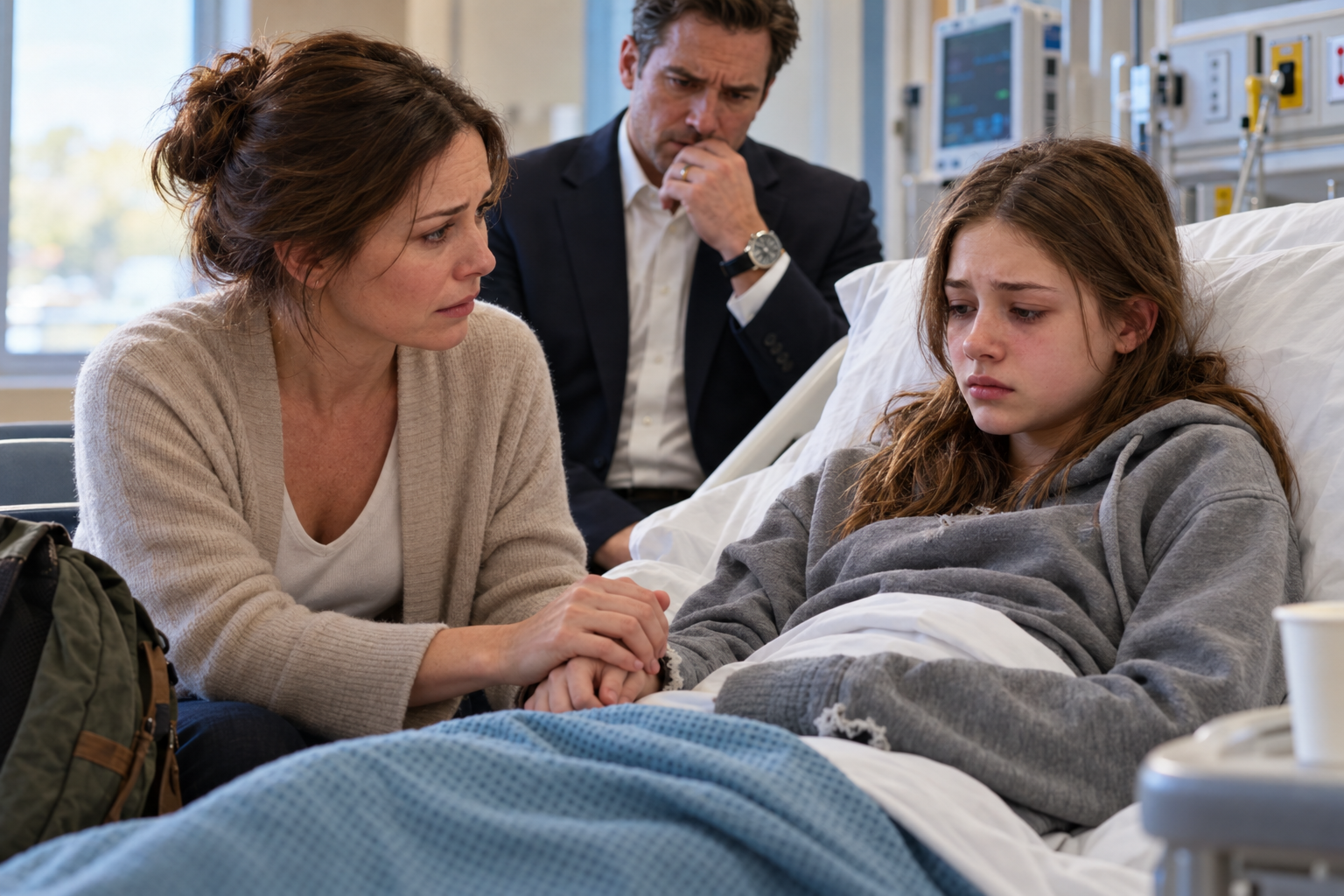
Grace was resting her head against my shoulder when I looked down at her.
Her eyes were closed, but I wasn't sure she was asleep.
"Are you comfortable?"
She opened her eyes.
"A little."
I adjusted the strap of her backpack so it wouldn't press against her leg.
"Do you need anything?"
She shook her head.
Then, after a pause, she asked, "Are you going to talk to Dad when we get home?"
I took a breath.
"Yes."
She looked away.
"Please don't fight."
The words hurt because I understood what she was asking.
She wasn't asking me to protect Daniel's feelings.
She was asking me to protect herself from the tension that followed whenever he and I disagreed.
"I'll try to keep things calm," I said.
She nodded.
I wished I could promise that there would be no argument.
But I couldn't promise that I would stay quiet, and I wasn't going to pretend otherwise.
"I am going to ask him what happened," I added. "You don't have to be part of that conversation."
Grace rubbed her thumb against the edge of her sleeve.
"Okay."
I leaned over and kissed her forehead.
Then I looked toward the desk again.
I wanted the staff to come back with an answer.
I also wanted more time to prepare myself for it.
Both feelings existed together.
That was something I was beginning to understand about fear. It didn't always make you run. Sometimes it made you sit still and hope that the truth would arrive slowly enough for you to handle it.
Eventually, a staff member approached and asked me to confirm some additional details.
I answered as best I could.
She explained that they were continuing to review the cancellation and the information associated with it.
I asked whether they had been able to establish exactly what had happened.
She said they were still checking.
I told her I understood, though I was becoming impatient.
I didn't blame her for the delay.
She hadn't created the problem.
Still, every unanswered question felt like another minute in which I couldn't be certain what would happen next.
I asked whether I could obtain a copy of the relevant records once the review was complete.
She explained what information they could provide and what would need to be handled through the appropriate process.
I listened carefully and made another note on my phone.
I wanted a record of what I had been told.
Not because I wanted to accuse anyone.
Because I no longer wanted to depend on my memory of a conversation that might later be disputed.
That thought frightened me.
I had never imagined that I would need to keep careful notes about something involving my husband and daughter.
But there I was.
Grace opened her eyes again.
"Mom, are you writing about me?"
I put the phone down.
"Just making notes so I remember what the hospital tells me."
She considered that.
Then she asked, "Can I see?"
I turned the screen toward her.
She read the short lines slowly.
When she reached the words about the canceled authorization, she stopped.
"Is that what Dad did?"
"That's what the hospital is checking."
She handed the phone back.
I could see the disappointment in her face.
She had already spent days feeling that her pain wasn't being taken seriously.
Now she had to sit in a hospital while adults tried to understand why her care authorization had been canceled.
I wanted to tell her that none of this was supposed to happen.
Instead, I said, "I'm sorry."
She looked at me.
"For what?"
"For not taking your pain seriously enough at the beginning."
She was quiet.
Then she moved closer and rested her head against my arm.
I didn't ask her to forgive me.
I didn't tell her that I had done my best.
Those things might have made me feel better, but they wouldn't have changed what she had experienced.
I had been wrong.
I needed to be able to say that without making excuses.
A little later, my phone rang again.
Daniel.
I answered.
"Have they told you anything else?" he asked.
"Not yet."
"Then why are you still there?"
I looked at Grace.
"Because she's still here."
He sighed.
"You could have waited until morning."
I felt the anger rise again.
"Would you have wanted her to wait if you knew how much pain she was in?"
He didn't answer.
I waited for him to say something about her health.
Instead, he asked whether I had spoken to the staff about the paperwork.
"Yes."
"And what did you tell them?"
"The truth."
His voice sharpened.
"Which is?"
"That Grace is in pain and that I don't understand why her authorization was canceled."
He exhaled.
"You keep using that word as if you know what it means."
"Then explain it to me."
He told me again that he would discuss it at home.
I asked him whether he had canceled the authorization.
He said that I was refusing to listen.
I told him that I had been listening all evening, but he had not answered the question.
The silence that followed was long enough for me to hear someone speaking at the nearby desk.
Then Daniel said, "I am not having this conversation over the phone."
I looked at the clock.
"Fine. But I'm not leaving until I know what the hospital can do for Grace."
He ended the call.
I lowered my phone.
For several seconds, I felt the old urge to call him back and smooth things over.
I wanted to tell him I hadn't meant to upset him.
I wanted to promise that we could talk calmly when I returned.
I wanted to restore the familiar order of things.
Then Grace shifted beside me and winced.
I turned toward her immediately.
"Is it worse?"
She shook her head, though her face remained tense.
I called for a staff member and explained that she was still uncomfortable.
They came to check on her.
I stayed close while they spoke with her and assessed what needed attention.
As I watched them, the urge to call Daniel faded.
There was something more important in front of me.
My daughter needed help.
I could deal with my husband's anger later.
That evening, I stopped treating those two things as if they were equally urgent.
Click here to continue reading: PART 8: I Could No Longer Blame Confusion for What Had Happened, Because My Daughter Was Sitting Beside Me Waiting for Someone to Explain
I Thought My Daughter Was Refusing Breakfast Until I Noticed What She Was Trying So Hard Not to Say
Part 7 of 20