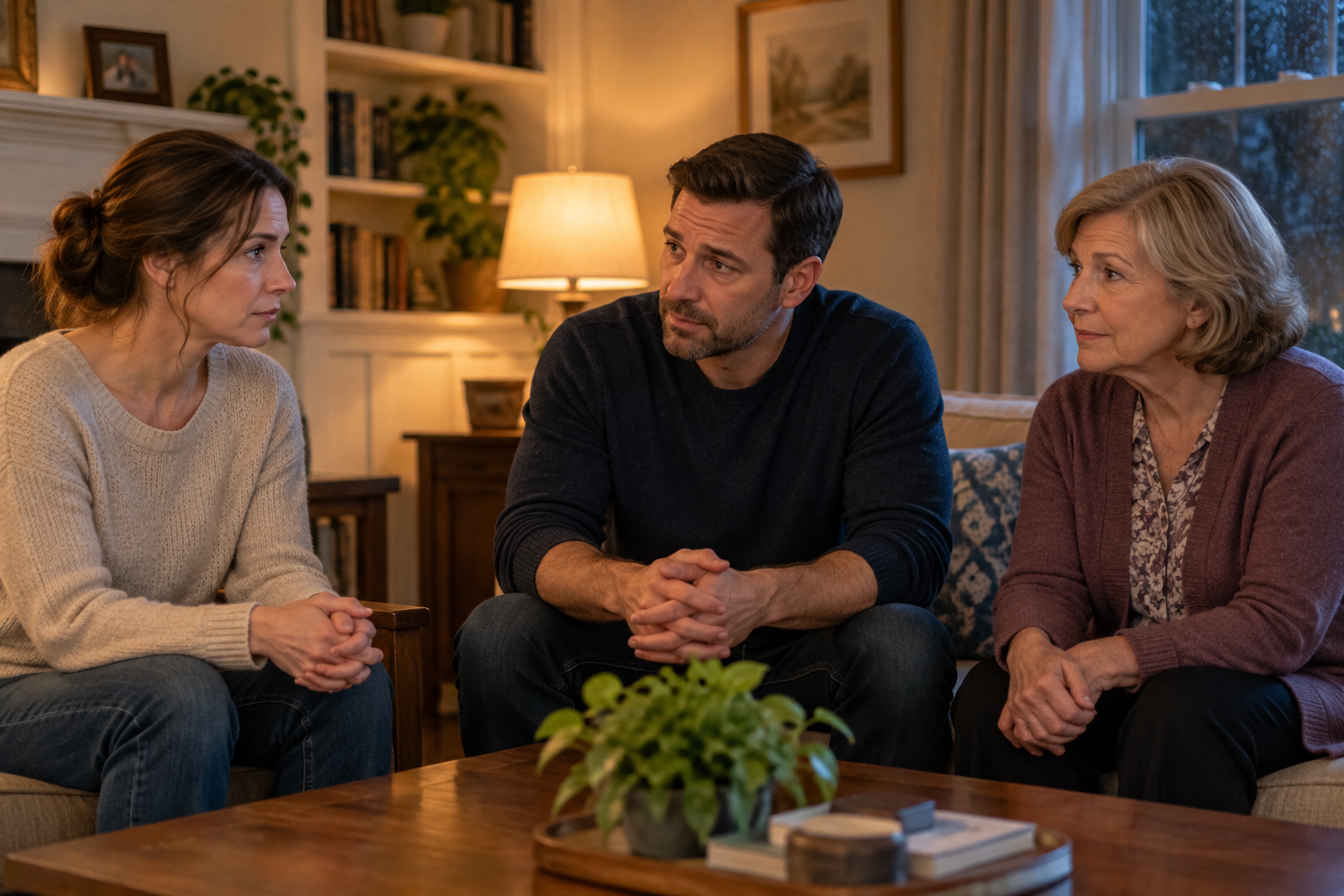
The next few days passed without any real conversation.
Brenda stayed in the blue bedroom.
Her belongings gradually spread into the hallway and the living room.
Gavin continued going about his usual routine.
He left for work.
He returned home.
He spoke to his mother.
And when he spoke to me, he acted as though nothing unusual had happened.
That was the part I found hardest to understand.
He had watched me struggle with the decision he made.
He had heard me explain why I objected.
Yet he behaved as though the disagreement had ended simply because he had stopped discussing it.
I tried to return to my normal routine.
I paid the bills.
I checked the mail.
I kept the kitchen clean.
I made sure the house stayed warm.
Small tasks.
Ordinary tasks.
They gave me something to do while I tried to decide what came next.
Every morning, I walked past the blue bedroom.
Sometimes the door stood open.
Sometimes it was closed.
Either way, I could hear Brenda moving around inside.
A drawer sliding.
A hanger scraping against the closet rod.
The soft thud of something being placed on the floor.
Those sounds should not have mattered.
People moved around their homes.
That was normal.
But I had begun noticing every small change because I no longer felt certain which parts of my own home I could call mine.
One morning, I found the lavender bathrobe hanging beside the bathroom door.
Brenda had left it there after wearing it.
I picked it up.
The belt was twisted.
One sleeve had fallen inside the other.
I straightened it and carried it toward the laundry room.
Then I stopped.
I had no reason to wash it.
It was not dirty.
I simply wanted it back in my bedroom.
I took it upstairs and hung it inside my closet.
When I returned to the hallway, Brenda was standing outside the blue bedroom.
She looked at the empty hook beside the bathroom.
“Have you seen my robe?” she asked.
I stared at her.
“Your robe?”
“The lavender one.”
I held her gaze.
“It belongs to me.”
She looked surprised.
Then her face settled into an expression I had already learned to recognize.
“Oh, I thought Gavin said I could use it.”
“He didn't ask me.”
She pressed her lips together.
“I only borrowed it.”
I wanted to ask why borrowing something required taking it without permission.
Instead, I said, “Please ask next time.”
She turned away.
I stood in the hallway until she went back into the bedroom.
The conversation had lasted less than a minute.
Still, my hands were shaking.
I felt ridiculous.
It was a bathrobe.
A piece of clothing.
But the problem had never been the robe itself.
It was another small decision made without me.
Another assumption that anything I owned could be used because Gavin had said so.
I went downstairs and opened the kitchen window for a moment.
Cold air entered the room.
I stood beside the sink until my breathing returned to normal.
Then I closed the window.
That afternoon, Gavin came home earlier than usual.
He found me at the dining table, reviewing a few household bills.
He placed his keys beside the mail.
“Mom says you took something from her room.”
I looked up.
“I took my bathrobe back.”
“You could have told her.”
“I did.”
He pulled out a chair.
“Why are you making such a big deal about a robe?”
I placed the bill on the table.
“Because I didn't give it to her.”
“She thought you wouldn't mind.”
“Then she should have asked.”
He leaned back.
I could see the familiar irritation settling across his face.
“You're treating her like a stranger.”
“No. I'm asking her to treat me like the person who lives here.”
He looked away.
For a moment, neither of us spoke.
Then he stood.
“I can't believe we're still talking about this.”
I watched him pick up his keys.
“Gavin, we need to talk about the house.”
He stopped beside the doorway.
“What about it?”
“About your mother staying here.”
“We've already discussed that.”
“No, you told me what was going to happen.”
He stared at me.
I had not planned to say it that way.
But once the words were out, I knew they were true.
He had announced his decision.
I had objected.
He had dismissed the objection.
That was not a discussion.
He shook his head.
“You're determined to turn this into something ugly.”
“I don't want it to be ugly.”
“Then stop pushing.”
He left the room.
I remained at the table.
The keys were gone.
The bills were still there.
One of the envelopes had slipped beneath the edge of the chair.
I bent down and picked it up.
It was another routine notice about the house.
I placed it with the others.
I was beginning to see how much of my life had been built around keeping everything running smoothly.
I had become good at solving practical problems.
I could balance a household budget.
I could manage repairs.
I could organize documents and remember payment dates.
But I had never learned what to do when the person creating the problem was the person I had promised to trust.
That evening, I went into my study.
I opened the lower drawer and took out the folder containing the deed.
I laid it on the desk.
Beside it, I placed the tax notice.
I studied both papers for a long time.
The property address appeared on each one.
1420 Maple Avenue.
I had lived there long enough to know the small marks on the doorframes and the places where the wooden floors creaked.
I knew which window rattled during a strong wind.
I knew how long the kitchen took to warm up on winter mornings.
I knew where Aunt Madeline had kept her favorite books.
Those things mattered to me.
The house was not simply an asset or a line on a legal document.
It was the one place in my life where I had expected to feel secure.
And now I was afraid to speak freely in it.
I put the papers back into the folder.
Then I opened the desk drawer again.
I took the deed out a second time.
I wanted to call someone who could explain what my ownership meant when my husband insisted that the house was his.
But I did not make the call.
I sat there with the phone in my hand until the screen went dark.
I was still hoping the situation would correct itself.
That Gavin would notice how unhappy I had become.
That Brenda would realize she had crossed a line.
That one of them would walk into the room and say we should have talked before making such a decision.
No one did.
The next morning, I found Brenda in the kitchen.
She was making coffee.
A small stack of her papers lay beside the toaster.
She looked up when I entered.
“Good morning.”
“Morning.”
She moved a cup across the counter.
“Would you like some?”
“No, thank you.”
I opened the refrigerator and took out a bottle of water.
For a moment, I considered asking her directly whether she intended to stay indefinitely.
But I could already imagine the answer.
She would tell me to speak to Gavin.
Gavin would tell me to stop making things difficult.
And I would be standing in the same place, holding another bottle of water, wondering how a simple question had become an argument.
So I said nothing.
I left the kitchen.
Later that day, I sorted the mail beside the front door.
It had become a habit to do it there.
The small table was convenient.
I could separate the bills from advertisements before carrying everything to the study.
I placed one envelope in the payment pile.
Another went beside it.
Then I found a yellow notice bearing the name of the Oakridge Municipal Court.
I stopped.
For a second, I remembered the first afternoon Brenda arrived.
I remembered holding a similar notice beneath my thumb while Gavin told me he did not need my permission.
The memory was so clear that I could almost hear the deadbolt turning again.
I read the new notice carefully.
Then I placed it beside the other paperwork.
I did not know why that ordinary piece of mail had unsettled me.
It was only a reminder about the property.
I had received notices like it before.
I had paid what was due.
I had kept the records.
There was nothing unusual about the envelope itself.
But I had begun to understand that the house required more than maintenance.
It required me to stop treating my own rights as something I had to apologize for.
I carried the mail into my study.
The folder containing the deed was still in the drawer.
I opened it and placed the new notice inside.
Then I sat down.
For the first time since Brenda arrived, I allowed myself to consider a question I had been avoiding.
What would happen if Gavin never changed his mind?
What if he continued to treat the house as his?
What if Brenda remained upstairs, and every objection I made became another reason for him to accuse me of being unreasonable?
I had no answer.
But I could no longer pretend that waiting would solve everything.
I closed the folder.
Then I returned it to the drawer and turned the key in the small desk lock.
It was a simple action.
It did not change anything in the house.
It did not make Gavin listen.
It did not send Brenda away.
Still, it was the first decision I had made in days that was entirely my own.
Click here to continue reading: PART 4: I Had Spent Years Keeping the House Safe, but My Husband’s Certainty Forced Me to Face What I Had Been Afraid to Say
My Husband Brought His Mother Home Without Asking, and I Realized the House I Owned Might No Longer Feel Like Mine
Part 3 of 20