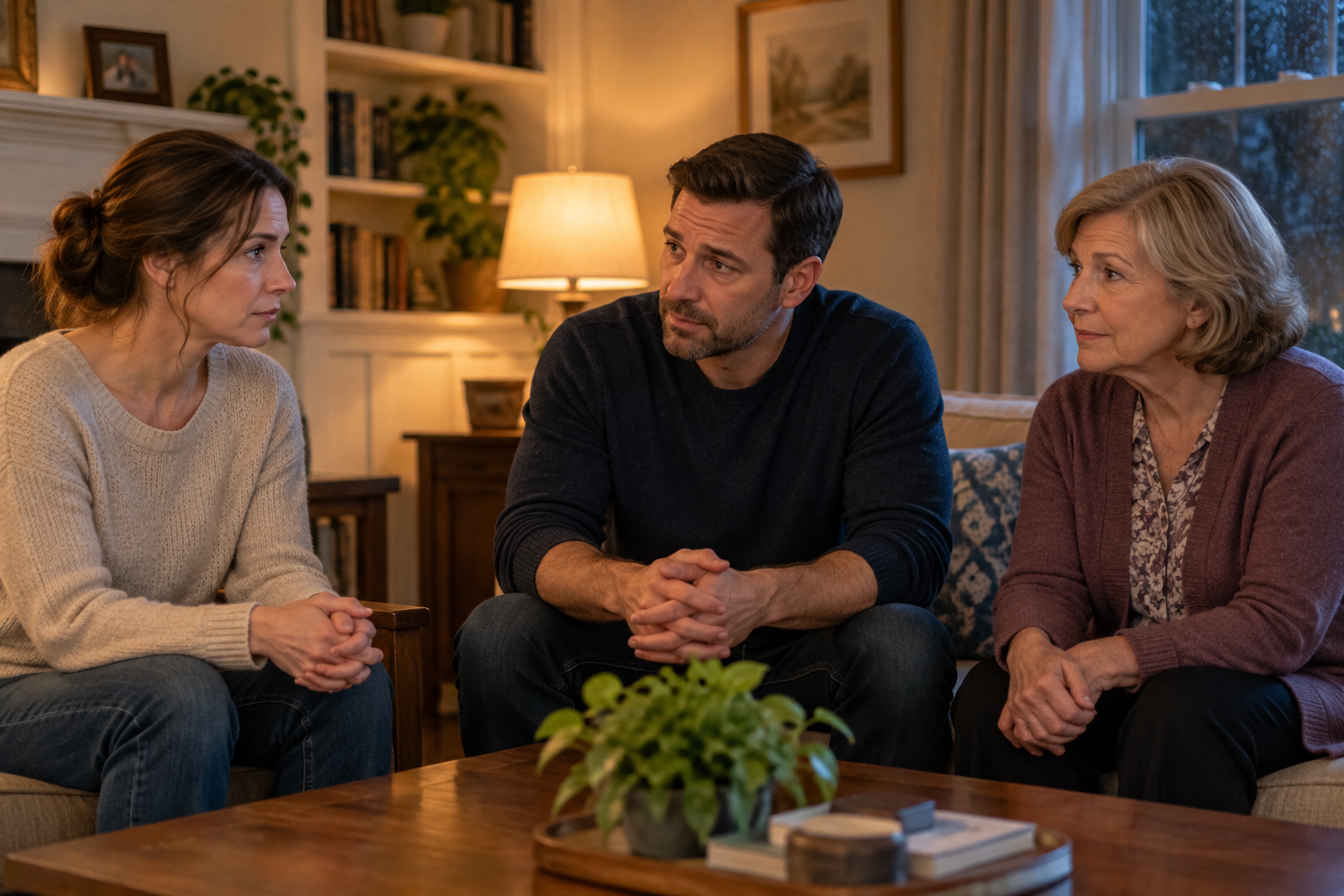
I began paying closer attention to the way Gavin spoke about the house.
Not because I wanted to argue with him.
Because I wanted to understand when he had started believing that my decisions no longer mattered.
At first, I thought it had happened recently.
Perhaps Brenda's arrival had changed something.
Perhaps he felt responsible for his mother and had decided that my objections were an obstacle.
But the more I thought about it, the less certain I became.
There had been smaller moments before.
Times when he volunteered my time without asking.
Times when he promised someone I would take care of something.
Times when he answered a question directed at me before I could open my mouth.
I had let those things pass.
They seemed too small to fight about.
And sometimes they were.
But small things can become habits when nobody questions them.
I had allowed Gavin to become comfortable making decisions on my behalf.
That did not mean he had the right to do it.
It meant I had become accustomed to avoiding the discomfort of saying no.
The distinction mattered.
I thought about it while I prepared breakfast one morning.
Brenda sat at the kitchen table, looking through a magazine.
Gavin stood near the counter, checking the time on his watch.
He adjusted the strap.
Once.
Then again.
I watched him do it.
“Gavin, I want to talk about the house tonight.”
He did not look up.
“About what?”
“About the arrangement with your mother.”
Brenda turned a page.
Gavin sighed.
“We've been through this.”
“We haven't settled anything.”
He looked at me.
“What exactly do you want?”
I had prepared an answer.
I wanted him to admit that he should have spoken to me before bringing Brenda home.
I wanted him to acknowledge that the property belonged to me.
I wanted us to agree on a living arrangement rather than having one imposed on me.
But standing there, with the kitchen clock ticking behind me, I found it difficult to say all of that.
“I want us to make decisions together,” I said.
He looked at Brenda.
Then he looked back at me.
“Fine. We'll talk tonight.”
He said it with such impatience that I almost wished I had never asked.
Still, I held on to the promise.
I spent the day thinking about what I would say.
I did not want to shout.
I did not want to threaten him.
I did not want to turn the disagreement into a contest over who could be more stubborn.
I wanted him to listen.
That seemed like a reasonable thing to want from a husband.
By late afternoon, I had rehearsed the conversation so many times that the words no longer sounded natural.
I decided to stop practicing.
I would speak plainly.
That evening, I waited until Brenda went upstairs.
Gavin was in the living room, sitting in his usual chair.
The television was on, but he was looking at his phone.
I stood near the doorway.
“Can we talk now?”
He set his phone on his knee.
“Go ahead.”
I sat on the opposite end of the sofa.
For a few seconds, I looked at the television.
I needed to remind myself that I was not asking for something unreasonable.
“Your mother moving into the house affects both of us,” I said.
“She needed a place to stay.”
“I understand that.”
“Then what's the problem?”
“The problem is that you made the decision without asking me.”
He rubbed his forehead.
“I knew you'd say that.”
I waited.
He did not continue.
So I did.
“This property was left to me by Aunt Madeline. I've paid the taxes and maintained it for years. I need you to understand that I have a say in who lives here.”
Gavin stared at me.
For a moment, I thought he might finally acknowledge what I had said.
Instead, he leaned forward.
“You keep bringing up the deed as though I'm trying to take something away from you.”
I looked at him.
“Then why do you keep calling it your house?”
“Because I live here.”
“So do I.”
“Exactly.”
He spread his hands.
I could not understand how he believed that settled the question.
Living in a place did not mean you had the right to decide everything about it.
But I could see that explaining this would not help.
He had already turned the conversation into a personal accusation.
“You're making me feel like I don't belong here,” he said.
I looked at him for a long moment.
I had not expected him to say that.
Not because I believed he would never feel unwelcome.
Because he had been the one telling me that my opinion did not matter.
“I haven't asked you to leave,” I said.
“You don't have to.”
He stood up.
“Your attitude makes it clear enough.”
I stayed seated.
My hands were resting in my lap.
I wanted to tell him that he had misunderstood everything.
I wanted to remind him that I had welcomed him into the house because I loved him.
I wanted him to understand that asking to be consulted was not the same as rejecting his mother.
But he had stopped listening.
He walked toward the stairs.
“I'm not having this conversation again.”
I heard him climb the steps.
A door closed upstairs.
I remained on the sofa until the television went to a commercial.
Then I turned it off.
The sudden silence felt heavier than the noise had.
I went into the kitchen and stood beside the counter.
A cup sat in the sink.
There were crumbs near the toaster.
The yellow tax notice was in the study, inside the locked drawer.
Everything was ordinary.
Everything was familiar.
And I had never felt less at home.
I went into my study.
The desk lamp cast a small circle of light across the wooden surface.
I unlocked the drawer and removed the folder.
I placed the deed on the desk.
Then I sat down and read it again.
My name was still there.
The address was still there.
Nothing about the document had changed.
I had been looking at it as though it could give me confidence.
But paper could not make me use my voice.
I folded the deed and placed it back in the folder.
Then I took out the yellow tax notice.
I read the figures.
I checked the date.
I put it away.
The task gave me a few minutes of calm.
Afterward, I sat still and listened to the house.
I could hear movement upstairs.
Brenda was walking between the bedroom and the bathroom.
A drawer opened.
Then closed.
Gavin's voice followed.
I could not make out the words.
I did not try.
Instead, I looked around the study.
The shelves held books I had collected over the years.
The desk had a small scratch near the front edge.
The window faced the driveway.
I remembered the first time I had come to the house after Aunt Madeline's death.
I had walked through every room slowly.
I had opened the closets.
I had checked the windows.
I had stood in the kitchen and imagined the life I might build there.
The house had seemed like a gift.
A place where I could grow older without worrying about rent or a mortgage.
A place where I could make my own choices.
I had not imagined that I would someday feel like a guest in it.
That thought hurt more than I expected.
I closed the drawer.
Then I turned off the desk lamp and went upstairs.
The blue bedroom door was open.
Brenda stood inside, arranging a few items on the dresser.
She looked toward me.
“Is something wrong?”
I almost laughed.
Not because the question was funny.
Because I could not think of a simple answer that would explain the last several days.
“I'm tired,” I said.
She nodded and returned to what she was doing.
I continued down the hallway.
When I reached my own bedroom, I closed the door.
I sat on the edge of the bed.
The lavender bathrobe hung inside the closet where I had put it.
I took it down and held it for a moment.
It was soft.
Familiar.
Ordinary.
I folded it and placed it on the chair beside the bed.
Then I looked at the clock.
I knew I would have to make a decision soon.
Not about the bathrobe.
Not even about the blue bedroom.
About whether I would keep waiting for Gavin to treat me as an equal partner in my own life.
I had been telling myself that patience was a virtue.
That marriage required compromise.
That families had to make room for one another.
All of those things could be true.
But none of them meant I had to surrender every boundary simply to keep the peace.
I lay down without changing the position of the folded robe.
Sleep did not come quickly.
I kept thinking about the front door.
The sound of the lock.
The moment Gavin had stepped aside to let his mother enter.
The way he had looked at me when I objected.
And the words he had used.
My house.
I had allowed those words to make me doubt something I had known for eight years.
I could not keep doing that.
The next morning, I went downstairs before either of them.
The house was quiet.
I made coffee and stood by the kitchen window.
The driveway was empty.
The pale morning light fell across the counter.
For a few minutes, I let myself imagine what it would feel like to make a decision without first considering how Gavin might react.
It was an unfamiliar thought.
But it was mine.
I set the coffee cup down.
Then I walked into the study and opened the desk drawer.
The folder lay inside.
I took it out and placed it on the desk.
This time, I did not open it.
I simply looked at it.
I had spent years protecting the house from damage, neglect, and debt.
Now I had to admit that I had been avoiding the one thing I could not repair with money or routine.
My marriage had reached a point where I was afraid to say what I needed.
I could no longer pretend that this was only a disagreement about a bedroom.
It was about respect.
It was about the choices I was allowed to make.
And it was about whether I could continue living with someone who treated my silence as agreement.
I closed the desk drawer.
Then I returned to the kitchen and finished my coffee.
I still did not know what I would do next.
But I knew what I could no longer do.
I could no longer wait for Gavin to give me permission to stand up for myself.
Click here to continue reading: PART 5: I Stopped Waiting for My Husband to Understand Why the House Mattered, and Began Facing the Questions I Had Avoided for Years
My Husband Brought His Mother Home Without Asking, and I Realized the House I Owned Might No Longer Feel Like Mine
Part 4 of 20