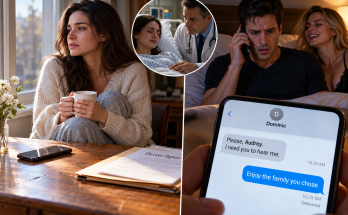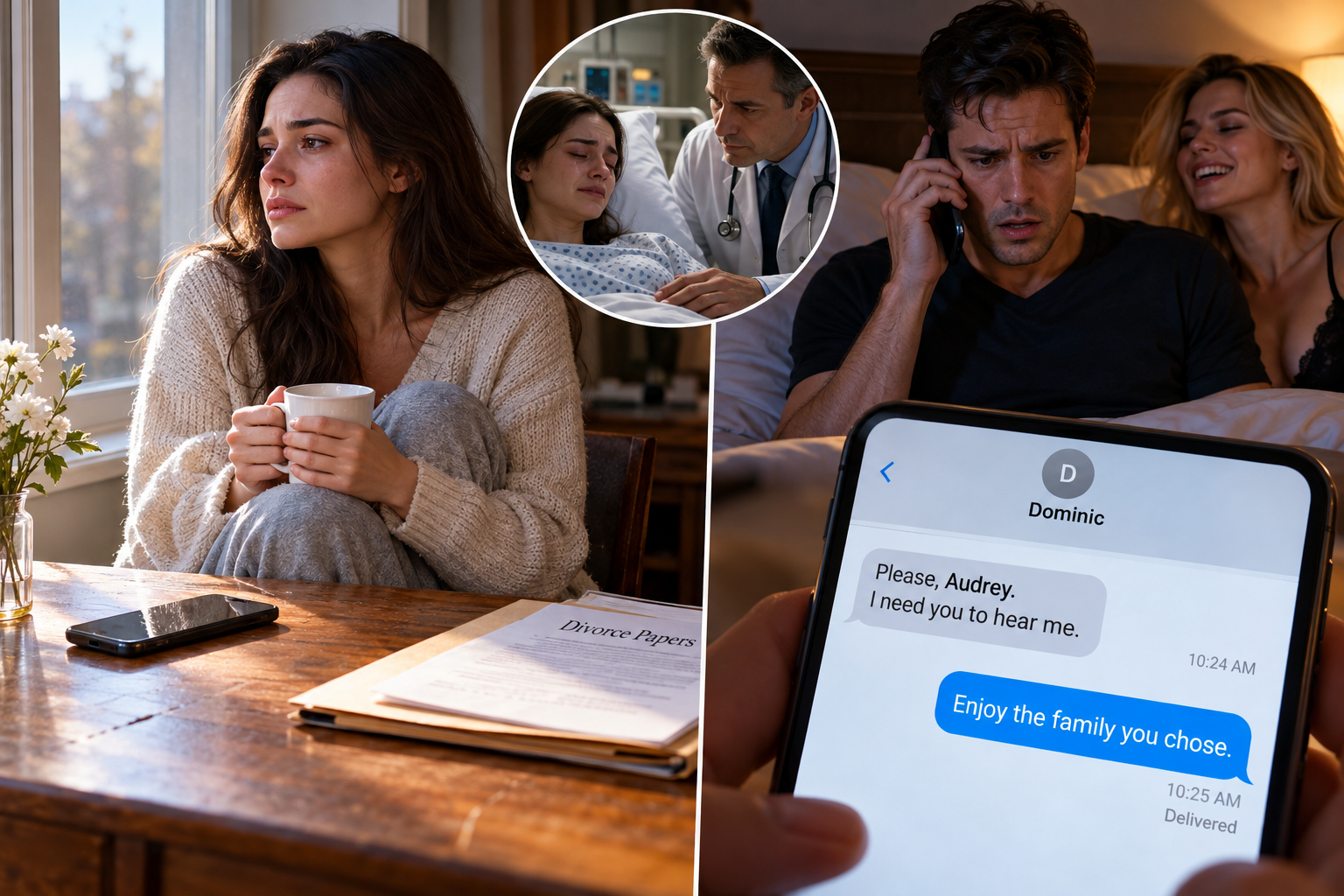
The next morning, I asked for a mirror.
The nurse looked at me as though she wasn't sure that was a good idea.
"Are you certain you want one right now?"
"Yes, please."
She brought me a small hand mirror and placed it on the table.
I held it with both hands.
The woman looking back at me seemed older than she had a few days earlier.
There was a dressing above my eyebrow, and bruising had begun to spread around it. My skin looked pale, and my eyes were swollen from crying.
I studied my reflection for a long time.
Then I put the mirror down.
I wasn't worried about how I looked.
I was wondering how a person could spend years trying to keep a marriage alive without realizing that she was the only one holding on.
Dr. Reed came to see me later that morning.
He asked about my pain and checked the injury to my head.
I answered his questions.
Then he pulled up a chair.
"Have you been able to rest?"
"A little."
"Have you spoken with your husband?"
I shook my head.
He didn't push me to explain.
Instead, he told me what I needed to know about recovering from the fall and what symptoms I should report if they appeared.
I listened carefully.
When he finished, I asked him whether I could have the flowers removed.
He glanced toward the vase.
"Of course."
A nurse carried them away a few minutes later.
The card remained on the table.
I had thought about throwing it out, but I couldn't bring myself to do it.
Not because I wanted to keep anything Victoria had given me.
I wanted to remember how easily she had dismissed what happened.
For years, I had made excuses for her.
She was protective of Dominic.
She had been through difficult things.
She had a strong personality.
I could find a reason for almost anything she did, provided the alternative meant admitting that she had treated me badly on purpose.
That morning, I ran out of reasons.
I asked the nurse whether the hospital had a telephone I could use.
She brought me one.
I called Dominic.
It rang several times.
Then he answered.
"What is it, Audrey?"
I closed my eyes.
Not hello.
Not are you all right?
Not where have you been?
Just a question that made it sound as though I had interrupted something important.
"I'm in the hospital."
There was a pause.
"I know."
I gripped the telephone.
"You know?"
"Mother told me you fell."
He sounded irritated.
I waited for him to ask what the doctors had said.
He didn't.
Instead, he asked whether I had told anyone about the argument.
I stared at the wall.
"What argument?"
"The argument with Mother."
I couldn't believe what I was hearing.
I had fallen down an entire staircase, struck my head, and lost my pregnancy.
Yet Dominic's first concern was whether his mother might be blamed.
"I didn't call to discuss an argument."
"Then why are you calling?"
I pressed my lips together.
I wanted to tell him everything.
I wanted to say that I had been pregnant, that our child was gone, and that I had spent the night hoping he would appear at my bedside.
I wanted to ask how he could lie beside another woman while his wife was in the hospital.
But I couldn't make myself say any of it.
The words felt too precious to give to someone who had already shown me how little he cared.
"I wanted to know whether you were coming."
He exhaled sharply.
"Audrey, I'm busy."
I heard a faint sound in the background.
A woman's voice.
Then laughter.
I knew it was the same woman I had heard in our bedroom.
My hand tightened around the phone.
"Are you with her?"
Dominic didn't answer immediately.
That silence told me more than a denial would have.
"Don't start this again," he said.
I looked down at the blanket covering my legs.
"I'm in the hospital, Dominic."
"And I'm telling you that I'll deal with it when I can."
When I could.
I had spent years waiting for him to have time for me.
Time to listen.
Time to defend me.
Time to make me feel like his wife rather than an obligation he had inherited.
I was tired of waiting.
"All right," I said.
He seemed surprised by how quickly I agreed.
"I'll call you later."
He ended the call before I could answer.
I held the telephone against my ear for a few seconds after the line went silent.
Then I returned it to the nurse.
I didn't ask him to call again.
I didn't send a message demanding an explanation.
I didn't tell him about the baby.
I told myself it was because I was too tired.
That was only partly true.
The rest was that I no longer wanted to give him another opportunity to hurt me.
That afternoon, Dr. Reed returned with the paperwork I needed to review.
He explained my treatment and the instructions I would need to follow after leaving the hospital.
I signed where he indicated.
My hand moved slowly across the page.
I had never thought much about signatures before.
They were marks people made when they agreed to something, confirmed something, or accepted responsibility for something.
My signature had helped establish my marriage.
Now it was recording the beginning of a life I hadn't planned.
I wondered what my father would have told me if he had been there.
I wondered whether he would have recognized how much of myself I had given away.
Mostly, I wondered why I had believed that enduring pain was proof of love.
The following day, a hospital administrator brought me another set of papers.
These concerned my discharge.
I read each page carefully.
I asked questions when something wasn't clear.
It was a small thing, but I wanted to make every decision for myself.
For so long, I had let Dominic speak first and explain things on my behalf.
He had answered questions that were directed at me.
He had made arrangements without asking what I wanted.
He had told his mother details about our private life that I had never agreed to share.
I had accepted all of it because I thought that was what marriage required.
Now I was learning how much I had forgotten about being an individual.
When the administrator left, I asked the nurse whether anyone had called for me.
She checked the information at the desk.
"No one new, Audrey."
I nodded.
I wasn't surprised anymore.
The hospital room became a place where I could hear my own thoughts.
I thought about the house.
The staircase.
The bedroom.
The woman who had been there with Dominic.
I thought about Victoria's card.
Then I thought about the child I had never held.
That was the part I couldn't escape.
I had never heard a heartbeat.
I had never seen a tiny face on a screen.
I hadn't even told the father.
My grief had no photographs, no name, and no memories I could share with anyone else.
It existed only in the future I had imagined.
I cried that evening.
Quietly.
When I finished, I washed my face and drank a glass of water.
Then I sat beside the window until the sky darkened.
I had no idea what would happen next.
I only knew I couldn't return to the marriage as though nothing had changed.
I couldn't walk into that house and pretend the stairs were just stairs.
I couldn't sleep beside Dominic and act as though the woman in our bedroom had never existed.
And I couldn't accept another bouquet from Victoria in place of the truth.
I had spent years trying to become indispensable to people who treated me as replaceable.
I wasn't going to keep doing it.
The next morning, I asked the nurse to help me contact someone who could explain my options for ending the marriage.
She gave me the information I needed.
I wrote it down.
My handwriting was shaky, but every letter was legible.
For the first time in days, I felt something other than pain.
Resolve.
I didn't know how to rebuild my life.
I didn't know where I would live or what I would do about the things I had left at home.
I didn't know whether Dominic would even notice that I was gone until he needed something.
But I had finally stopped waiting for him to choose me.
That was the first decision I made without asking anyone's permission.
Click here to continue reading: PART 3: I Had Once Begged My Husband to Hear Me, but When I Finally Asked for a Divorce, His Silence Became My Answer
I Thought Being a Good Wife Would Protect My Marriage, Until One Fall Destroyed Everything I Had Been Afraid to Lose
Part 2 of 20