I thought the hardest part would be learning about the money.
I was wrong.
The hardest part was accepting that the documents couldn't answer every question I had.
The trust existed.
The amount recorded was enormous.
And for almost two years, I had known nothing about it.
Those facts were clear.
What wasn't clear was why the correspondence had never reached me.
Or what had happened to my allergy pens.
Or why the dessert at my sister's baby shower had caused such a dangerous reaction.
I wanted one explanation that tied everything together.
Something simple enough to say aloud.
One person.
One motive.
One betrayal.
But wanting a complete explanation wasn't the same as having one.
I had spent too much of my life accepting things because they sounded reasonable.
I wasn't going to make the opposite mistake now.
I wasn't going to declare someone guilty because a frightening story fit together in my imagination.
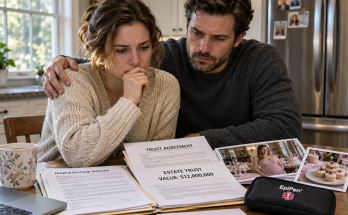
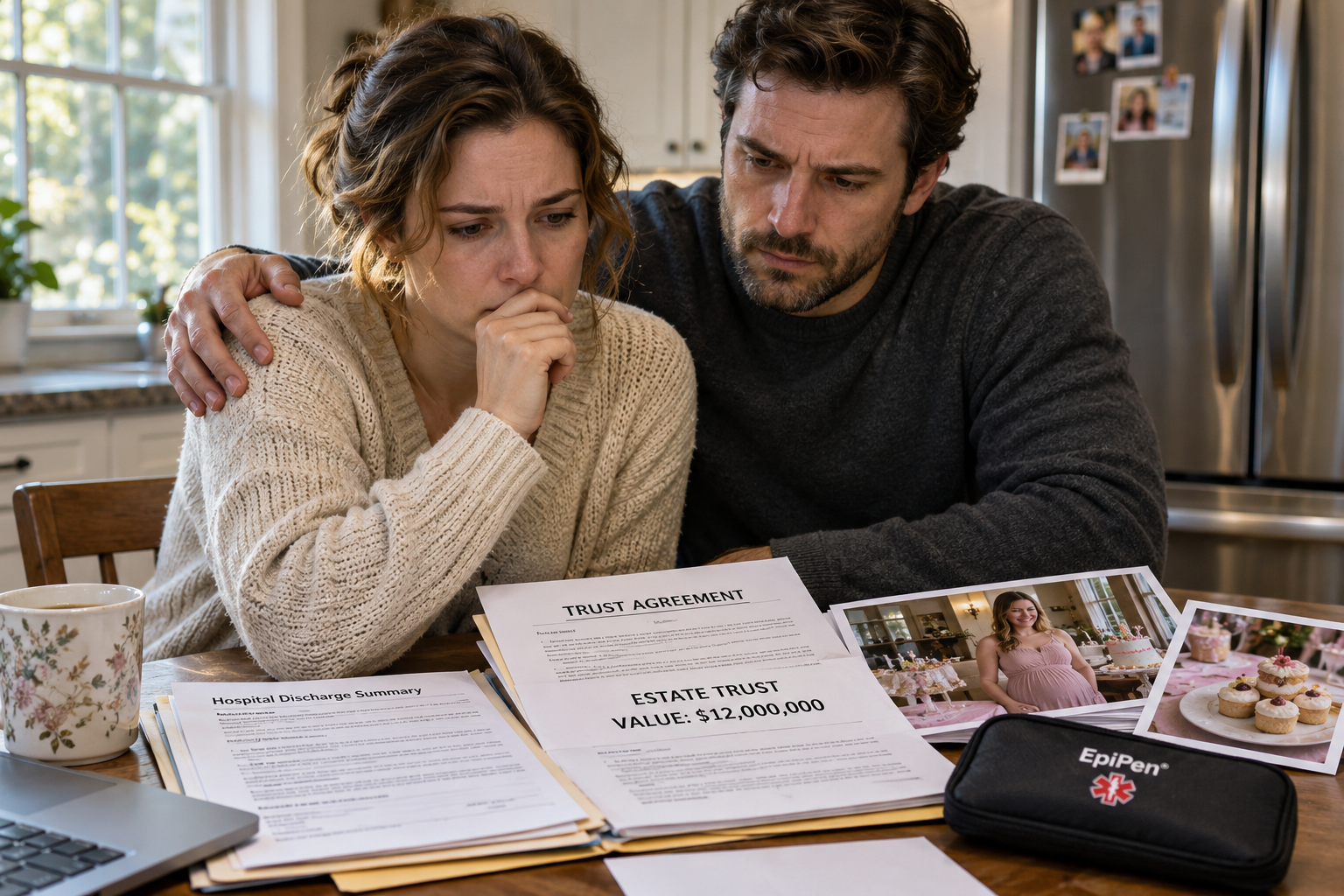
My husband and I returned to the kitchen table.
We took out the folder again.
The lawyer's documents were on one side.
The hospital records on the other.
Between them lay the photographs from the baby shower.
I looked at the papers for a long time.
Then I spoke.
"We need to keep these separate until someone can establish whether they're connected."
My husband nodded.
"I agree."
I could see how much it cost him to say that.
He had watched me nearly die.
He had searched for the emergency pens.
He had been frightened in a way neither of us could easily forget.
But he understood that fear wasn't proof.
We contacted the appropriate authorities about the medical incident and the missing medication.
We gave an account of what happened.
We provided the records we had.
We explained what we remembered.
And we made clear which details we could not verify.
That distinction was important.
I knew my sister had handed me the dessert.
I knew I had asked about the ingredients.
I knew I had been told it was safe.
I knew I suffered a severe allergic reaction after eating it.
But I didn't know who had prepared every ingredient.
I didn't know whether the dessert had been contaminated deliberately.
And I hadn't seen anyone remove the pens from my purse.
Those things needed investigation.
I wasn't going to pretend otherwise.
My husband described checking the medication before we left home.
He described searching for it during the emergency.
He explained that we never found it afterward.
He didn't change his account.
He didn't add details to make it sound more dramatic.
I loved him for that.
The truth was already serious enough.
I didn't want to make it larger by guessing.
We also followed up with the lawyer.
He continued reviewing the trust records and the correspondence.
I asked for copies of the information I was entitled to receive.
I kept a record of our conversations.
Dates.
Questions.
Answers.
Anything that might matter later.
I had learned what happened when I relied entirely on memory and trust.
Sometimes people made mistakes.
Sometimes records were incomplete.
And sometimes a person didn't even know what she needed to ask.
I wanted to be better prepared.
The lawyer explained that the administration of the trust had to follow the governing documents and applicable legal requirements.
I listened.
I asked questions.
Then I went home and read the relevant pages again.
I didn't assume that being named in a trust meant every dollar belonged to me immediately.
I didn't assume that a missing notice proved someone had stolen money.
I wanted the financial records reviewed properly.
I wanted an accounting where one was required.
And I wanted any question about authority or distributions resolved through the appropriate process.
That wasn't as satisfying as imagining someone being exposed in a dramatic confrontation.
But it was real.
And reality mattered more now.
There were moments when I still became angry.
I thought about the time that had passed.
Almost two years.
The meetings I could have attended.
The questions I could have asked.
The information I might have understood sooner.
Then I reminded myself that I couldn't recover the time by rushing into an accusation.
I could only use what I knew now.
My husband helped me organize everything.
We made copies.
We kept the originals safe.
We wrote down what still needed to be confirmed.
He never told me to forget what happened at the shower.
He never told me I had to accuse my sister.
He simply stayed beside me.
That meant more than I could say.
One evening, I took out a photograph of my grandmother.
I looked at it for a long time.
I thought about the trust.
The documents.
The amount of money recorded there.
And the fact that I had nearly missed learning about it.
I wished I could ask her why she had made the arrangements she did.
I wished she could explain what she wanted us to understand.
But she couldn't.
The documents would have to speak for her.
And the people responsible for administering them would have to answer the questions the records raised.
I had spent days thinking about the money.
Twelve million dollars.
I still could barely say the amount without feeling strange.
It was more than I had ever expected to be connected to.
But I began to understand that the value of a trust and the amount a beneficiary might ultimately receive were not necessarily the same thing.
There were terms.
Responsibilities.
Procedures.
And questions about what had already occurred.
I wanted all of those things explained before making plans.
I didn't buy anything.
I didn't start talking about a different life.
I didn't tell myself I was suddenly wealthy.
I waited for the documents to establish my position.
That was something I could control.
The rest would take time.
My sister remained the hardest part.
I couldn't look at the baby shower photographs without remembering the hospital.
I couldn't remember the hospital without thinking about my husband's face.
And I couldn't think about the missing pens without wondering how they had disappeared.
I wanted to speak to my sister.
I also wanted to avoid her.
Both feelings were real.
I knew that accusing her without evidence could cause damage that might never be repaired.
But I also knew that ignoring the incident would leave serious questions unanswered.
I had to accept that those were not my only choices.
The incident could be investigated.
The medical records could be examined.
The available evidence could be reviewed.
And any conclusion would have to rest on what could actually be established.
That mattered.
Not just for me.
For everyone involved.
If someone had deliberately endangered my life, I wanted accountability.
If the reaction had resulted from an accident or misunderstanding, I wanted to know that too.
I didn't want a story that merely confirmed my fears.
I wanted the truth.
The same was true of Grandma's trust.
If correspondence had been mishandled, I wanted the record corrected.
If someone had improperly acted with respect to trust assets, I wanted that addressed.
And if administrative errors explained the missing information, I wanted a complete account of those errors.
I wasn't interested in revenge for something that hadn't been proved.
I was interested in understanding what had happened.
I remembered the first phone call.
My hand trembling.
The lawyer asking about correspondence.
My answer.
No.
Then his question about a certified letter.
Again, no.
I had been frightened by how little I knew.
Now I was frightened by how much remained unresolved.
But there was a difference.
I wasn't helpless anymore.
I knew where to ask questions.
I knew which records mattered.
And I had stopped confusing silence with an explanation.
One afternoon, my husband found me sitting at the kitchen table.
The folder was open.
I was looking at the first page of the trust.
He sat beside me.
"Are you all right?"
I thought about the question.
Then I answered.
"Not completely."
He nodded.
I looked at him.
"But I'm better than I was."
He smiled a little.
"So am I."
I closed the folder.
For a while, neither of us spoke.
Then I told him something I had been thinking about for days.
"I used to believe I had to protect the family by not asking difficult questions."
He waited.
"I don't believe that anymore."
He took my hand.
"You can ask questions without deciding the answers first."
I nodded.
That was exactly what I needed to learn.
I had trusted my sister when she handed me the dessert.
I had trusted that my emergency medication would be where it belonged.
I had trusted that my grandmother's affairs had been handled after her death.
Some of those beliefs had been shaken.
Others still needed answers.
But I didn't regret having trusted people I loved.
What I regretted was believing that love required me to ignore facts that made me uncomfortable.
It didn't.
I could care about my sister and still ask what had happened at her shower.
I could remember my grandmother with love and still insist on understanding her trust.
I could be grateful to my husband without needing him to solve every uncertainty for me.
And I could accept that not every question had an immediate answer.
The trust documents remained in the drawer.
The medical records stayed with them.
The photographs were preserved.
The questions about the certified delivery and the missing allergy pens were still being addressed.
There were things I couldn't yet conclude.
I wasn't going to pretend otherwise.
But I could finally say what I knew.
My grandmother had established a trust.
I had not received the correspondence the lawyer expected me to have.
The records reflected a value of twelve million dollars.
My husband had discovered that my emergency allergy pens were missing during a serious reaction at my sister's baby shower.
And those circumstances deserved careful, independent examination.
No more guesses offered as proof.
No more silence accepted as reassurance.
No more pretending that difficult questions were somehow disloyal.
I put the folder away.
Then I returned to the kitchen table and sat beside my husband.
The small scratch near my coffee mug was still there.
Nothing about that ordinary room had changed.
But I had.
I no longer needed to be the person who agreed with everyone just to keep the peace.
I could ask for records.
I could insist on clear answers.
I could follow the evidence wherever it actually led.
And I could refuse to invent certainty where none existed.
Grandma's twelve million dollars had brought questions into my life that I never expected to face.
The dessert had left me with fear I was still learning to live with.
And the missing pens had shown my husband and me how quickly an ordinary family celebration could become an emergency.
Those things had consequences.
They deserved answers.
But the final outcome of the trust review and the investigation could not be established from the information we possessed.
I had to live with that uncertainty rather than fill it with a convenient ending.
For once, I was willing to do exactly that.
Because I had learned the difference between believing a story and knowing the truth.
And I wasn't going to confuse them again.
The End
Read more original stories on Feel Every Story.
The Lawyer Asked About My Grandmother’s Trust, and I Realized Someone Had Kept Her Final Wishes From Me
Part 8 of 8