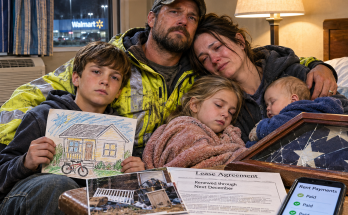
I had always believed that having proof would make people listen.
I was about to find out how slowly proof could work.
The first thing I did was get Ginny and the children somewhere warm.
I couldn't bear another night in that minivan.
Not after seeing Della shivering beneath a blanket.
Not after holding Moe in his snowsuit.
Not after watching Hayden try to act older than nine.
We found a motel with a room available.
Nothing fancy.
Two beds.
A small bathroom.
A heater that made a rattling noise whenever it started.
I had never been so grateful for an ordinary room.
Ginny carried Moe inside.
Della went straight to the bed nearest the heater.
Hayden stood by the door, looking around.
"Are we staying here?"
"For now," I told him.
He nodded.
Then he asked the question I had been expecting.
"Are we going back to our house?"
I set our bags down.
"I'm working on it, buddy."
He looked disappointed.
I couldn't blame him.
He'd heard enough uncertain answers.
I wanted to give him something better.
But I wasn't going to promise him a home I couldn't open.
Ginny helped the children settle.
Della was still coughing.
Moe needed changing.
Hayden wanted to know whether his bicycle was safe.
Three children.
Three different needs.
And one mother who had been trying to manage all of it alone.
I watched Ginny moving between them.
She looked exhausted.
There were dark circles beneath her eyes.
She hadn't complained about them.
She hadn't complained about much of anything.
That made me feel worse.
I knew she was trying to hold herself together for the kids.
I had been doing the same thing.
But there was a difference between being strong and pretending nothing hurt.
We'd both been doing too much of the second.
Once the children were settled, I sat at the little table beside the window.
I opened my phone.
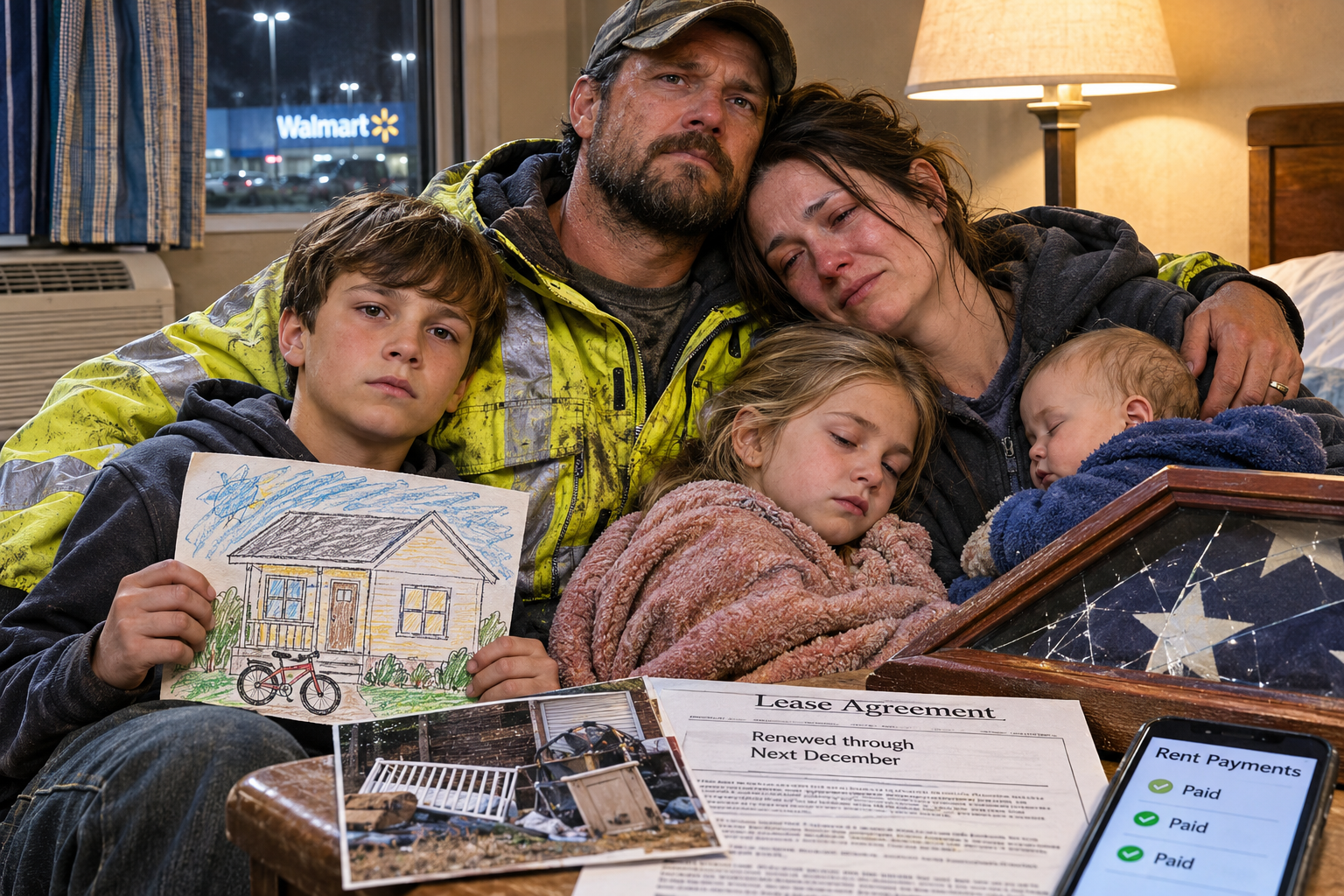
The first thing I saw was the photograph of the dump truck.
I had taken it that morning.
The image showed the metal bed.
Hayden's bicycle.
The broken crib.
The torn bag of clothes.
I stared at it.
The photograph looked worse than I remembered.
Maybe because I wasn't standing in the cold anymore.
Maybe because I finally had time to look properly.
I opened the next picture.
My father's flag.
The cracked glass.
I enlarged the image.
The damage was clear.
I remembered the way Mr. Cobb had stood in the driveway with his coffee.
The way he'd laughed.
The way he'd acted as though I was being unreasonable for wanting him to stop.
I closed the photograph.
Anger wasn't going to help me organize the evidence.
So I opened the rent application.
Every payment was still there.
Every receipt.
Every message.
I found the renewal confirmation.
Mr. Cobb had written that our lease continued through the following December.
Those words mattered.
I'd read them so many times that I could almost repeat them without looking.
I made sure the screenshot was saved.
Then I gathered the other documents.
The payment history.
The photographs.
The police report information.
The notice from the window.
The messages from Mr. Cobb.
I put everything together.
I wanted a clear record.
Not a collection of angry statements.
Not a story that depended on somebody believing me.
Dates.
Payments.
Photographs.
Written words.
Things that could be checked.
I had learned that discipline from working around electrical equipment.
If something failed, we didn't guess at the cause and hope for the best.
We checked the conditions.
We followed the procedures.
We identified what was wrong.
Then we dealt with it.
I wanted to handle the house the same way.
That evening, I began looking for legal help.
I didn't know much about landlord disputes.
I knew how to climb a utility pole.
I knew how to work safely around high voltage.
I knew how to restore electricity after a storm.
But I didn't know what paperwork was needed to challenge a lockout.
I wasn't ashamed to admit that.
I needed somebody who did.
I found information about tenant assistance and legal services.
I wrote down the numbers.
Then I read through the documents again.
Ginny came over.
She pulled out the chair beside me.
"Any luck?"
"I've got some places to call."
She looked at the screen.
"Do you think they'll help us?"
"I hope so."
I hated saying that.
Hope wasn't the same as certainty.
But it was the truth.
She reached for my hand.
For a while, we sat quietly.
Then she asked something I hadn't expected.
"Are you angry with me?"
I looked at her.
"What?"
"For not telling you sooner."
I put the phone down.
"Ginny."
She stared at the table.
"I should've called you when he first came."
I wanted to tell her that she was right.
Because part of me still wished she'd called.
I wished I'd known before the locks were changed.
Before the children ended up in the van.
Before the dump truck arrived.
But I also knew what Mr. Cobb had threatened.
She'd been alone with three children.
He'd told her everything would be destroyed if she contacted me.
And she'd believed him.
After seeing that truck, I understood why.
"I wish you'd told me," I said.
She nodded without looking up.
"But I'm not angry with you."
She wiped at her face.
"I'm angry that he put you in that position."
She started crying.
Quietly.
Like she'd been holding it in for days.
I moved my chair closer.
She leaned against me.
I didn't tell her everything would be fine.
I didn't know that yet.
I just held her.
After a while, she whispered something.
"I was so scared, Zeke."
"I know."
"I kept thinking he'd take the Christmas presents."
I closed my eyes.
The presents were still inside the house when he'd changed the locks.
So were the children's clothes.
So was Moe's crib.
And my father's flag.
Ginny had been trying to save all of it.
She'd ended up losing access to everything anyway.
That was what his threat had done.
It had made her feel trapped.
I looked at her.
"You don't have to deal with him by yourself anymore."
She nodded.
I meant it.
The next morning, I started making calls.
I explained the situation as clearly as I could.
I gave my name.
I gave the address.
I explained that we had rented the house for four years.
I explained that the lease had been renewed.
I described the lock change while Ginny was at the doctor's office with Della.
Then I mentioned the children.
The Walmart parking lot.
The freezing temperature.
The dump truck.
It was strange hearing myself tell the story.
Each time, the details sounded worse.
One person asked whether I had documentation.
I said yes.
Another asked whether the police had been contacted.
I said yes.
I was asked about the rent.
I explained that it had been paid through November.
Then I was asked whether the landlord had provided a court order.
I couldn't produce one.
Ginny had never been shown one.
All she'd been given was Mr. Cobb's demand that she leave.
And the threat that he'd destroy our belongings if she told anybody.
The legal help I contacted explained that a landlord generally couldn't simply change locks and remove tenants without following the required process.
That was what I'd believed.
But hearing it from someone who understood housing law mattered.
I asked what we should do next.
I was told to keep every record.
I was also told that the lease documents and the police report could be important in challenging the lockout.
There might be legal steps to restore access.
There might also be a claim involving damaged belongings.
I listened carefully.
I wrote everything down.
I didn't want to miss anything.
When the conversation ended, I sat at the table for a while.
I looked toward the motel beds.
Hayden was sitting beside Della.
Moe was with Ginny.
They were warm.
That was something.
But it wasn't enough.
The house still belonged to our everyday lives.
Our children's rooms were there.
Their belongings were there.
The things we had collected over four years were there.
A motel could keep us out of the cold.
It couldn't give us back what we'd lost.
Later that day, I returned to the property.
I didn't go alone because I wanted a confrontation.
I went to check the situation.
The house looked much the same.
The padlock was still on the door.
The notice remained in the window.
The driveway looked emptier without the workers moving furniture.
I took more photographs.
I wanted a record of the property's condition.
I didn't break the lock.
I didn't force the door.
That temptation had never entirely disappeared.
But I wasn't going to give Mr. Cobb a reason to shift attention away from what he'd done.
I stood on the porch and looked through the window.
I recognized the rooms.
Four years.
That was how long we'd lived there.
Long enough for the place to feel like ours even though we rented it.
Long enough to remember where the children usually left their shoes.
Long enough to know which parts of the house got cold first in winter.
Long enough for Ginny to make ordinary routines around every room.
And now there was a padlock between us and all of it.
I took another picture.
Then I stepped away.
My phone rang while I was walking back to my vehicle.
It was Ginny.
"Everything okay?"
"Yeah. I'm just checking the house."
"Is he there?"
"No."
She sounded relieved.
I looked back at the porch.
"I haven't touched anything."
"Good."
I knew why she said it.
She was afraid I'd lose my temper.
She knew what the landlord had done to my father's flag.
She knew how much that had hurt.
But I'd already made a decision.
I wasn't going to let anger destroy whatever chance we had of resolving this properly.
When I returned to the motel, Hayden was sitting at the table.
He was drawing something.
I sat beside him.
"What've you got there?"
He turned the paper toward me.
It was a picture of a house.
Our house.
He'd drawn the front door and the windows.
There was a bicycle beside the porch.
The wheel was round.
Not bent.
I looked at it for a long time.
"That's a good drawing, buddy."
He shrugged.
"I made my bike normal."
I swallowed.
"I see that."
He looked at me.
"Can you fix the real one?"
I wanted to say yes.
I wanted to promise him a new bicycle if the old one couldn't be repaired.
But I didn't know what the next few weeks would cost us.
I didn't know how long we'd be paying for a motel.
I didn't know whether we'd have to replace the crib or the other damaged furniture ourselves.
So I told him something smaller.
"We'll look at it together."
He nodded.
That seemed to satisfy him for the moment.
I kept the drawing.
I put it beside the documents on the table.
The picture wasn't legal evidence.
It wouldn't prove a lease.
It wouldn't show who damaged a bicycle.
But it reminded me why I was gathering the rest.
That evening, I looked through the photographs one more time.
I found the picture of my father's flag.
Then I looked at Hayden's drawing.
One showed what had happened.
The other showed what my son wanted back.
I understood then that winning an argument with Mr. Cobb wasn't the same as repairing the damage he'd caused.
Even if the house was opened tomorrow, the children wouldn't forget sleeping in the van.
Ginny wouldn't forget being threatened while I was away.
And I wouldn't forget climbing into that truck.
The broken glass could be replaced.
The furniture might be repaired.
But trust was different.
Once somebody showed you how little your family's security meant to them, you couldn't pretend you hadn't seen it.
I put the papers in order.
I saved the last photographs.
Then I told Ginny what I'd decided.
"We're going to keep pursuing this properly."
She nodded.
"And if it takes longer than we want?"
I looked at our children.
"Then we keep them safe while we do it."
That was all I could promise.
Not a quick victory.
Not a perfect ending.
Just that I wouldn't stop protecting them because the process was difficult.
I turned off the phone.
The heater rattled beneath the motel window.
Della was asleep.
Moe was quiet.
Hayden's drawing lay beside the lease records.
And for the first time since coming home, I let myself understand that this was going to take more than one angry morning in a driveway.
Click here to continue reading: PART 10: After Finding My Father’s Flag in a Dump Truck, I Learned That Getting Justice Was Only Part of Bringing My Family Home
I Returned From Hurricane Duty Expecting to Find My Family at Home, but the Minivan Told Me Something Had Gone Terribly Wrong
Part 9 of 10