When Rebecca finished speaking, I sat very still.
I thought I would feel victorious.
I didn't.
I felt tired.
For months, I'd been afraid of what might happen to me.
I'd worried about losing my home.
I'd worried about money.
I'd worried that a judge or jury might believe I'd attacked Wayne Haller.
But I'd also been carrying another fear.
One I hadn't been able to put into words.
I was afraid Quinn had never made it safely back to her mother.
Now I knew she had.
That mattered more than anything else.
The legal proceedings continued.
Rebecca's testimony had changed what everyone understood about the incident.
But it didn't settle every accusation Wayne had made against me.
My attorney still had to address his claims.
And I still had to tell the court what happened.
I had dreaded that part.
I wasn't accustomed to speaking in front of strangers.
Even at ValuMart, my conversations had been brief.
A greeting.
A question.
A smile.
Now I had to explain the most frightening afternoon of my working life.
When it was my turn, I took my seat and tried to keep my hands steady.
I was asked about my employment.
I explained that I'd worked as a greeter for nine years.
I described my usual duties.
Welcoming customers.
Helping them find what they needed.
Giving children stickers.
Nothing complicated.
Then the questions turned to March 14.
I remembered the rain.
The wet parking lot.
The noise of the registers.
The little pink boots.
My attorney asked what had first caught my attention.
"The child was having trouble keeping up with him."
I explained that Wayne had been holding Quinn by her wrist.
I explained how quickly he'd been walking.
Then I described what she'd said.
"She told me he wasn't her father."
I felt my throat tighten.
I took a breath.
"She wanted her mother."
My attorney asked whether I knew Quinn.
I explained the Saturday mornings.
Her mother in the blue scrubs.
The little girl's dark curls.
Her habit of coming straight toward me for a sticker.
I smiled a little when I remembered it.
Then the smile disappeared.
"That afternoon, she wasn't behaving the way I'd seen her behave before."
I explained that she looked frightened.
That she cried when the man tried to leave.
That she said he'd taken her from Miss Corliss's place.
My attorney asked why I'd stepped in front of the door.
I looked down for a moment.
Then I answered.
"Because I thought somebody needed to check."
That was the truth.
I hadn't known Wayne's history.
I hadn't known about the restrictions involving Quinn.
I hadn't known whether he had permission to take her.
I hadn't known any of the things Rebecca had explained.
I only knew what Quinn had said.
And I believed her distress deserved attention.
My attorney asked whether I had touched Wayne.
"No."
He asked whether I'd grabbed his arm.
"No."
He asked whether I'd accused him of kidnapping a child in front of the other customers.
"No."
I explained that I'd asked for Quinn's name.
I'd asked whether the man was her father.
And I'd called my manager.
That was all.
I hadn't shouted accusations through the store.
I hadn't tried to take Quinn from Wayne by force.
I hadn't threatened him.
I had simply delayed him while asking questions.
Then Mr. Darby had arrived.
I described the driver's license.
The photograph of Wayne holding a baby.
The way my manager accepted those things as proof that everything was alright.
My attorney asked whether I'd obeyed Mr. Darby's instruction to move.
"Yes."
I remembered how ashamed I'd felt.
How badly I'd wanted my manager to listen.
How I'd wished someone else would take responsibility.
But I had stepped aside.
Wayne had left with Quinn.
That was when I'd taken the photographs.
My attorney asked why.
I explained that I was still concerned for the child's safety.
I knew the vehicle might be gone before I could give anyone enough identifying information.
So I took pictures.
Three of them.
Wayne's face.
Quinn through the vehicle window.
The license plate.
Then I called 911.
I hadn't known whether the police would agree with me.
But I thought they needed to know what had happened.
When I finished explaining, I felt strangely relieved.
Not because the lawsuit was over.
It wasn't.
But because I'd finally said everything without someone ordering me to move aside.
For months, I'd wanted somebody to listen.
Now people were listening.
Wayne's attorney questioned me as well.
He challenged my decision to interfere.
He asked about my training.
He asked whether I had any authority to determine who could take a child out of the store.
I answered carefully.
I had no such authority.
I wasn't a police officer.
I wasn't a child protection worker.
I wasn't a security guard.
I was a greeter.
I knew that.
I had never claimed otherwise.
But I hadn't tried to make a legal decision about Quinn's custody.
I had asked questions because she appeared frightened and said she'd been taken.
The attorney returned to the confrontation.
He suggested that Wayne had been embarrassed.
I didn't deny that he might have felt embarrassed.
I couldn't know how he felt.
But embarrassment wasn't the reason I'd stopped him.
I had been concerned about the child.
That hadn't changed.
He asked whether I regretted blocking the exit.
I took a moment.
I thought about losing my job.
I thought about the legal papers.
I thought about the sleepless nights.
Then I thought about Rebecca saying Quinn had been returned safely to her.
"I regret that the little girl had to go through it."
I paused.
"But I don't regret listening to her."
The courtroom was quiet.
I wasn't trying to make a speech.
I wasn't trying to sound brave.
I was simply telling the truth.
The case continued through the necessary questions and arguments.
The photographs were considered.
The claims about physical contact were examined.
The circumstances of Quinn being taken from her caregiver were no longer something the court could ignore.
Wayne's lawyer had presented me as an employee who had attacked and humiliated an innocent father.
But Rebecca's testimony showed that the situation was not as simple as Wayne had claimed.
He was Quinn's biological father.
That part was true.
But he hadn't been authorized to take her that afternoon.
And Quinn had been trying to tell people exactly that.
The accusation that I'd grabbed Wayne remained unsupported by what I had described and the evidence presented.
Eventually, the court rejected Wayne's claims against me.
I did not owe him $250,000.
I remember hearing the decision.
I remember understanding the words.
But I didn't immediately feel anything.
I sat there for several seconds.
My attorney turned toward me.
"It's over, Loretta."
I looked at him.
"Really?"
He nodded.
I lowered my head.
And I cried.
Not loudly.
I didn't want everyone watching me.
But I couldn't stop.
For months, I'd imagined that number hanging over the rest of my life.
Two hundred and fifty thousand dollars.
I'd pictured losing everything Harold and I had worked for.
I'd imagined leaving the home where we'd spent our years together.
I'd imagined growing old with a debt I could never repay.
Now that threat was gone.
I was relieved.
Deeply relieved.
But the relief didn't erase everything.
I was still unemployed.
I'd still spent months frightened.
I'd still lost a place that had helped me cope with my husband's death.
The court's decision couldn't give those months back.
It couldn't undo Mr. Darby's dismissal.
And it couldn't erase Quinn's fear that afternoon.
I understood that.
The case was over.
But what happened had changed all of us.
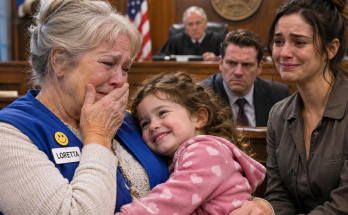
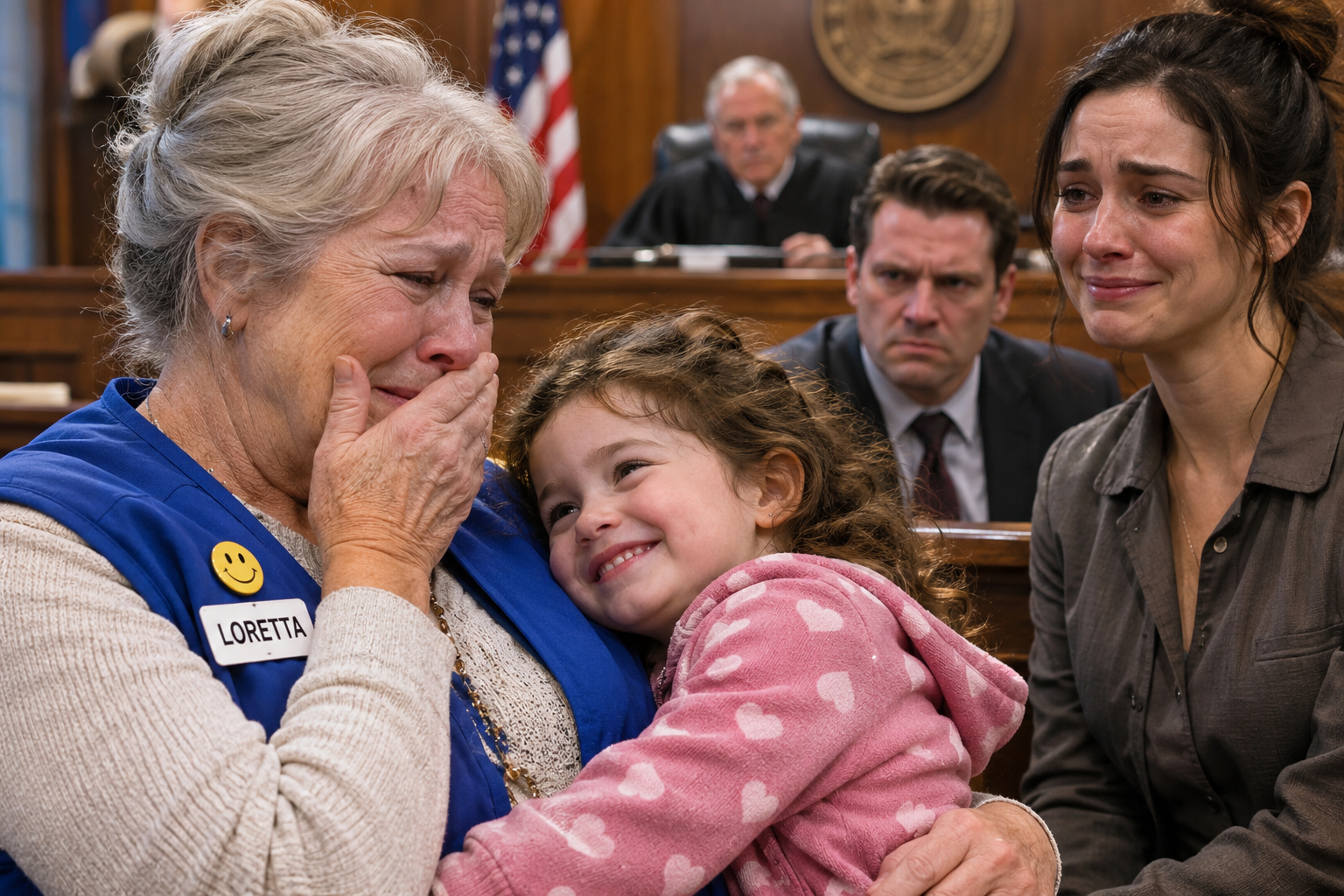
When I left the courtroom, Rebecca approached me.
For a moment, neither of us spoke.
Then she reached for my hands.
"Thank you."
I shook my head.
"I wish I'd been able to stop him from leaving."
She held my hands more firmly.
"You called the police."
I looked at her.
"I let him walk out."
"You did what you could after they told you to move."
I didn't answer.
I was thinking about the automatic doors.
The moment Mr. Darby had ordered me aside.
The way I'd watched Quinn leave with Wayne.
I had carried that memory like a failure.
Rebecca seemed to understand.
"Quinn is home because people followed up on what happened."
I nodded slowly.
I didn't want to take credit for work the police had done.
I hadn't found Quinn myself.
I hadn't brought her home.
I had only given the authorities information they could use.
But I had done that.
And it had mattered.
I looked at Rebecca's face.
She still looked tired.
Just as she had on those Saturday mornings.
But the fear I'd seen when she first stood in court had eased.
"How is she?"
Rebecca smiled a little.
"She's doing better."
I felt another wave of relief.
I asked whether Quinn still remembered coming to the store.
Rebecca nodded.
"She remembers her stickers."
That made me laugh.
A small, unexpected laugh.
After everything that had happened, Quinn still remembered those yellow circles.
I could picture her holding out her little hand.
Palm open.
Waiting for me to peel one off.
I had spent nine years thinking I was doing something ordinary.
Something almost silly.
A sticker for a child.
A smile for a tired parent.
A friendly word at the entrance.
But those small moments had helped Quinn recognize me when she needed someone.
I hadn't understood that until now.
Rebecca thanked me again.
I told her I was glad Quinn was safe.
I didn't know what else to say.
Some feelings were too large for the words available.
After we parted, I went home.
The house was quiet.
Just as it had been after Harold died.
I put my things down and sat for a while.
I thought about the last several months.
The day I lost my job.
The lawyer's letter.
The trial.
Rebecca standing up.
Quinn being found.
The judge's decision.
I had expected the end of the lawsuit to make everything feel normal again.
It didn't.
I still missed my job.
I still missed the people who came through ValuMart.
I still missed the children who wanted stickers.
And I still missed Harold.
Some losses didn't disappear because another problem had been solved.
I knew that better than most.
But something had changed.
I no longer had to wonder whether Quinn had been telling the truth.
She had been.
I no longer had to wonder whether the photographs mattered.
They had.
And I no longer had to live with the fear that Wayne could take $250,000 from me because I'd asked about a frightened child.
The court had rejected his lawsuit.
I thought about Mr. Darby.
I wondered whether he knew what Rebecca had said.
I wondered whether he'd thought again about the driver's license and the baby photograph.
I didn't know.
I hadn't heard him apologize.
And I wasn't going to invent an apology he hadn't given.
I had once wished he'd understood why I was concerned.
Now I understood that I couldn't control what he believed.
I could only control whether I told the truth.
That was enough.
The roll of smiley-face stickers was still among my things.
I picked it up.
Yellow circles.
Little cheerful faces.
Nothing expensive.
Nothing remarkable.
I turned it over in my hands.
For years, I'd thought those stickers were simply a way to make children smile.
I hadn't realized they were also a way of becoming familiar to them.
Someone safe.
Someone recognizable.
Someone they might approach without being afraid.
I thought about Quinn.
The child who had once run toward me every Saturday.
The child who had cried out to me when she was frightened.
I wished I could give her another sticker.
Not because it would erase what happened.
It wouldn't.
But because I wanted her to have more ordinary afternoons.
More Saturday mornings with her mother.
More little reasons to smile.
I wanted her life to become simple again.
I hoped it would.
I set the stickers down.
Then I looked at Harold's photograph.
I had gone to work nine years earlier because I couldn't bear staying home alone.
I hadn't expected anything important to happen there.
I hadn't expected to find purpose in greeting strangers.
But I had.
And on one rainy Friday afternoon, that ordinary job had put me in front of a child who needed someone to listen.
I hadn't done everything perfectly.
I had been frightened.
I had hesitated.
I had obeyed my manager when I wished I'd stood firm.
Those things were true.
But another thing was true as well.
I hadn't ignored Quinn.
I had asked questions.
I had taken pictures.
I had called for help.
And when Wayne tried to make me pay for it, I had told the court what really happened.
That was the part I could live with.
I was still sixty-nine.
Still a widow.
Still an ordinary woman whose hands sometimes shook.
I had lost my job.
I had endured a lawsuit.
I had learned how frightening it could be to challenge someone who insisted he had every right to do what he was doing.
But I had also learned something I would carry for the rest of my life.
A person didn't need to know every answer before taking a child's fear seriously.
Sometimes the first responsibility was simply to listen.
I thought about the words Quinn had spoken.
The words that had changed everything.
I hadn't known whether Wayne was her father.
I hadn't known what had happened at Miss Corliss's house.
I hadn't known how the police would find her.
I hadn't known what a court would eventually decide.
But I'd known she was frightened.
I'd known she wanted her mother.
And I'd known I couldn't ignore her.
I looked at the roll of yellow stickers one last time.
Then I placed it where I could see it.
I hoped Quinn would grow up remembering happy things.
Her mother.
Saturday shopping trips.
Little stickers with smiling faces.
And maybe, somewhere in those memories, the older woman who had stopped to listen.
That would be enough for me.
The End
Read more original stories on Feel Every Story.
I Was Standing Near the Store Exit When a Little Girl Said Something That Made Me Question the Man Holding Her Wrist
Part 10 of 10