The next morning, George called before I had finished my breakfast.
“Have you slept?”
“A little.”
“That makes two of us.”
I smiled despite myself.
I had spent much of the night looking at the ceiling.
Whenever I closed my eyes, I saw the ultrasound monitor.
Black and gray.
An unfamiliar shape.
The doctor's finger pointing toward it.
I wished I could erase that image.
Instead, I folded the appointment papers and placed them beside my handbag.
George arrived to accompany me to the hospital.
He didn't ask whether I wanted him there again.
He simply knocked on my door and waited.
I was grateful.
There were times when being asked to make another decision felt exhausting.
We arrived early.
I checked in and sat beside him in the waiting area.
He glanced at the paperwork.
“Do you know what they're doing today?”
“A scan and blood tests.”
He nodded.
“Then that's what we'll do.”
I looked at him.
“You make everything sound simple.”
“One thing at a time, Margaret.”
I wished I possessed that ability.
My mind was already imagining conversations that hadn't happened.
Operations that hadn't been scheduled.
Results that hadn't been received.
George was thinking about the appointment in front of us.
When a nurse called my name, he stood.
“I'll be here.”
I followed her through a doorway.
The examination room was unfamiliar.
The equipment looked larger than I had expected.
A member of the medical team explained the procedure and asked several questions about my health.
I answered each one carefully.
This time, I didn't dismiss anything.
I mentioned the discomfort I had experienced.
I described the changes I had noticed.
I admitted that some of them might have begun earlier than I originally believed.
That last admission troubled me.
I had been so certain about the timing.
But the more carefully I thought about it, the less certain I became.
There was a difference between remembering something and remembering when it began.
I had confused the two.
The staff finished their preparations.
I was asked to remain still during the scan.
That wasn't difficult physically.
Mentally, it was another matter.
I thought about George sitting outside.
I wondered whether he was frightened.
He had been remarkably calm with me, but calmness didn't mean he felt nothing.
When the scan was finished, I was told that the images would need to be reviewed.
I returned to the waiting area.
George stood as soon as he saw me.
“How was it?”
“Not too bad.”
“Any answers?”
“Not yet.”
He helped me with my coat.
We waited for the blood tests.
Then we waited some more.
Hospitals seemed to have their own understanding of time.
A few minutes could feel like an hour.
An hour could feel like an entire afternoon.
Eventually, we were able to leave.
George insisted that I eat something.
“I don't have much appetite.”
“You don't have to finish everything.”
We sat together and shared a quiet meal.
I caught him looking at me several times.
“What?”
“Nothing.”
“George.”
He put down his cup.
“I'm worried about you.”
There it was.
He hadn't tried to make the words sound prettier.
I appreciated that.
“I'm worried too,” I admitted.
We sat quietly.
I realized how much energy I had spent pretending otherwise.
A few days later, the hospital contacted me about the scan results.
George accompanied me again.
The doctor opened my medical record.
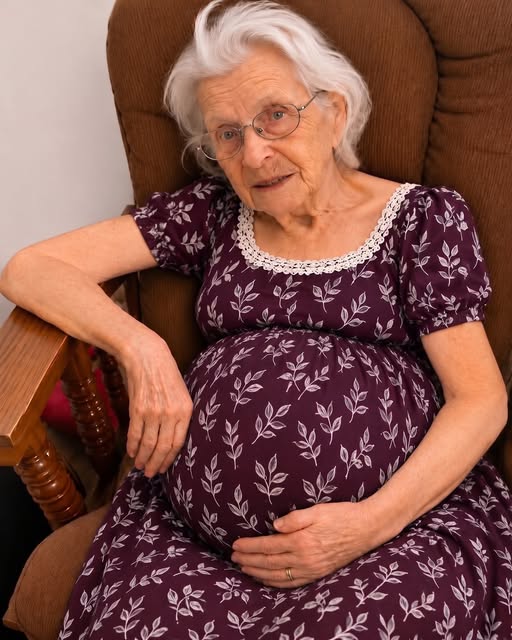
He explained that the more detailed images confirmed the presence of a large mass, measuring roughly twenty centimeters.
The finding appeared to be associated with one of my ovaries.
I looked at him in disbelief.
“At my age?”
“Yes.”
I had assumed that certain parts of my body had become medically unimportant after so many years.
Apparently, I had been mistaken.
The doctor explained that an ovarian mass could occur long after menopause.
Further assessment was necessary to understand its nature.
“Is it cancer?” I asked again.
He didn't pretend to know.
“The findings need specialist evaluation.”
I felt George's hand settle beside mine.
The doctor discussed the next steps.
Because of the mass's size and my age, the medical team needed to consider several factors carefully.
My overall health.
The characteristics of the growth.
The possible benefits and risks of treatment.
I tried to follow everything.
Then I asked the question that mattered most to me.
“Can it be removed?”
“Potentially, yes. But we need to establish the safest approach.”
George leaned forward.
“What happens if nothing is done?”
The doctor explained that leaving a large mass untreated could involve risks, depending on its nature and location.
He didn't recommend ignoring it.
Neither did he suggest rushing into surgery without proper assessment.
I appreciated his caution.
Still, I wanted something definite.
When we left the consultation, George carried the new paperwork.
I walked beside him.
Outside, I stopped.
“I'm eighty-four years old.”
He turned toward me.
“I know.”
“What if I'm too old for all this?”
He considered his answer.
“Then the doctors will tell us what is safe.”
I shook my head.
“I don't want to spend whatever time I have left frightened and miserable.”
“Neither do I.”
He took my hand.
“But knowing what you're dealing with might give you more choices.”
I understood what he meant.
Ignoring the growth wouldn't make it disappear.
I had already given it enough time without knowing.
At home, I placed the reports on my table.
George sat opposite me.
Together, we read the documents again.
There were medical words I didn't recognize.
There were measurements.
There were recommendations.
At the bottom was information about the specialist consultation.
I looked at the appointment details.
Then I reached for my telephone.
I was going to attend that consultation.
Whatever the specialist told me, I wanted to hear it.
Click here to continue reading: PART 7: When the Specialist Explained My Choices, I Realized That the Most Important Decision Was One Nobody Else Could Make for Me
I Thought the Doctor Was Going to Explain What Had Happened to My Body, but His Expression Made Me Afraid to Ask
Part 6 of 10