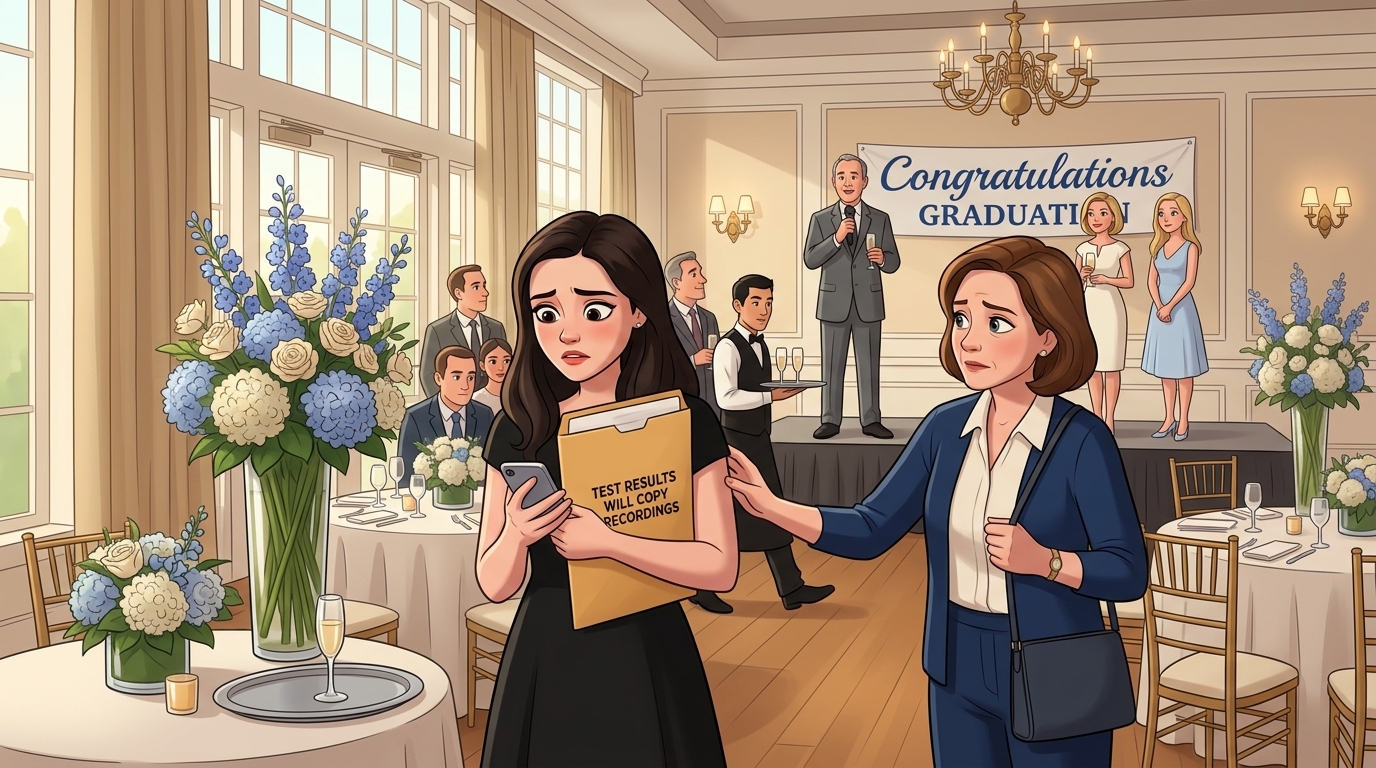
I spent the rest of that day in rooms with bad lighting.
At the precinct, officers separated Daniel from me and began asking questions. I repeated the story until it sounded like something that had happened to another woman.
My husband became ill.
My husband died.
The coffin remained sealed.
I received ashes.
His mother handled the arrangements.
Five months later, I saw him crossing a street.
Each sentence sounded impossible by itself.
Together, they sounded worse.
An investigator placed a cup of coffee in front of me. I held it for warmth and never drank it.
"Did your husband have financial problems?"
"Apparently."
"Did you know about the insurance policy?"
"I knew we had insurance. I didn't know he planned to use his own funeral as a withdrawal form."
The investigator did not smile.
Laura sat beside me.
Every few minutes I looked at her just to confirm she was still there.
When someone asked whether I had received psychiatric treatment since Daniel's supposed death, I felt my chest tighten.
"They forged those papers."
"We know the documents need verification."
"I'm not hallucinating."
The investigator leaned forward.
"No one here is saying you are."
It took me several seconds to believe her.
Later, she gave me information for counseling and crisis support. She explained that shock could do strange things to sleep, memory and appetite.
For once, concern about my mental state did not sound like an accusation.
That night I went home with Laura.
Her apartment in Queens was small enough that the subway seemed to pass through the living room. I lay on her couch listening to trains and trying not to close my eyes.
Whenever I did, I heard Daniel asking why I was not where he expected me to be.
So I began naming facts.
My name was Mariana Rios.
My birthday was April 12.
My first dog had been Spot.
My mother's favorite perfume smelled of gardenias.
Laura snored softly in the next room.
Daniel was alive.
Daniel had lied.
I had seen him.
I repeated the facts until morning.
The investigation widened quickly.
The first arrest did not explain how a living man had acquired a legitimate death certificate. Detectives began tracing hospital records, funeral documents, insurance claims and the unidentified body used in Daniel's place.
Then they questioned his mother.
At first she denied everything.
She claimed grief had confused her. She claimed Daniel had manipulated her. She claimed she had signed documents without understanding them.
The investigators had records.
Eventually, her story changed.
She had known Daniel intended to disappear.
She had helped persuade me not to view the body.
She had assisted with paperwork.
And she knew people who could make the fraudulent death look official.
When investigators told me she was cooperating, I remembered her hands around mine at the funeral.
I had thanked her.
That memory hurt in a different way from Daniel's betrayal.
He had been my husband.
She had pretended to mourn her own son while watching me mourn him for real.
Her cooperation led investigators to a hospital administrator.
The administrator led them to a man involved in supplying the unclaimed body.
A notary's name surfaced.
Then a physician.
The psychiatric application had not been improvised after Daniel saw me on the street. It had been prepared in advance by a doctor with a disciplinary history.
That discovery kept me awake for another night.
Daniel had not merely hoped people would dismiss me.
He had built a system for making them dismiss me.
The plan depended on sequence.
First, establish his death as unquestionable.
Second, let grief isolate me.
Third, prepare documents describing me as unstable.
Fourth, arrange financial transfers while I was too devastated to scrutinize them.
If I ever saw Daniel—or began noticing inconsistencies—my insistence that a dead man was alive could be presented as proof of psychological collapse.
My truth had been designed to incriminate me.
Laura sat at her kitchen table while I explained this.
She listened without interrupting.
When I finished, she said, "He underestimated you."
I shook my head.
"No. He understood me very well."
"What do you mean?"
"He knew I loved him."
The words surprised me.
"That's what he used."
Months passed.
The legal case grew.
Insurance investigators joined the process. Financial records showed money moving through accounts I had never known existed. Documents connected to our house had been prepared for transactions I had never authorized.
Nearly two hundred thousand dollars in insurance fraud formed only part of the case.
Prosecutors explained charges to me in language stripped of emotion: fraud, forgery, conspiracy, identity theft and other offenses arising from the scheme.
The words were clean.
What happened to me had not been clean.
I had stood in a cemetery believing my husband was inside a coffin.
No statute could contain that.
I began therapy.
At first, I hated the office.
Daniel's forged psychiatric papers had made every discussion of mental health feel contaminated.
My therapist understood that immediately.
She never told me how I ought to feel.
Instead, she asked what happened inside my body when someone questioned my memory.
My answer was simple.
"I want evidence."
So we worked with evidence.
Dates.
Documents.
Sensations.
What I knew versus what I feared.
Gradually, I stopped treating every moment of uncertainty as proof Daniel had succeeded.
The criminal case took almost a year to reach trial.
During that time, Daniel remained startlingly consistent.
Through his attorneys, he minimized.
He had been threatened.
He had acted under pressure.
He never intended to harm me.
The psychiatric paperwork was merely precautionary.
The financial arrangements had been misunderstood.
Every explanation transformed a deliberate act into something that had simply happened around him.
Then his mother accepted a plea arrangement.
She agreed to testify.
The night before she took the stand, I sat with Laura in her kitchen.
"Do you want her to apologize?" Laura asked.
I considered it.
"No."
"You don't?"
"I don't think I'd believe her."
Laura poured tea.
"What do you want?"
"The truth under oath."
That was exactly what I got.
Daniel's mother entered the courtroom looking smaller than I remembered.
She described the false funeral arrangements. She admitted knowing Daniel was alive. She explained how the sealed coffin prevented identification.
She confirmed that the plan required me to remain unaware long enough for Daniel to finish his financial scheme.
Then the prosecutor asked about the psychiatric paperwork.
Daniel's mother hesitated.
I saw Daniel watching her.
Finally she spoke.
The documents were meant to discredit me if necessary.
"If she claimed she saw him?" the prosecutor asked.
"Yes."
"And if she refused to accept that her husband was dead?"
Another pause.
"Then people would think grief had affected her mind."
I looked at Daniel.
He did not look back.
Something inside me became unexpectedly quiet.
For months I had feared there might be some missing piece that would make his actions less deliberate.
There wasn't.
The cruelty had not been an accident produced by desperation.
It had been architecture.
My turn to testify came later.
Before entering the courtroom, Laura squeezed my hand.
"You don't have to prove you're sane," she whispered.
I looked at her.
"Just tell them what happened."
I walked to the witness stand.
Daniel sat at the defense table in a clean shirt.
For years, I had known the angle of his face better than my own. Now he seemed strangely ordinary.
The prosecutor began with our marriage.
Then the illness.
The reported death.
The funeral.
The ashes.
The five months afterward.
Finally she asked about the morning I saw him.
I described the street.
The groceries.
The oranges rolling away.
The way he turned when I called his name.
Then she asked what convinced me beyond doubt that the man was Daniel.
I looked at the jury.
"He called me Butterfly."
Daniel shifted.
I explained what the name meant.
No one else had known it.
Then I described the apartment and the false identification.
The folder.
My documents.
The forged signature.
The psychiatric application.
The defense attorney questioned me aggressively.
Wasn't grief capable of affecting memory?
Had I been sleeping badly?
Had I been emotionally distressed after my husband's death?
"Of course," I said.
"So you admit you were psychologically vulnerable."
"I admit I was grieving."
"Could grief have affected your interpretation of what you saw?"
I looked toward Daniel.
"No."
"Why are you so certain?"
"Because hallucinations don't carry passports."
A few jurors looked down.
The attorney changed direction.
He suggested Daniel had acted to protect us from dangerous creditors.
I answered, "Then he could have told me."
He suggested Daniel had never actually placed me in a psychiatric institution.
"He forged paperwork to make it possible."
He suggested I was angry.
"Yes."
"Very angry?"
"Yes."
"Enough to want revenge?"
I considered the question.
Then I said, "I wanted my life back. A verdict can't give me the five months he stole."
The courtroom became silent.
For the first time that day, Daniel looked directly at me.
There was no affection in his face.
No apology.
Only recognition.
The woman he had expected to discredit was sitting beneath oath telling strangers exactly what he had done.
The jury received the case after closing arguments.
They left to deliberate.
And for the first time since seeing Daniel on that Bronx sidewalk, there was nothing left for me to prove.
All I could do was wait.