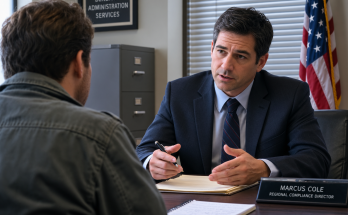
Monday morning found us in a bank conference room that felt far too formal for a family argument.
Sarah sat beside me.
Mitchell sat across from us.
Chloe sat at the far end of the table with her arms folded tightly against her chest.
Mr. Henderson, the bank manager, entered carrying a thick folder.
He placed it on the table.
“Mrs. Eleanor,” he said, “the attempted transfer was stopped before any funds left your account.”
I nodded.
“Good.”
He turned toward Chloe.
“You submitted the power of attorney through our online portal late Friday.”
Chloe said nothing.
“You also scheduled the forty-two-thousand-dollar transfer.”
“I was authorized.”
Sarah leaned forward.
“By whom?”
Chloe looked at me.
“She needed help.”
“That isn't an answer,” Sarah said.
Mr. Henderson opened another file.
“This signature is supposed to belong to Eleanor.”
He placed a printed authorization form on the table.
I stared at it.
Even with my poor vision, something looked wrong.
Sarah examined it.
“It resembles her signature.”
“It is her signature,” Chloe insisted.
Sarah shook her head.
“No.”
Chloe's eyes narrowed.
“You can't prove that.”
“We don't need to prove it here,” Sarah said. “The forensic review will.”
Mr. Henderson pointed to the signature.
“The fraud department already noticed irregularities.”
I looked at the loops.
They were almost right.
Almost.
But Arthur had taught me long ago that almost right was usually the same thing as wrong.
Chloe had copied my signature from somewhere.
Sarah asked Mr. Henderson whether there were other transactions.
He hesitated.
“There is another issue.”
Mitchell leaned forward.
“What issue?”
Mr. Henderson opened a second report.
“An authorized debit card was issued for household purchases.”
I nodded.
“I gave Chloe that card.”
“For groceries,” Mr. Henderson said.
“And prescriptions,” I added.
“And basic household expenses.”
Chloe stared at the table.
Mr. Henderson continued.
“Our audit shows nearly twenty-four thousand dollars in cash withdrawals and personal purchases that don't appear related to household expenses.”
Mitchell looked at Chloe.
“What?”
She said nothing.
“Twenty-four thousand?”
“That's impossible,” she whispered.
Mr. Henderson slid the report toward him.
“ATM withdrawals. Retail purchases. Several online transactions.”
Mitchell read the pages.
His jaw tightened.
“Chloe.”
She looked up.
“You told me Mom was helping us with expenses.”
“She was.”
“You told me everything was under control.”
“It was.”
“How?”
She looked at him.
Her eyes filled with tears.
“Because I was fixing it.”
“Fixing what?”
She didn't answer.
I did not need to.
Sarah already knew.
“Ask her about the debt,” she said.
Mitchell turned slowly.
“What debt?”
Chloe covered her face.
He stood.
“What debt?”
She began crying.
The confession came in pieces.
Credit cards.
Personal loans.
Late payments.
Accounts Mitchell didn't know existed.
Nearly one hundred thousand dollars in hidden debt.
Then came the crypto investment.
She had put money into it believing she could recover everything quickly.
Instead, she lost more.
Mitchell sat down again.
I watched his hands.
They were shaking.
“So that's why you needed Mom's money.”
“No.”
“Then why?”
“I was trying to save us.”
“By taking her house?”
“I thought if the property sold…”
She stopped.
Mitchell finished the sentence for her.
“You'd pay everything off.”
She cried harder.
“I didn't know what else to do.”
“You could have told me.”
“You would have left.”
The room went quiet.
Mitchell stared at her.
She looked away.
Then he asked the question I had been afraid he would ask me.
“Mom, did you know about this?”
“No.”
He nodded slowly.
His shoulders dropped.
I could see years of denial collapsing inside him.
He remembered every time I had warned him.
Every time Chloe had interrupted.
Every time he had told me she was only trying to help.
“I should have listened,” he said.
I didn't answer.
Not yet.
There were consequences beyond the marriage.
The fraudulent documents had to be reported.
The attempted transfer had to be documented.
The property deed had to be protected.
The bank needed every questionable transaction reviewed.
Sarah handled the legal work.
I handled something else.
My own anger.
I had spent years telling myself that family deserved patience.
That a son deserved understanding.
That a daughter-in-law deserved the benefit of the doubt.
But patience had become permission.
And permission had nearly cost me my home.
The court order remained in effect.
Chloe could not return to the house.
Mitchell was allowed to collect belongings under supervision.
A sheriff's deputy accompanied him several days later.
I stood in the hallway as they entered.
Chloe avoided my eyes.
She moved through the house with a suitcase.
Her shoes made soft sounds against the hardwood floor.
For four years, she had walked those floors as though they belonged to her.
Now every step required permission.
She packed clothes.
Shoes.
Personal photographs.
A few kitchen items.
Then she reached for the silver chest.
I spoke before she touched it.
“No.”
She stopped.
“That belongs to my mother.”
She withdrew her hand.
The deputy watched silently.
The chest returned to the dining-room hutch.
The house felt different afterward.
Not emptier.
Clearer.
A month later, Mitchell filed for divorce.
I never told him to.
I never celebrated it.
That was his decision.
One afternoon, he came to my porch.
He sat in the chair beside mine.
For several minutes, he said nothing.
Then he looked at me.
“I should have protected you.”
“Yes.”
His eyes lowered.
“I should have read what I signed.”
“Yes.”
“I should have believed you.”
“Yes.”
He nodded.
He seemed almost relieved that I did not soften the answers.
Then he asked the harder question.
“Can you forgive me?”
I looked at my son.
I remembered him at six years old, running through the living room with a wooden airplane.
I remembered him at eighteen, leaving for college.
I remembered Arthur holding him by the shoulders and telling him to become a decent man.
I remembered the man sitting beside me now.
“I love you,” I said.
He waited.
“But love isn't the same thing as trust.”
His eyes filled.
“I know.”
“Forgiveness isn't a shortcut either.”
“I know.”
He nodded.
Then he said something I hadn't expected.
“I'll earn it.”
I watched him leave.
For the first time, I wondered whether the house could become a home again.
But there was still one thing I had not done.
I had not decided what would happen to the property after I was gone.
Sarah had an idea.
She wanted to protect it permanently.
Click here to continue reading: PART 4: I Had Spent Decades Building a Home, but Protecting It Meant Making One Final Decision About My Son’s Future
The Sunday Morning I Stopped Pretending My Home Was Still Safe While Someone Else Quietly Planned to Take It Away
Part 3 of 20