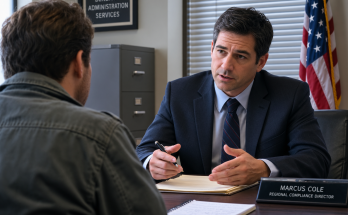
The bank manager did not raise his voice when he explained what had happened. That almost made it worse. Mr. Henderson sat across from me with a folder open between us, his reading glasses low on his nose, while Sarah Jenkins stood beside the conference table with her arms folded. The amount was forty-two thousand dollars. Someone had attempted to move it from my primary savings account into another account through a transfer that had been stopped before completion.
Sarah looked at me first, not at Mitchell. “Your accounts are frozen temporarily,” she said. “That is a protection, not a punishment. Nothing leaves without verification now.” I nodded. My hands were steady. I had expected to feel panic, but what I felt was something colder. The attempted transfer was no longer a suspicion or an ugly possibility. It was evidence that someone had been willing to reach directly into the money I had spent a lifetime protecting.
Mr. Henderson explained that Chloe had submitted what appeared to be a power-of-attorney document electronically the previous Friday. The document was the same kind of paper she had left beside my breakfast weeks earlier. The signature at the bottom was supposed to be mine. It resembled my signature enough to pass an automated comparison, but the bank's fraud department had noticed inconsistencies in the loops and pressure patterns.
I stared at the photocopy. My name sat there in black ink, confident and familiar-looking. Yet it was not mine. I knew my own handwriting the way I knew the grooves in Arthur's old wedding band. The person who had written those letters had studied my signature carefully. She had not merely guessed. She had practiced.
Mr. Henderson turned another page toward us. “We found the source of the concern here,” he said. “The signature pattern is unusually close to one on an older canceled check. That appears to have been used as a reference.” I did not need to ask whose idea that had been. Chloe had spent years in my house. She knew where old checkbooks were kept. She knew which drawers I opened and which papers I rarely touched.
Mitchell sat very still. He had not spoken since we entered the bank. His shoulders seemed to have collapsed inward, and his eyes remained fixed on the documents. For the first time since this nightmare began, he looked less like the son who had come to defend his wife and more like a man realizing he had been absent from his own life.
Sarah asked Mr. Henderson what else the bank had discovered. He hesitated for a moment before answering. “There are additional transactions that deserve review.” He slid another statement across the table. “Some go back approximately eighteen months.” The paper made a soft scraping sound against the polished surface. It was an ordinary sound, but I felt my stomach tighten before I even read the first line.
The transactions were not enormous individually. Grocery stores. Pharmacies. Household purchases. ATM withdrawals. Small amounts at first, then larger ones. Some were legitimate. I recognized several prescriptions and grocery trips Chloe had made for me. But beside those familiar expenses were cash withdrawals I had never authorized and purchases I had never seen.
I remembered how often Chloe had told me not to worry about receipts. “I'll keep track of everything,” she used to say. At the time, it sounded generous. Now those words seemed to carry a second meaning. She had indeed kept track of everything. She had simply been keeping track for herself.
Mr. Henderson explained that Chloe had originally been given limited access to help with ordinary household expenses. That authorization had never included unrestricted cash withdrawals or personal shopping. According to the preliminary audit, nearly twenty-four thousand dollars had disappeared over the previous year and a half.
I leaned back and closed my eyes. Twenty-four thousand dollars was not an abstract number. It was the repairs Arthur and I had once saved for. It was the cushion I had built because old age made uncertainty expensive. It was the money that allowed me to believe I could choose my own care if I ever needed it.
Mitchell finally spoke. “Mom, I didn't know.” His voice was barely above a whisper. I opened my eyes and looked at him. “I believe you,” I said. That was the truth. But there was another truth beneath it. He had not known because he had not looked.
Sarah placed her hand on the edge of the statement. “There is something else you need to understand. The attempted forty-two-thousand-dollar transfer was not an isolated financial event. It was connected to the legal documents we found and to the proposed sale of the property.” Mitchell swallowed hard.
“Why would she need that much money?” he asked.
Sarah did not answer immediately. Instead, she looked at the office door as though deciding whether she wanted to give him the next piece of information herself. “That is what we need to establish,” she said. “But you should be prepared for the possibility that your wife's financial situation is much worse than you have been told.”
The silence afterward felt different from the silences in my house. Those had been full of avoidance. This one was full of facts. Mitchell rubbed both hands over his face. I could see the exhaustion there, but I could also see the beginning of understanding.
When we left the bank, the afternoon air felt strangely bright. Cars moved through the parking lot. People carried shopping bags toward their vehicles. Somewhere nearby, a child laughed. Ordinary life continued without knowing that mine had just been rearranged by a few pages of paper.
Mitchell walked beside me but did not touch my arm. That was new. Chloe had always been the one guiding me physically, taking my elbow, steering me through doors, answering before I could. Mitchell had watched it happen so many times that he had stopped seeing the difference between assistance and control.
At the car, he stopped. “I need to talk to Chloe.”
“You do,” I said.
He looked at me. “Are you sure you don't want to come?”
“No.”
He nodded slowly. “I understand.”
I almost corrected him. Understanding was something we had both been waiting for, and I was not ready to trust that one moment of clarity. But I did not say anything. I simply watched him drive away, carrying the statements Sarah had copied for him.
That evening, I returned to the house alone. The new deadbolts were still unfamiliar beneath my fingers. I locked the door and stood in the foyer for a long moment. The house sounded different when I was the only person inside. The refrigerator hummed. Pipes clicked somewhere behind the wall. The old clock in the hallway marked each minute with a patient wooden tick.
I walked into the dining room and looked at the empty space where my mother's silver chest had sat for nearly fifty years. I thought about Arthur bringing it home after our wedding, about the ridiculous care he took carrying it through the doorway as though it contained something fragile. He had teased me that I was more excited about the chest than the honeymoon.
I smiled despite myself. Then the smile faded. Chloe had seen that chest as an item on an inventory sheet. She had reduced something that carried half a century of memory to a photograph beside a list of things to remove before a house went on the market.
I went upstairs slowly, touching the banister with one hand. My eyesight made the edges of the hallway soft, but I knew every turn by heart. At the top, I stopped beside the framed photograph of Mitchell as a little boy. His knees were muddy. His hair was sticking up. Arthur was behind him, laughing.
For years I had told myself that protecting my son from his mistakes was part of being his mother. That night, for the first time, I wondered whether protecting him from consequences had helped make him vulnerable to someone else's manipulation.
The thought hurt more than I expected. I did not want revenge on Mitchell. I wanted him to wake up. But waking up meant seeing things he had spent years refusing to see.
My phone rang.
It was Sarah.
“Eleanor,” she said, “there's been another development.”
I sat down on the edge of the bed.
“What happened?”
She paused.
“The district attorney's office wants the original documents.”
Click here to continue reading: PART 6: The Papers Were No Longer Just Evidence of Greed; They Showed How Carefully Someone Had Prepared to Rewrite My Life Before I Ever Realized It Was Happening
The Sunday Morning I Stopped Pretending My Home Was Still Safe While Someone Else Quietly Planned to Take It Away
Part 5 of 20