At 7:15 on a gray Tuesday morning, my daughter-in-law called me by accident. I knew it was an accident because she never once said hello. She never asked how I was. She never realized that I had answered. Instead, I heard the sound of a car moving through traffic, the rhythmic click of a turn signal, and her voice asking my son a question that made my hand stop halfway to my tea.
“Did you bring the folder?”
My son, Mark, answered from somewhere beside her.
“It’s in the back.”
I sat perfectly still at my kitchen table.
The phone was lying beside my saucer, the screen still lit with Alicia’s name. I could hear the radio playing softly through the car speakers. Every few seconds there was the hiss of tires crossing damp pavement.
Then Alicia asked, “And the brochure?”
“Glove compartment.”
She laughed.
Not nervously.
Not uncertainly.
She laughed like two people discussing something already decided.
I should have hung up. A decent person might have. I could have cleared my throat and said, “Alicia, you’ve called me by mistake.” Instead, I reached for the small grocery notepad beside my sugar bowl and uncapped my pen.
My husband, Raymond, had taught me to write things down when they mattered. He used to say that memory became unreliable precisely when fear entered the room.
So I wrote the time.
7:16.
Then I wrote the first sentence I had heard.
Did you bring the folder?
I had been seventy-three for six months. Raymond had been gone four years. The house around me was the same one we had bought when Mark was a baby, the same place where his height had been marked on the kitchen doorframe until adolescence finally made the pencil lines unnecessary. Every room held something I could remember without trying.
The blue chair Raymond used to read the newspaper in.
The brass clock above the fireplace.
The photograph of Mark at six years old, grinning through a missing front tooth.
And now, from that little phone on my table, I was hearing my son and his wife discuss me as though I were an obstacle they needed to move.
Alicia spoke again.
“She’ll sign.”
Mark was quiet.
“She always signs things.”
I pressed the pen harder against the paper.
Alicia continued, almost amused.
“Remember when she got those medical forms? She barely looked at them.”
There was something ugly about hearing someone describe your trust as a weakness.
At 7:19, Mark finally spoke.
“What if she wants to read it?”
I stopped breathing for a moment.
Alicia answered immediately.
“Then you distract her.”
“How?”
“Take her glasses. Tell her they need cleaning.”
I stared at the wall.
For a second, I could see Mark at seven years old, standing in this same kitchen with a scraped knee and tears running down his cheeks because he had fallen from his bicycle. I had knelt in front of him, cleaned the cut, and promised him the pain would pass.
Now the adult version of that same boy was sitting in a car, discussing how to keep his mother from reading a document before she signed it.
I wrote everything.
Not because I knew what I would do.
Because I did not.
A few minutes later, Alicia mentioned Silver Meadows.
She described it as a beautiful senior community with gardens, organized activities, transportation, and medical services nearby. She said her cousin could get them a favorable rate.
Mark asked, “Does Mom even want to move?”
Alicia sighed.
“Mark, she doesn’t have to want it.”
My stomach tightened.
Then she said something that made me stop writing.
“We've been paying for that house for years.”
I knew immediately that she was lying.
The mortgage on my house had been paid in full in 1998.
Raymond and I had made the final payment ourselves. We had celebrated that night with cheap champagne and takeout Chinese food because we were too tired to cook.
There had never been a mortgage for Mark and Alicia to pay.
Four years earlier, when they were struggling after the birth of their twins, I had given them forty thousand dollars. It was not a loan. I had never demanded repayment.
I had simply wanted my son to have a stable home.
Apparently, they had found another meaning for that money.
At 7:26, Alicia lowered her voice.
“The moment she’s settled, we list the property.”
Mark said nothing.
“Bruce says we can get around one-eighty without making it difficult.”
I knew Bruce.
Bruce Carter had been a real-estate agent for years. He had visited my home twice. Both times, Alicia had laughed and told me he was fascinated by the old crown molding in the living room.
Now I wondered how much time he had spent measuring the walls with his eyes.
Alicia continued.
“That covers the boat, the lake trip, and gets us out of the hole.”
My pen stopped.
The boat.
The lake trip.
The hole.
I wrote those words too.
Then came the sentence that hurt more than anything else.
“Let me do the talking,” Alicia said. “You just look worried. Can you manage that?”
Mark answered softly.
“Yeah.”
I closed my eyes.
The call ended at 7:34.
For another full minute, I didn't move.
The tea beside my hand had gone untouched. Steam no longer rose from it.
I looked down at the page.
Seven minutes of notes had become a map of something I had not wanted to believe.
My son knew.
Maybe not everything.
Maybe not the full extent of Alicia's plan.
But enough.
That was the part I could not excuse.
I stood, walked to the sink, and poured the cold tea away.
Then I made two phone calls.
The first was to Eleanor, my neighbor of forty years.
She answered on the second ring.
“What happened?”
“I need you.”
There was no hesitation.
“Give me twenty minutes.”
The second call was to Samuel, the attorney Raymond had trusted for decades.
I told him only that I needed him to come to the house immediately and bring every document connected to my property, accounts, estate plan, and previous transfers to Mark.
He asked if I was in danger.
“No.”
“Are you sure?”
I looked at the notepad.
“No one has threatened me.”
“That wasn't my question.”
I understood.
“I’m sure.”
He said he was on his way.
Then I did something that felt strangely ordinary.
I made banana bread.
Alicia always praised my banana bread.
She rarely ate more than one bite.
I sliced it neatly anyway and placed it on a plate beside the good cups.
If they were coming to my house expecting an old woman who would be easy to manage, I wanted them to see exactly what they had underestimated.
At 8:41, I saw their car turn into my driveway.
Alicia was driving.
Mark sat beside her.
They remained in the car for almost a minute.
Then Alicia checked her reflection in the mirror.
Mark straightened his shoulders.
I almost laughed.
He was practicing the sadness she had asked him to perform.
The doorbell rang.
I waited.
Then I opened the door.
Alicia smiled brightly.
“Mother D!”
I had always disliked that nickname, though I had never told her.
“Come in.”
She kissed the air beside my cheek.
“We were just nearby.”
“Of course.”
Mark stepped inside.
He didn't look at me.
That hurt.
Not because he was guilty.
Because I remembered when he used to look at me first whenever he entered a room.
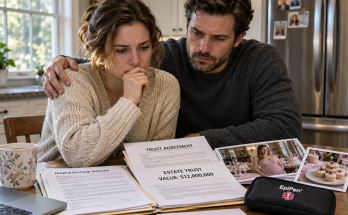
Alicia carried a thick folder under her arm.
She placed it beside the butter dish as casually as if it were a grocery list.
“We've been worried about you,” she said.
“Have you?”
She smiled.
“Of course.”
Mark finally sat down.
I poured coffee.
Neither of them touched it.
Alicia began explaining that the house was becoming too much for me. Too many stairs. Too much maintenance. Too much responsibility.
She spoke gently.
Almost lovingly.
It might have worked if I hadn't heard her forty minutes earlier.
“Silver Meadows is beautiful,” she said. “You'd have people around you.”
“That sounds nice.”
Her shoulders relaxed.
“We knew you'd understand.”
“I usually do.”
Mark glanced at me.
For a second, his eyes looked frightened.
Then Alicia slid the folder closer.
“These are just some documents we thought you should look at.”
I placed my hand on the folder.
Before opening it, I looked at my son.
“Mark.”
“Yes?”
“Did you bring this from the car?”
His face changed.
Alicia answered for him.
“It’s nothing important.”
I looked at her.
“Then why does it feel important?”
The doorbell rang.
Alicia frowned.
“Are you expecting someone?”
I stood.
“Yes.”
I opened the door.
Eleanor stood there.
Beside her was Samuel.
Alicia's face lost its color.
Mark went completely still.
Eleanor lifted her phone slightly.
Samuel carried a leather folder.
I stepped aside.
“Come in.”
Alicia stared at me.
“What is this?”
I smiled.
“My home.”
Then I looked at the folder beside the butter dish.
“And my paperwork.”
For the first time that morning, nobody knew what to say.
Click here to continue reading: PART 2: They Came Expecting My Signature, But the Documents on My Kitchen Table Told a Very Different Story
The Call I Was Never Supposed to Hear Changed What I Thought I Knew About My Son
Part 1 of 20