The document was older than Frank's marriage to me.
Older than the foundation.
Older than Emily House.
Older than the cottage.
Michael placed it on his desk and waited.
I didn't touch it.
“What is it?”
“A trust created by Frank's father.”
I frowned.
“I thought his father cut him off.”
“He did.”
“Then why is there a trust?”
“Because the cutoff was never complete.”
Michael explained that Frank's father had created a private family trust before his death.
The trust had been intended for Frank.
But after Frank left the family business, his father attempted to remove him.
There had been a dispute.
A legal battle.
Then a settlement.
Frank won.
But he never claimed the money.
“How much?”
Michael looked at me.
“Enough.”
“That isn't a number.”
“Four million dollars.”
I stared at him.
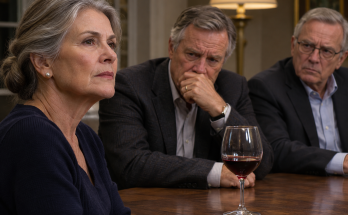
Diane was sitting beside me.
Ross stood near the window.
Nobody spoke.
Four million dollars.
Frank had spent decades giving away small amounts while a fortune sat somewhere untouched.
“Why didn't he take it?”
Michael opened another file.
“Because he believed accepting it would mean returning to the man his father wanted him to become.”
Ross shook his head.
“That sounds like Dad.”
Diane looked at me.
“Did he know about it?”
“Yes.”
“When?”
“All his life.”
I felt something strange.
Not anger.
Not surprise.
Something closer to admiration mixed with sadness.
Frank had walked away from millions.
He had built his own business.
He had married me.
He had raised children.
He had helped strangers.
He had taken care of Laura.
And he had done all of it without using the money that could have made everything easier.
Michael continued.
“The trust has accumulated interest.”
“How much now?”
He gave us the figure.
It was considerably larger.
Ross sat down.
“Oh.”
Diane stared at the page.
“What happens to it now?”
Michael looked at me.
“Legally, it passes to Frank's estate.”
I shook my head.
“No.”
Michael blinked.
“No?”
“I don't want it.”
Ross looked at me.
“Eileen.”
“No.”
Diane asked,
“What will you do with it?”
I thought about Emily House.
The people who had slept there.
The woman with the suitcase.
The children.
The young man who had returned to school.
The families who had found somewhere safe to breathe.
I knew what Frank would have done.
But I also knew this wasn't about copying him.
It was about deciding for myself.
“I'll expand Emily House.”
Ross smiled.
“I knew you'd say that.”
I looked at him.
“No.”
He frowned.
“No?”
“Not all of it.”
Diane looked at me.
“What then?”
“We establish a fund.”
“For what?”
“For people who don't need a house.”
Michael leaned forward.
I explained.
Emergency medical care.
Education.
Temporary housing.
Small business grants.
Legal assistance.
The kinds of things Frank had quietly paid for.
But this time, there would be no secrecy.
The recipients would know where the money came from.
And they would not owe us their gratitude.
They would owe themselves the chance to rebuild.
Michael nodded.
“That would be consistent with his wishes.”
I smiled.
“It isn't his wish anymore.”
Everyone looked at me.
“It's mine.”
That distinction mattered.
The fund was created six months later.
We named it the Emily Coleman Fund.
Laura objected to using Emily's surname.
“She belonged to herself,” she said.
So we changed it.
The Emily Fund.
Nothing more.
The first grant went to a medical student who had nearly dropped out.
The second helped a family leave an unsafe home.
The third repaired a small business after a fire.
The fourth paid for a young woman's surgery.
Each time, I signed the documents.
Each time, I thought of Frank.
But I no longer felt that I was carrying out his unfinished work.
I was doing my own.
That was the difference.
One evening, Diane and I sat on the porch at Emily House.
She was holding a cup of tea.
“You know what I realized?”
“What?”
“I spent my whole life thinking Dad's money was proof of how much he loved me.”
I waited.
“Then he died, and I realized he had been trying to teach me how to live without it.”
I smiled.
“He was stubborn.”
She laughed.
“Very.”
We watched the sun disappear.
“Do you ever wish things had been different?”
“Yes.”
“What would you change?”
I thought about it.
“I would ask more questions.”
She looked at me.
“About Dad?”
“About everything.”
She nodded.
“I would have listened more.”
We sat quietly.
Then she said,
“I think that's what he wanted.”
“What?”
“For us to stop assuming we already knew the truth.”
The words stayed with me.
Years earlier, Diane had assumed I was taking her mother's place.
Ross had assumed his father's love could be measured in money.
I had assumed Frank told me everything important.
Laura had assumed her past would always make her a ghost.
We had all been wrong.
Not because we were bad people.
Because people often mistake the parts they can see for the whole story.
Frank's final lesson had been simple.
Look again.
Ask.
Listen.
Then decide.
Laura died two years later.
Peacefully.
She had been asleep.
Diane was there.
I was there.
Ross arrived shortly afterward.
We sat around her bed.
There was no bitterness.
No competition.
No unfinished argument.
Before she died, Laura had given me one final instruction.
“Don't make me into a sad story.”
I promised.
So we didn't.
We remembered her laughter.
Her stubbornness.
Her terrible cooking.
Her habit of leaving books open everywhere.
Her love for old music.
We remembered Emily too.
Not as the child who died.
As the child whose brief life changed several others.
The Emily Fund continued.
Emily House expanded.
Eventually there were three houses.
Then five.
The work became larger than anything Frank could have imagined.
Diane ran the foundation.
Ross handled operations.
Michael remained the attorney.
And I became the person who visited every new house before it opened.
I always stood in the doorway.
I always looked around.
I always asked one question.
“Does this feel safe?”
If the answer was no, we fixed it.
If the answer was yes, we opened the doors.
Years after Frank's death, I returned to the old house one final time.
It had new owners.
A young couple lived there.
They had two children.
The woman invited me inside.
I almost declined.
Then I saw the window.
Frank's chair was gone.
The clock was gone.
The walls had been painted.
But sunlight still fell across the same floor.
I smiled.
The woman asked,
“Did you live here?”
“For nineteen years.”
“Was it a good home?”
I looked around.
“Yes.”
She smiled.
“Then I'm glad we found it.”
I walked outside.
The house no longer belonged to me.
And that was okay.
I didn't need it to.
Some places are meant to be lived in, not possessed forever.
I drove back toward the coast.
My mother's clock was waiting at home.
The photograph of Emily was in my wallet.
The letters from Frank were in a wooden box.
Laura's last photograph sat beside them.
And the sticky notes were tucked into a drawer.
Pink.
Blue.
Faded now.
Almost meaningless.
Except they weren't.
They reminded me of the woman I had been on the day of Frank's funeral.
A woman who believed she had to defend every object because losing the objects meant losing the life.
I knew better now.
The life wasn't in the furniture.
It wasn't in the house.
It wasn't in the money.
It wasn't even in Frank.
The life was in what remained after all of those things were gone.
Diane called that evening.
“Eileen?”
“Yes?”
“I found something.”
I laughed.
“You and Ross are always finding things.”
“This is different.”
“What is it?”
“Dad's old tape measure.”
I smiled.
“Ross had it?”
“Yes.”
“What are you going to do with it?”
“Keep it.”
I laughed.
“Why?”
“Because it reminds me of who I was.”
I became quiet.
Then Diane said,
“And who I became.”
I understood.
Some memories shouldn't be erased.
They should be kept where they can no longer hurt you.
After we hung up, I walked to the window.
The clock ticked softly.
The ocean was dark beyond the porch.
I thought about the day of the funeral.
Diane had marked my mother's clock.
Ross had measured the television.
They had come looking for what Frank left behind.
Instead, they found themselves.
And I had spent years believing Frank's final gift was freedom.
It wasn't.
Freedom had been the consequence.
The gift was truth.
Truth about Laura.
Truth about Emily.
Truth about the foundation.
Truth about the money.
Truth about Diane and Ross.
Truth about myself.
I had spent nineteen years thinking I needed to prove I belonged.
I didn't.
I had belonged because I loved him.
Because he loved me.
Because we built a life together.
And because that life was real even when other people refused to recognize it.
Frank was gone.
The house was gone.
The fortune was no longer sitting untouched.
Laura was gone.
Emily had never had the chance to grow up.
But something remained.
Not a monument.
Not a name carved into stone.
A door.
A safe room.
A warm bed.
A second chance.
A person being told, “You can stay until you're ready.”
That was enough.
I turned off the kitchen light.
Before going to bed, I touched the wooden clock.
Tick.
Tick.
Tick.
For a moment, I imagined Frank beside me.
Not speaking.
Just smiling.
I didn't ask him whether he was proud.
I didn't ask whether I had done enough.
I didn't ask what he wanted next.
I had finally learned the lesson he had been trying to leave me all along.
There would always be another choice.
And this time, I would make it myself.
ENDPART 9 TITLE: The Life Frank Left Unfinished
The first morning after I decided to build the Emily Fund, I woke before sunrise with the strange feeling that I had inherited something much larger than money. The house was quiet, the kettle had not yet begun to whistle, and for several minutes I simply sat at the kitchen table with both hands wrapped around a cup of coffee. Frank had spent years making decisions in rooms I never knew existed. He had helped strangers without telling me. He had carried guilt from one decade into another. He had built a hidden network of promises and called it responsibility. Now, for the first time, there was nothing hidden from me. The choice belonged entirely to me.
I opened the folder Michael had left on the table the night before. The old trust from Frank’s father was still difficult to understand. Four million dollars had once been placed beyond Frank’s reach, then quietly accumulated over decades. Frank could have taken it. He could have used it to expand his business, buy another house, build the kind of life his father had expected him to build. Instead, he had walked away from it. The money had remained untouched because Frank refused to become dependent on the values that had once demanded he choose between love and obedience.
I read the documents again, slowly. There was no grand instruction attached to the money. No final command. No clause saying it had to become a foundation or fund. Frank had not decided this for me. That realization mattered more than the amount itself. He had spent so much of his life trying to repair damage through action that I had begun to assume every discovery came with an assignment. But this one did not. The money was simply there. What I did with it would be mine.
I called Michael after breakfast. He answered on the third ring.
“You're awake early,” he said.
“I don't think I've slept properly in weeks.”
He laughed softly. “That sounds more like grief than insomnia.”
“I want to do something with the trust.”
There was a pause.
“What kind of something?”
“I don't know yet. That's the problem.”
“That may actually be the healthiest answer you've given me.”
I smiled despite myself. “Frank would have hated that.”
“No,” Michael said. “Frank would have understood it better than anyone.”
Later that morning, Diane arrived without warning. She stood on the porch holding a cardboard box against her chest. She looked older than she had six months earlier, though perhaps it was simply that I no longer saw her through the lens of resentment. The first time she had come to that house after Frank's funeral, she had measured furniture with sticky notes. Now she was holding a box of old files and photographs as if she were afraid to put them down.
“I found these in Dad's storage room,” she said.
“You could have called.”
“I almost did.”
“Why didn't you?”
“Because I didn't know if I was coming as his daughter or as your family.”
The sentence caught me off guard.
“You don't have to choose.”
She looked at me for a long moment. “I think Dad spent his whole life trying to make people understand that.”
I stepped aside and let her in.
We spread the contents of the box across the dining room table. There were photographs, receipts, handwritten notes, old business cards, and several envelopes bearing names I did not recognize. Some were people Frank had helped through the Harbor Foundation. Others were connected to the Emily House project we had begun from the cottage. Diane handled everything carefully, no longer treating his possessions as objects waiting to be claimed.
“This one,” she said, holding up a photograph, “I remember.”
It was Frank standing outside a grocery store with an elderly man I had never seen before.
“Who is he?”
“Mr. Alvarez. Dad helped him keep his store open.”
“For how long?”
Diane turned the photograph over.
“Eight years.”
I stared at her.
“Eight years?”
She nodded. “Apparently the man never knew who was paying his back rent.”
Something shifted inside me. Frank had never needed applause. He had not even needed acknowledgment. He had simply found a problem and decided that, if he could help, he would.
Diane looked at the photograph again.
“I used to think Dad was secretive because he didn't trust us.”
“Maybe he was secretive because he didn't want gratitude.”
She shook her head.
“No. I think he was secretive because he didn't want anyone to owe him.”
That sounded exactly like the man I had slowly come to understand.
Ross arrived an hour later. He had grease on one sleeve and a folder under his arm.
“Car trouble?” I asked.
“Emily House van.”
“You have a van now?”
“Technically, the foundation has a van. I'm just the person who keeps it alive.”
Diane smiled. “He likes having something that breaks for a legitimate reason.”
Ross gave her a look.
“I heard that.”
For once, the room felt ordinary.
We spent the afternoon discussing the Emily Fund. The plan changed several times. At first I wanted it focused entirely on housing. Then Diane suggested emergency education grants. Ross wanted assistance for people trying to keep small businesses alive. Michael, joining us by speakerphone, reminded us that the fund needed boundaries if we wanted it to survive beyond our own intentions.
By sunset, we had a rough structure. The fund would help with medical emergencies, education, temporary housing, legal assistance, and small opportunities that could change someone's direction. It would not become a machine for rescuing people from every consequence. Frank had taught me that compassion without boundaries could become another form of harm.
I wrote that sentence down.
Diane watched me.
“You sound like Dad.”
“I don't know whether that's a compliment.”
“It is now.”
We laughed.
That evening, after everyone left, I returned to the old office. Frank's chair remained near the window. I had resisted sitting in it for months. It still felt too much like trespassing.
But that night I sat down.
The room smelled faintly of cedar and old paper. On the desk was the photograph Laura had given me of Frank holding baby Emily. I touched the corner of the frame.
“I think I finally understand,” I whispered.
Not everything.
Maybe I would never understand everything.
But enough.
Frank had not spent his life collecting secrets. He had spent it trying to keep his failures from becoming someone else's inheritance.
I opened the bottom drawer.
Inside was the old tape measure Ross had mentioned. I picked it up and smiled. For years, Frank had measured rooms, furniture, shelves, buildings, distances. Diane had once used sticky notes to measure what she believed belonged to her. Now the same family was using that old tape measure to determine how much space could be made for other people.
The irony was almost too perfect.
My phone rang.
It was Laura's apartment number.
My heart tightened.
“Hello?”
Her voice was weak but calm.
“Eileen?”
“Yes.”
“I wanted to hear your voice.”
I closed my eyes.
We spoke for nearly an hour. She asked about the Emily Fund. I told her everything.
“You know,” she said, “Emily would have liked that.”
“You think so?”
“I know so.”
There was silence.
Then Laura said, “Frank spent years trying to make peace with what happened to her. You are doing something different.”
“What?”
“You're letting her life mean something without making her death your responsibility.”
I swallowed hard.
“I miss him.”
“I know.”
“I still talk to him.”
“So do I.”
The next morning, Laura was gone.
Her passing was peaceful, just as she had wanted. There was no emergency, no dramatic final scene, no unfinished confession. She had simply reached the end of a long illness after finally making peace with the man who had been both her first love and one of the deepest wounds of her life.
I went to her apartment that afternoon.
On the table beside her chair was a sealed envelope with my name on it.
Inside was one final photograph of Frank.
On the back, Laura had written only one sentence:
He loved you in the life that came after everything else.*
I sat there for a long time.
Then I cried.
Not because I was losing Frank again.
Because I finally understood that love did not have to be a competition between ghosts.
Laura had never been my rival.
She had been another person who had loved a complicated man and survived the parts of him that had hurt her.
I folded the photograph carefully and placed it inside my purse.
Outside, the evening light settled over the street.
For the first time since Frank died, I did not feel as though the past were standing behind me.
It was beside me.
And that was different.
END PART 9
Click here to continue reading: PART 9: A Choice That Belonged to Me
Before the Funeral Food Was Cleared, My Stepchildren Had Already Decided Which Pieces of My Life Belonged to Them
Part 8 of 20