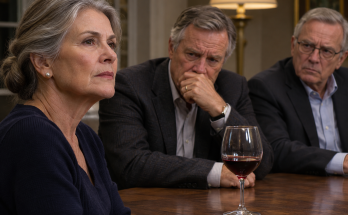
By spring, the Emily Fund had outgrown the office.
Not physically.
In responsibility.
There were too many applications, too many mentors, too many families, too many stories arriving in envelopes and emails from people who had never heard Frank's name but had somehow benefited from choices he had made years before.
The board considered moving into a larger building.
Diane argued against it.
“We don't need impressive,” she said during the meeting. “We need useful.”
Michael nodded.
Ross, now helping with operations and repairs, added, “And affordable.”
I sat at the end of the table and listened.
Once, Frank had sat in rooms like this and made decisions alone.
Now nobody could.
That was progress.
Not because groups were always wiser than individuals.
They weren't.
But disagreement forced people to explain themselves.
And explanation made hidden assumptions visible.
After the meeting, Diane walked me outside.
“You're smiling.”
“I am?”
“Yes.”
“I'm proud of you.”
“I know.”
“That's becoming irritating.”
She laughed.
We stood beneath a tree beginning to flower.
“There's something else,” she said.
“What?”
“I want to step down from the board.”
I looked at her.
“Why?”
“Because I don't want to become what Dad was.”
The sentence landed harder than she intended.
“You won't.”
“I could.”
She looked toward the building.
“I've been here long enough to start believing my opinion matters more than everyone else's.”
“Does it?”
“No.”
“Then you're safe.”
She smiled.
“I want to work with the students directly.”
“That sounds like you.”
“I think I need to remember why I started.”
“Then do it.”
She hugged me.
Before she left, she turned.
“Would you be disappointed?”
“No.”
“Dad might have been.”
“He isn't here.”
She nodded.
“I know.”
There it was again.
The sentence that had once meant resignation.
Now it meant freedom.
That summer, I traveled again.
Not for a month this time.
Six weeks.
I went north first, then inland, then back toward the ocean.
I stayed in small hotels.
I ate breakfast alone.
I sat in bookstores until employees turned the lights down.
I bought another pair of ridiculous shoes.
I sent Ross a photograph.
He replied:
*Those are a crime.**
I wrote:
*They're comfortable.**
He answered:
*That's worse.**
I laughed so loudly in the hotel lobby that two strangers turned around.
Years earlier, I would have apologized.
Instead, I smiled at them.
“Sorry,” I said anyway.
Old habits die slowly.
But they die.
One evening, I sat at a café overlooking a harbor.
A young couple at the next table was arguing quietly.
Not dramatically.
Just two tired people disagreeing about where to live.
I listened for a moment before looking away.
I remembered how often Frank had tried to prevent conflict by solving it before it happened.
He believed peace meant silence.
I had learned that peace sometimes meant surviving the conversation.
The next morning, I received a message from Diane.
A student had completed her nursing degree.
She wanted to become a mentor.
I smiled.
The cycle was working.
Not because people were repaying a debt.
Because they had discovered they could carry something forward without carrying it exactly as they had received it.
That was the kind of inheritance I trusted.
A few weeks later, I returned home.
There was a package waiting.
Inside was a small wooden box.
Ross had made it.
The craftsmanship was uneven.
One corner sat slightly higher than the others.
I loved it immediately.
Inside was the tape measure.
He had cleaned it.
On the lid he had burned four words.
*Measure what matters.**
I sat at the kitchen table and ran my fingers over them.
Then I laughed.
“Your father would have loved this.”
I stopped.
I had said the sentence naturally.
Not painfully.
Not ceremonially.
Just naturally.
That was new.
I put the box beside the clock.
That evening, Diane called.
“I have news.”
“Are you pregnant?”
“No.”
“Then I don't know.”
“I got accepted.”
“Into what?”
“The counseling program.”
I stood up.
“You're going back to school?”
“Yes.”
“When did you decide?”
“A while ago.”
“Why didn't you tell me?”
“I wanted to make sure I was doing it for me.”
I sat again.
“I'm proud of you.”
She was quiet.
Then she said, “I used to think you were the person standing between Dad and us.”
My chest tightened.
“I know.”
“But now I think you were the person standing there when we weren't ready to see ourselves.”
I didn't answer.
She continued.
“I don't know whether that's fair.”
“Probably not.”
She laughed.
“That's why I love talking to you.”
“Because I'm difficult?”
“Because you don't make everything beautiful.”
That was perhaps the greatest compliment anyone had ever given me.
The world was not beautiful all the time.
Frank's secrets had not been beautiful.
Laura's suffering had not been beautiful.
Emily's death had not been beautiful.
The years of cruelty between Diane, Ross, and me had not been beautiful.
But none of those things had made the rest of life worthless.
That was the difference.
Beauty did not have to erase pain.
It could exist beside it.
Autumn came quietly.
One morning, I found myself standing in front of the old photograph again.
Frank held Emily.
His face was young.
Her fingers were curled against his shirt.
For years I had thought the photograph represented everything he had lost.
Now I saw something else.
It represented the beginning of his lifelong struggle with love.
He had spent years believing that loving someone meant preventing loss.
Eventually, he learned that it meant continuing after loss.
Perhaps that was what I had learned too.
Not from his secrets.
Not from his letters.
From surviving him.
A week later, Laura's old apartment was emptied.
She had been gone for years, but some things remained in storage.
Michael asked if I wanted anything.
I said no.
Then I changed my mind.
I asked for one thing.
A small ceramic cup Laura had used for coffee.
When it arrived, I placed it in my kitchen.
Diane saw it and asked why I wanted it.
“Because she liked coffee.”
“That seems like a strange reason.”
“It is.”
She smiled.
“Okay.”
No one needed to understand.
That was another freedom.
I no longer needed permission for my own memories.
Near the end of the year, the Emily Fund approved its largest group of grants yet.
I signed the final documents.
Then I put the pen down.
There was no ceremony.
No photograph.
No speech.
Just paperwork.
I thought of Frank.
Then I thought of Laura.
Then Thomas.
Then Emily.
Then my mother.
Then Diane.
Ross.
Michael.
All the people whose lives had crossed mine.
I realized something.
My life was not a straight line.
It was a collection of crossings.
Some lasted decades.
Some lasted minutes.
Some left scars.
Some left gifts.
None required me to remain standing at the place where they had ended.
That night, I walked onto the porch.
The ocean was black beneath the moon.
I heard the clock through the open window.
Tick.
Tick.
Tick.
I smiled.
I wasn't waiting for anything.
I wasn't listening for a message.
I wasn't asking whether Frank approved.
I was simply alive.
And that was enough.
Click here to continue reading: PART 20: The Second Goodbye
Before the Funeral Food Was Cleared, My Stepchildren Had Already Decided Which Pieces of My Life Belonged to Them
Part 19 of 20