Years passed.
The company grew.
The scholarship program expanded.
The apprenticeship center became one of the busiest parts of the business.
Sophie eventually joined the company.
Not because she was my daughter.
Because she earned it.
She started in the field.
She spent mornings learning project scheduling and afternoons working with apprentices.
She hated being treated differently.
So I made sure no one did.
When she made mistakes, she corrected them.
When she succeeded, she received credit.
When someone assumed she had been handed everything, she simply showed them her work.
That was enough.
Claire continued rebuilding her life away from her father's influence.
She never asked me to return.
She never demanded that Sophie forgive her.
She wrote occasionally.
Short messages.
No excuses.
No pressure.
Sophie answered when she wanted.
Sometimes months passed.
Sometimes they spoke for an hour.
Their relationship never returned to what it had been before Christmas Eve.
But it became something more honest.
That was enough.
Martin eventually served his sentence.
His sons faced their own legal consequences.
The family business connections disappeared.
The people who had once gathered around Martin slowly scattered.
Some blamed him.
Some blamed themselves.
A few never admitted wrongdoing.
I stopped caring.
That was the final freedom.
Not needing them to admit what they had done.
I already knew.
And more importantly, Sophie knew.
One winter evening, years after everything had ended, my daughter and I sat on the porch of our new home.
Snow was falling softly.
She had a mug between her hands.
I had coffee.
The porch light cast a warm circle onto the steps.
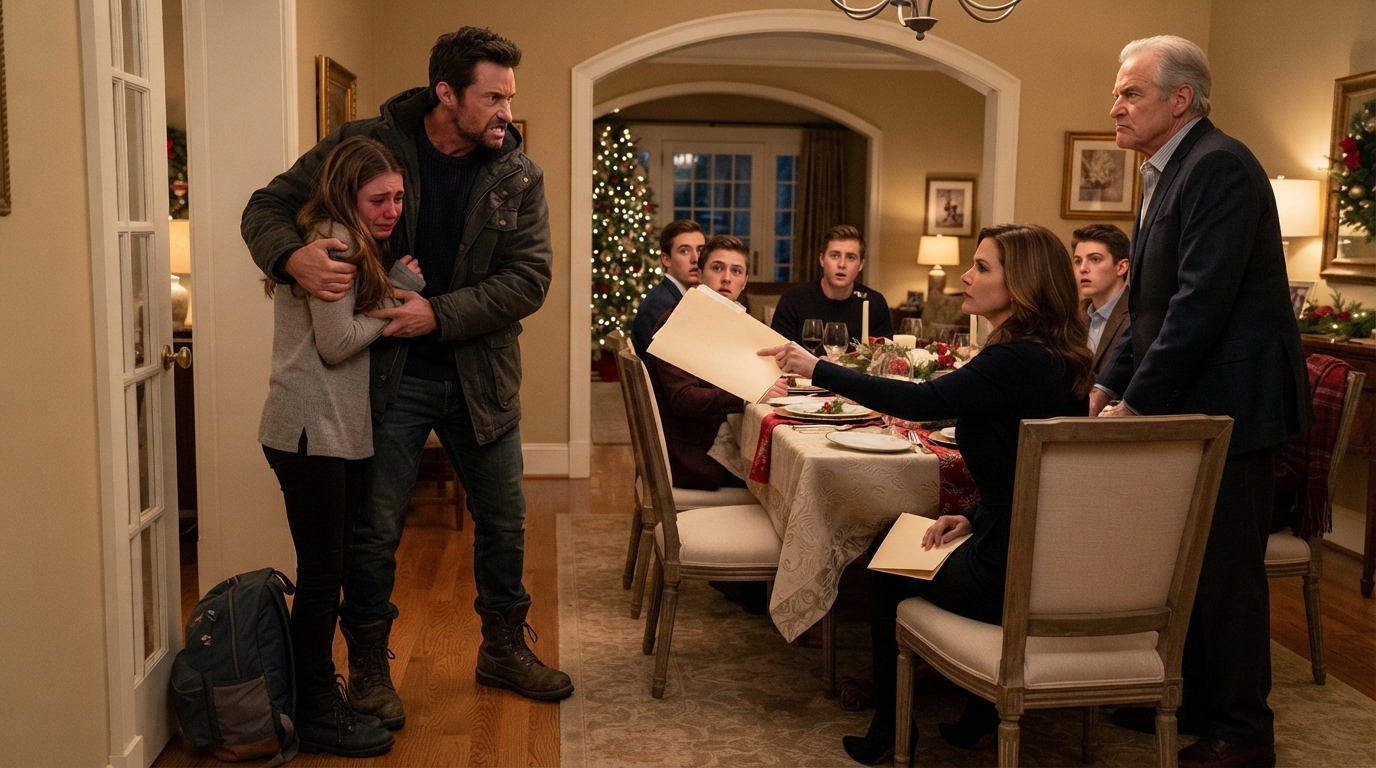
She looked older than the girl who had once stood outside in a thin sweater while her grandfather called her baggage.
But I could still see that girl in her eyes.
“Dad?”
“Yeah?”
“Can I ask you something?”
“Anything.”
“Do you ever wish you had told them who you really were sooner?”
I smiled.
I had thought about that question many times.
“No.”
She looked surprised.
“Why not?”
“Because if I had told them sooner, I would have learned who they really were much later.”
She considered that.
Then she nodded.
“I understand.”
The snow continued falling.
Neither of us moved.
After a while, she said, “Do you remember the company lobby?”
“Of course.”
“The first night you showed me.”
“You were shocked.”
“I thought you were secretly some billionaire.”
I laughed.
“I wasn't.”
“You owned a sixteen-million-dollar company.”
“That doesn't make someone a billionaire.”
“You know what I mean.”
I smiled.
“I do.”
She looked toward the driveway.
“I remember asking whether the company was ours.”
“You did.”
“And you said no.”
“It was mine.”
She smiled.
“I liked that answer.”
“Why?”
“Because nobody had given it to us.”
I nodded.
“That mattered to you.”
“It still does.”
She turned toward me.
“Do you know what I learned from all of this?”
“What?”
“That money isn't the opposite of being poor.”
I raised an eyebrow.
She continued.
“Being poor is sometimes having no choices.”
I was quiet.
She looked at the snow.
“You had money, but you were still trapped for years.”
“Yes.”
“Because you were afraid of losing people.”
I nodded.
“And then you realized losing the wrong people wasn't losing everything.”
I looked at her.
“That's exactly right.”
She smiled.
“I think that's why the scholarship matters.”
“It does.”
“Because you're giving people choices.”
I looked toward the distant lights of the training center.
“That's what I wanted.”
“Not revenge?”
“No.”
“Not proving Grandpa wrong?”
“No.”
“Then what?”
I thought about the first paycheck.
The first building.
The first employee.
The first time Sophie had held my hand during a difficult conversation.
“A future.”
She smiled.
“That sounds like you.”
We sat quietly again.
The snow became heavier.
I watched flakes settle on the railing.
For years, snow had reminded me of that Christmas Eve.
The cold.
The porch.
The thin sweater.
The silence.
The divorce papers.
But now it meant something else.
Warmth.
Home.
My daughter beside me.
A life that no one else controlled.
Sophie nudged my shoulder.
“Dad?”
“Yeah?”
“Would you do anything differently?”
I smiled.
“Yes.”
“What?”
“I'd listen when you told me you were hurt.”
She looked down.
“I was loud.”
“You were.”
“I was also annoying.”
“Extremely.”
She laughed.
Then she became serious.
“I mean it.”
“So do I.”
She rested her head against my shoulder.
“I think you did okay.”
I kissed the top of her head.
“Thank you.”
A few weeks later, Sophie accepted a position at the company.
She didn't take my office.
She didn't want it.
She chose the training division.
“I want to work with the teenagers,” she said.
“Why?”
“Because I know what it feels like to think everyone else has something you don't.”
I nodded.
“You'll be good at it.”
“I hope so.”
“You will.”
She smiled.
Then she added, “Eventually, though, I might run the whole company.”
I laughed.
“There she is.”
“What?”
“The ambition.”
“You taught me.”
I shook my head.
“No. You had that already.”
She smiled.
The company continued growing.
We opened another training center.
Then another.
The scholarship program funded students who would otherwise have left school to work.
Some became electricians.
Some carpenters.
Some engineers.
One became an architect.
Another came back years later as a project manager.
Every time someone told me the program had changed their life, I thought about Sophie.
Not about the money.
About the night she asked, Which home?
That question had changed mine.
Because I realized I had spent years trying to keep a marriage alive while my daughter was quietly learning that love could be conditional.
I couldn't undo that.
But I could make sure she never had to question it again.
One afternoon, Sophie and I stood in the company lobby beneath the sign.
The old plaque had been moved to a hallway.
The new display showed photographs from the scholarship program.
Sophie looked at them.
“You know what I like?”
“What?”
“You didn't name the program after yourself.”
I smiled.
“Why would I?”
“Some rich people would.”
“I don't want the students remembering my name.”
“What should they remember?”
“That someone gave them a chance.”
She nodded.
“That sounds right.”
Then she looked at the old plaque.
Founded by Daniel Whitaker.
2011.
She smiled.
“You were really young.”
“I was.”
“Were you scared?”
“Every day.”
“You didn't look scared.”
“That was the trick.”
She laughed.
I looked at the plaque.
For years, I had believed the greatest thing I had built was that company.
I was wrong.
The company had given me money.
The money had given me choices.
But Sophie had taught me what to do with those choices.
That was the real inheritance.
Not the buildings.
Not the contracts.
Not the millions.
The ability to choose a life based on values instead of fear.
Years later, I drove past Martin's old house.
It had been sold.
The windows were different.
The landscaping was gone.
There was no sign of the family gatherings that had once filled the rooms.
I didn't slow down.
There was nothing left there for me.
The Collins family had once thought I was a broke handyman.
They mocked my old truck.
They laughed at my clothes.
They assumed I had married into their wealth.
They believed they could pressure my wife, hurt my daughter, manipulate a divorce, and eventually take control of a company they had never owned.
They were wrong.
But the important part wasn't that they were wrong.
The important part was what I did after learning the truth.
I didn't destroy them.
I didn't humiliate them.
I didn't take what belonged to Claire.
I didn't punish relatives who hadn't known what was happening.
I protected what was mine.
I gave back what wasn't.
And then I walked away.
That was freedom.
Not watching Martin lose.
Not hearing people admit they had underestimated me.
Not seeing my name in the newspaper.
Freedom was waking up one morning and realizing I no longer cared what any of them thought.
The greatest answer I could give them was not revenge.
It was the life they could never take from me.
A life built carefully.
A life built honestly.
A life with my daughter beside me.
Years after Christmas Eve, Sophie and I sat on another porch while snow fell around us.
She was grown now.
She had her own career.
Her own apartment.
Her own plans.
But she still came home for the holidays.
She looked at me.
“Dad?”
“Yeah?”
“I'm glad you came that night.”
I smiled.
“For you?”
“For me.”
I squeezed her hand.
“I'd come every time.”
She leaned against me.
The snow continued falling.
This time she wore gloves.
A thick coat.
Warm boots.
She was safe.
She was home.
And I finally understood the difference between having a house and having a home.
A house is something you own.
A home is somewhere you are free to be yourself.
I had spent years building houses.
I had spent years building a company.
But the greatest thing I ever built was the relationship between a father and the daughter who stood beside him when everyone else walked away.
That was worth more than every dollar Martin had tried to steal.
More than every insult his family had thrown at me.
More than every building carrying my name.
Sophie squeezed my hand.
“Dad?”
“Yeah?”
“Are you happy?”
I looked at the snow.
Then at my daughter.
Then at the warm light coming through the windows behind us.
“Yes.”
She smiled.
“Good.”
I smiled back.
And for the first time, when the snow began to fall, neither of us was afraid of the cold.
Because we had finally learned that a family isn't defined by the people who share your name.
It is defined by the people who choose you when choosing you costs them something.
And that Christmas Eve, my daughter had chosen me.
So I chose her.
And I would keep choosing her.
Every time.
The End
Read more original stories on Feel Every Story.
My Daughter Called Me From the Cold, and Within Minutes I Knew the Family I Had Protected Was No Longer Worth Protecting
Part 20 of 20