For several seconds, I simply stood there with the envelope open in my hand.
The restaurant continued around us. A server passed carrying dessert plates. Someone laughed at another table. Music drifted through the speakers.
But my family had gone silent.
My mother stared at the key.
It was small and dull with age, the brass darkened except where years of handling had worn the edges smooth. Near the top, three numbers had been engraved into the metal.
317.
I turned it over.
Nothing else.
The letter was written on heavy cream-colored paper. The handwriting belonged to a man I didn't know.
Claire,
If this has reached you, then I have finally located you.
Your grandmother, Evelyn Thompson, instructed me to give you the enclosed key only after your father officially retired.
She believed certain members of the family would prevent the truth from being discovered before that time.
Please come to my office tomorrow morning.
Come alone.
There are documents that belong to you and you alone.
Harold Simmons.
I read it again.
Then once more.
My father's name was Robert.
My grandmother had been Evelyn.
The words about my father retiring were unmistakable.
I looked at Dad.
He was reading my face rather than the letter.
“What truth?” he asked.
“I don't know.”
My mother pushed her chair backward so quickly it struck the wall.
“We're leaving.”
I looked at her.
She pointed toward the envelope.
“Give that to me.”
“No.”
“Claire.”
“No.”
Her voice hardened.
“I said give it to me.”
“Why?”
She stopped.
“Because you don't understand what you're holding.”
“Then explain it.”
Her mouth opened.
Closed.
For once, my mother had no immediate answer.
Eric looked between us.
“Mom, what is going on?”
She ignored him.
Instead, she stepped closer.
“I am your mother.”
“I know.”
“I have a right to know.”
“If Grandma wanted you to know, she could have addressed the letter to you.”
That landed harder than I expected.
Mom's face tightened.
Dad stood slowly.
“Margaret.”
She wouldn't look at him.
“What's in that letter?”
Still nothing.
Then she whispered, “I thought she destroyed everything.”
Dad frowned.
“Destroyed what?”
My mother looked at me.
“I tried to protect this family.”
My stomach tightened.
“From what?”
She shook her head.
“You're going to hate me.”
I almost laughed, though nothing about the moment was funny.
“I don't know if there's anything left for you to say that would surprise me.”
She flinched.
Dad took a step toward her.
“Margaret, what happened?”
She remained silent.
I looked back at the letter.
Near the bottom, beneath Harold Simmons's signature, I noticed a second handwritten sentence.
The ink was lighter.
I had missed it the first time.
Please do not bring your mother.
My father saw the line at almost the same moment.
His face changed.
Mom saw it too.
She sank into her chair.
No one spoke.
I folded the letter and put it back inside the envelope.
“I have an appointment tomorrow.”
Dad looked at me.
“I'll come.”
I shook my head.
The letter had been very clear.
Bring no one.
Especially not my mother.
I took Noah's hand.
“We're going home.”
Nobody stopped us.
The drive home was quiet.
Noah watched the streetlights slide across the passenger window. I kept both hands on the steering wheel, although my thoughts were nowhere near the road.
Finally, he spoke.
“Mom?”
“Yeah?”
“Did I do something wrong tonight?”
I felt my chest tighten.
I pulled into the garage and turned off the engine.
“No.”
He looked at me.
“Then why didn't Uncle Eric want me to have steak?”
There was no good answer for an eight-year-old.
So I gave him the honest one.
“Sometimes adults make choices that have nothing to do with whether a child deserves something.”
He frowned.
“That doesn't make sense.”
“No,” I said. “It doesn't.”
I unbuckled and turned toward him.
“When I was little, Grandpa once took me to a diner.”
Noah smiled faintly.
“Really?”
“Really. We didn't have much money.”
“What did you eat?”
“One hamburger.”
“Just one?”
“Just one.”
I smiled at the memory.
“Your grandfather cut it in half.”
“And you got half?”
“The bigger half.”
Noah laughed.
“Did Grandpa keep the small piece?”
“He did.”
“That's not fair.”
“No.”
I touched his hair.
“But he gave me the bigger half because he loved me.”
Noah became quiet.
“So people who love you don't make you earn food?”
“Exactly.”
He leaned against me.
“Then I think I like hamburgers better anyway.”
I laughed.
“That's convenient.”
He smiled.
A real smile.
Then he hugged me.
For a few minutes, the strange envelope and brass key disappeared from my thoughts.
After putting Noah to bed, I returned to the kitchen.
The house was silent.
I placed the envelope beside the sink.
Then I took out the key.
317.
I rolled it between my fingers.
What did it open?
A safe deposit box?
A storage locker?
A private drawer?
Something hidden in my grandmother's old house?
Why had she waited until Dad retired?
Why had she specifically excluded Mom?
And why had an attorney kept this secret for twelve years?
At midnight, my phone rang.
Dad.
I answered.
“Are you okay?”
“No.”
His voice sounded exhausted.
“What happened?”
“Your mother left.”
I sat upright.
“What?”
“She packed a suitcase.”
“Where is she going?”
“She wouldn't tell me.”
“What did she say?”
There was a long silence.
Then Dad breathed out slowly.
“She said something I don't understand.”
“What?”
He swallowed.
“She said that if you open whatever that key unlocks, our family will never be the same.”
I looked toward the kitchen.
The brass key lay beneath the light.
I didn't sleep much that night.
The next morning, I dropped Noah at school.
He waved from the entrance.
“Good luck, Mom.”
I smiled.
“Thanks, buddy.”
Then I drove downtown.
Harold Simmons's office occupied the third floor of an old brick building whose lobby smelled faintly of paper and floor polish. The receptionist checked my name and immediately stood.
“Mr. Simmons is expecting you.”
She led me down a quiet hallway.
The attorney was older than I expected.
Gray hair.
Careful movements.
Kind eyes.
He looked like a man who had spent decades learning how to keep other people's secrets without letting them become his own.
“Claire Thompson.”
He offered his hand.
“Harold Simmons.”
I shook it.
“You knew my grandmother?”
“For thirty-four years.”
He gestured toward a chair.
I sat.
His eyes immediately went to the brass key.
“You brought it.”
“I don't know what it opens.”
“You will.”
He crossed the room to a filing cabinet.
After unlocking the bottom drawer, he removed a thick folder.
My grandmother's handwriting appeared across the front.
OPEN ONLY AFTER ROBERT RETIRES.
My father's name.
Robert.
Harold placed the folder on the desk.
But he didn't open it.
Instead, he looked directly at me.
“Before we begin, I need to ask you something.”
“What?”
“Has your mother contacted you since last night?”
“No.”
He nodded.
“Good.”
My stomach tightened.
“Why?”
“Because once you see what's inside this folder, you'll understand why she spent twelve years hoping this appointment would never happen.”
He pushed the folder toward me.
I placed my fingers against the edge.
“Harold?”
“Yes?”
“Was my grandmother wealthy?”
He gave me a faint, almost sad smile.
“That is the first question you should ask.”
I opened the folder.
The first document wasn't a will.
It wasn't a property deed.
It wasn't a letter.
It was a bank statement.
I looked at the balance.
$2,843,611.42.
For several seconds, I couldn't make sense of the numbers.
Then I read the account holder.
EVELYN THOMPSON FAMILY TRUST.
Beneath it was the beneficiary.
Claire Thompson.
My name.
I looked up at Harold.
“There has to be a mistake.”
“There isn't.”
“My grandmother lived in a two-bedroom house.”
“I know.”
“She drove the same car for twenty years.”
“I know.”
“She clipped coupons.”
“I know.”
“Then where did nearly three million dollars come from?”
Harold leaned back.
“Your grandmother was never poor, Claire.”
I stared at him.
“She chose to look poor.”
“Why?”
His answer came quietly.
“Because she spent the final years of her life trying to discover which members of her family loved people, and which members loved what people could provide.”
He opened another drawer.
Inside were notebooks.
Dozens of them.
Every one bore my grandmother's handwriting.
The first was labeled Family Observations.
I opened it.
She had recorded birthdays, holidays, visits, phone calls, favors, arguments, illnesses, and small moments that no one else would have considered important.
Then I found my name.
Claire.
Always arrives with groceries.
Repairs things before being asked.
Never asks for repayment.
Apologizes when work keeps her away.
I don't think she understands how much of this family rests on her.
I swallowed.
Then I turned the page.
Eric.
Appears before holidays.
Often needs money.
Asks about investments.
Leaves quickly.
Rarely asks how I am.
Another entry was only one sentence.
Today he asked whether my house had been appraised.
My fingers stopped moving.
Harold watched me.
“Your grandmother kept records because she was trying to understand something.”
“What?”
“Who would still love one another if the money disappeared.”
I looked at the enormous trust balance.
Then at the family account I had been funding.
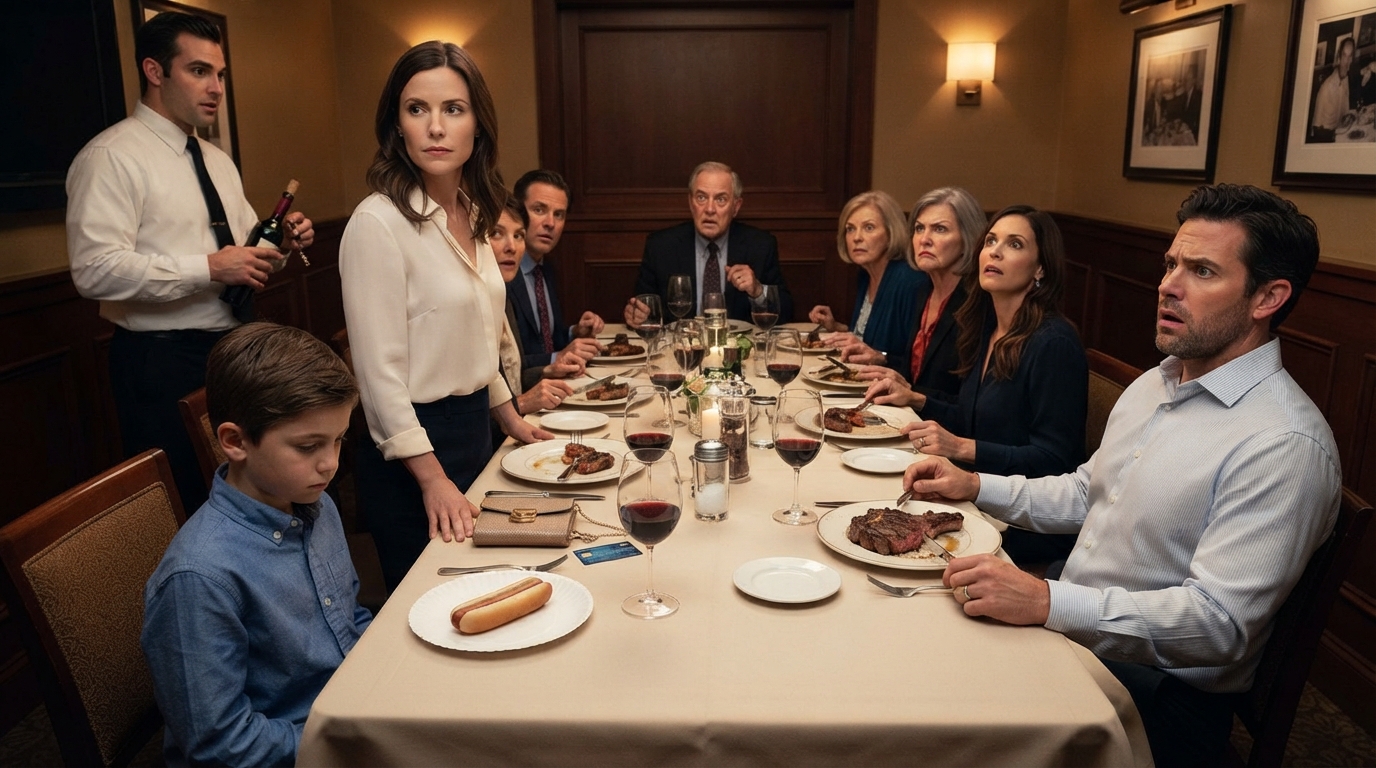
Then at the memory of Noah eating a hotdog while everyone else ate steak.
For the first time, I wondered whether tonight's humiliation had been the final piece of something my grandmother had started twelve years earlier.
Harold closed the notebook.
“The trust was not originally meant to belong only to you.”
I looked at him.
“What changed?”
He reached for another envelope.
And placed a hospital photograph on the desk.
I recognized the room immediately.
My mother's surgery.
The medical crisis that had changed my finances three years earlier.
The crisis I had believed had emptied my savings.
Harold placed the hospital records beside it.
“Do you remember how much you paid?”
“Forty-one thousand, two hundred sixty dollars.”
He nodded.
“You worked overtime.”
“Yes.”
“You sold your car.”
“Yes.”
“You canceled your vacation.”
“Yes.”
“I know.”
Then he turned over one more document.
A hospital receipt.
Stamped in green.
PAID IN FULL.
The date was one week before I had withdrawn my savings.
I stared at it.
“What is this?”
Harold's voice was gentle.
“Your grandmother paid the entire bill.”
I looked at him.
“She what?”
“She paid it directly.”
He showed me the transfer confirmation.
My grandmother's signature.
The hospital's acknowledgment.
Everything was there.
My hands went cold.
“If she paid it…”
I couldn't finish.
Harold completed the sentence.
“Then we need to find out where your money actually went.”
Click here to continue reading: PART 4: My Grandmother Had Quietly Paid the Medical Bill I Nearly Ruined Myself Covering, and the Records Revealed Where My Missing Money Had Gone
My Son Watched His Cousins Eat Steak While My Brother Served Him a Hotdog, and I Finally Decided to Stop Pretending Nothing Was Wrong
Part 3 of 20