The courthouse was already crowded when we arrived.
Reporters stood near the entrance.
Lawyers spoke quietly in clusters.
People who had never cared about our family suddenly wanted to know who owned the land.
I kept my eyes forward.
Harold walked beside me.
Dad followed.
Mom came behind him.
Eleanor waited inside.
Eric was being brought in separately.
I looked toward the courtroom doors.
“Where is Bell?”
Harold glanced at his watch.
“Not here yet.”
“That doesn't surprise me.”
“What does?”
He lowered his voice.
“He requested a delay.”
“Did the judge grant it?”
“No.”
We entered.
The judge reviewed the preliminary filings.
Bell's attorney argued that the trust should be frozen until ownership could be determined.
Harold agreed to temporary preservation.
Then he requested permission to submit the original records.
The opposing attorney objected.
“Those documents were discovered only after the beneficiary began this dispute.”
Harold answered calmly.
“They were preserved by the decedent and independently corroborated.”
The judge looked at me.
“Ms. Thompson, do you understand that submitting these records may affect your own financial interests?”
“Yes.”
“And you still wish to proceed?”
“Yes.”
“Why?”
I looked at the ledgers.
“Because if property was taken from people who had a right to it, I don't believe keeping it becomes right simply because my family passed it down.”
The courtroom became quiet.
The judge nodded.
“Proceed.”
Harold presented the first ledger.
Then the second.
Then the original deeds.
He explained the discrepancies.
Amounts promised.
Amounts actually paid.
Companies involved.
Transfers.
Dates.
Signatures.
The evidence created a pattern without needing dramatic language.
Bell's attorney stood.
“Your Honor, these documents require interpretation.”
“Of course,” the judge said.
“And some annotations are handwritten.”
“Yes.”
“They may not be authentic.”
Harold called Eleanor.
She testified first.
She explained Edward's role.
She described the original investigation.
She identified his handwriting.
Bell's attorney challenged her credibility.
“You allowed your family to believe you were dead.”
“Yes.”
“For decades?”
“Yes.”
“Why should this court believe anything you say?”
Eleanor looked at him.
“Because I am not asking the court to believe me.”
She pointed toward the documents.
“I am asking you to read them.”
The attorney had no immediate response.
Next came Dad.
He described the documents he signed when he was twenty-three.
He admitted that he had not understood their full purpose.
The attorney asked whether he benefited.
“Yes.”
“Then you had a reason to protect the arrangement.”
“I did.”
“Did you?”
Dad looked toward me.
“For many years.”
The honesty weakened the attack.
The attorney tried again.
“Isn't it true that your daughter now stands to gain millions if the trust survives?”
Dad answered.
“She may lose millions if the records are accurate.”
The courtroom went still.
He continued.
“That is why I am telling the truth.”
I looked at him.
For years, Dad had tried to protect us from consequences.
Now he was accepting them.
Mom was called next.
She walked slowly to the witness stand.
The opposing attorney asked about the family account.
She admitted creating it.
He asked why.
“To keep Eric's business from collapsing.”
“Did you know the assets were disputed?”
“Yes.”
“Did you conceal that from Claire?”
“Yes.”
“Why?”
“I was afraid.”
“Afraid of what?”
“Losing the family.”
The attorney leaned forward.
“Or losing money?”
Mom looked directly at him.
“Both.”
The honesty changed the room.
He asked whether Bell had instructed her.
She said yes.
He asked whether she had evidence.
She produced letters.
Bell's instructions.
Payments.
Messages.
The attorney objected.
Harold countered.
The judge admitted the documents provisionally.
Then came the physician.
Or rather, the absence of him.
Bell's attorney requested another delay.
The judge refused.
“Where is your witness?”
The attorney hesitated.
“We have been unable to locate him.”
“Then you cannot rely on his testimony today.”
I saw Harold exhale.
Bell entered the courtroom.
He had arrived quietly.
He sat behind his attorney.
Our eyes met.
His expression was no longer calm.
The judge asked whether Bell wished to address the court personally.
His attorney whispered to him.
Bell shook his head.
Then stood.
“Your Honor, I believe the court is being presented with an incomplete picture.”
The judge allowed him to continue.
“My grandfather's transactions may have been imperfect, but that does not make them fraudulent.”
Harold stood.
“Your Honor, we can address every transaction individually.”
Bell looked at him.
“And who decides restitution?”
“The court.”
Bell's expression hardened.
“Then these assets could be taken from innocent descendants.”
I spoke before I could stop myself.
“That is what happened to the original owners.”
The judge looked at me.
“Ms. Thompson, please allow counsel to proceed.”
“Yes, Your Honor.”
Bell returned to his seat.
Harold presented the payment records.
One series showed transfers from my grandfather to Bell.
Another showed payments from Bell's company to several intermediaries.
A third connected those intermediaries to property acquisitions.
The pattern was difficult to dismiss.
Bell's attorney asked for an adjournment.
The judge denied it.
Then Harold produced Edward's final statement.
He explained that it had been written before Edward's death and authenticated by multiple sources.
Bell's attorney objected.
The judge examined it.
“Where is the original?”
I looked at Harold.
He answered.
“In our possession.”
The judge requested it.
Harold handed it over.
The judge read silently.
Her expression changed.
She looked at Bell.
“Mr. Bell, did you know Edward Taylor?”
“Yes.”
“Did you know of his investigation?”
“No.”
Eleanor spoke from the witness area.
“That is false.”
The judge raised a hand.
“Ms. Taylor, please wait.”
Bell's attorney objected to Eleanor's outburst.
The judge nodded.
Then she asked Bell another question.
“Did you receive payments from Thomas Thompson?”
Bell paused.
“Yes.”
“For legal services?”
“Among other matters.”
“How much?”
“I don't recall.”
Harold produced the records.
The judge examined them.
The amounts were substantial.
Bell's attorney tried to explain.
The judge stopped him.
“Counsel, I am not asking you to explain the documents. I am asking your client whether the payments occurred.”
Bell said nothing.
The judge looked at him.
“Mr. Bell?”
“Yes.”
The answer was quiet.
“Yes, they occurred.”
A murmur moved through the courtroom.
Then Harold produced one final document.
A bank transfer.
The date was the day after my grandfather's death.
The recipient was Bell's company.
The amount was enormous.
The description field contained three words.
Final settlement — Thompson properties.
I felt my stomach turn.
Bell's attorney stared at it.
The judge asked, “What was settled?”
Bell said nothing.
The judge ordered him to answer.
He finally said, “A private matter.”
Harold replied.
“There was no legal settlement.”
The judge looked at Bell.
“Then what was this payment?”
Bell's face had gone pale.
“A consulting fee.”
Harold held up another document.
“The consulting company was incorporated four days earlier.”
The judge read the page.
Then another.
Then another.
The pattern was unmistakable.
Shell company.
Payment.
Property transfer.
Payment back.
The same structure repeated.
The judge ordered the documents entered.
At that moment, the courtroom doors opened.
A man entered.
He was carrying a cane.
Everyone turned.
Harold whispered, “That's the physician.”
The man walked slowly toward the witness area.
Bell stood.
“What are you doing here?”
The physician looked at him.
“Finishing what I started.”
The judge ordered him to identify himself.
He did.
Then he said something that changed everything.
“I was never asked to testify by the Thompson family.”
The judge looked at Bell's attorney.
“Who contacted you?”
The physician answered.
“Mr. Bell.”
Bell's attorney stood.
“Your Honor—”
The physician continued.
“He told me what to say.”
The courtroom erupted.
The judge demanded silence.
I stared at the physician.
“Why?”
He looked at me.
“Because I was afraid.”
“Afraid of Bell?”
“Yes.”
“Did my grandmother have mental problems?”
The physician hesitated.
“No.”
The answer was simple.
“No, she did not.”
The judge leaned forward.
“Doctor, are you prepared to testify under oath?”
“Yes.”
He explained that Grandma was mentally competent when she amended the trust.
She understood the assets.
She understood the conditions.
She understood the possibility of restitution.
She had specifically asked him to document her capacity because she expected someone to challenge the trust.
Harold asked one final question.
“Did she tell you why?”
The physician looked at me.
“She said, ‘They will call me confused because the truth is inconvenient.’”
I closed my eyes.
Grandma had anticipated this too.
The judge ordered the physician's statement entered into the record.
Bell sat motionless.
The case was no longer about whether Grandma had known what she was doing.
It was about what Bell had known.
And what he had done with that knowledge.
After a recess, Harold found me in the hallway.
“The judge will not rule today on every property.”
“I understand.”
“But the trust will remain protected.”
“What about Bell?”
“That will be a separate matter.”
I nodded.
Eleanor joined us.
“You did what she wanted.”
“I haven't done enough.”
“You've done the part she couldn't.”
“What part?”
“Opened the door.”
I looked toward the courtroom.
Eric was standing beside Dad.
Mom was speaking with a court officer.
For once, no one was trying to hide.
Then Harold approached again.
“Claire.”
“What?”
“The judge wants to see you privately.”
I followed him.
The judge sat behind her desk.
She removed her glasses.
“I have one question.”
“Yes?”
“Do you intend to keep the undisputed assets?”
I thought of Grandma.
The farm.
The money.
The years of arguments.
The people who had lost property.
“Yes,” I said. “Whatever was acquired lawfully.”
“And the disputed assets?”
“I want them placed under independent review.”
“Even if that reduces your inheritance?”
“Yes.”
The judge studied me.
“That may be expensive.”
“I know.”
“It may take years.”
“I know.”
“You may receive criticism from your family.”
I glanced toward the hallway.
“I've survived that already.”
The judge nodded.
“Then your position is clear.”
I left the chamber.
Outside, Bell was being escorted by investigators.
He looked at me.
“You think this ends with me?”
I stopped.
“No.”
His eyes narrowed.
“There are others.”
“I know.”
“You'll lose more than you expect.”
“Maybe.”
He looked almost disappointed by my answer.
Then he was taken away.
I returned to the farmhouse that evening.
The fire-damaged barn stood black against the sunset.
Dad joined me outside.
“It's strange,” he said.
“What?”
“I spent my whole life thinking the land was the thing we had to protect.”
I looked at the fields.
“What do you think now?”
He took a long breath.
“The people.”
I nodded.
Inside the house, Mom was helping Eleanor organize the remaining documents.
Eric had been released pending further proceedings.
He stood in the doorway.
“I found something.”
I turned.
He held out a small envelope.
“Where did you get it?”
“From Bell's file.”
I opened it.
Inside was a list of names.
Not properties.
People.
Original owners.
Witnesses.
Employees.
And beside several names was a date.
Some had been crossed out.
At the bottom was one final name.
Charles Bell.
Beside it:
Primary beneficiary if trust fails.
I looked at Eric.
“So this was always his plan.”
Eric nodded.
“But there's something else.”
He pointed to the bottom.
Under Bell's name was another entry.
A beneficiary after Bell.
I stared.
The name was familiar.
My grandfather's.
But beneath it was another name.
One I had never expected to see.
Mom.
She looked over from the table.
Her face changed when she saw the page.
“I never knew that was there.”
I believed her.
But the question remained.
If Mom was listed as a beneficiary, who had added her?
And why?
The answer would determine whether the family had been manipulated by Bell from the beginning—or whether someone much closer to us had been helping him all along.
I folded the paper.
The investigation wasn't over.
But for the first time, the truth had stopped hiding.
Click here to continue reading: PART 17: The Name Beneath Mom’s Was the First Sign That Someone Had Been Steering Our Family Toward the Same Trap for Years
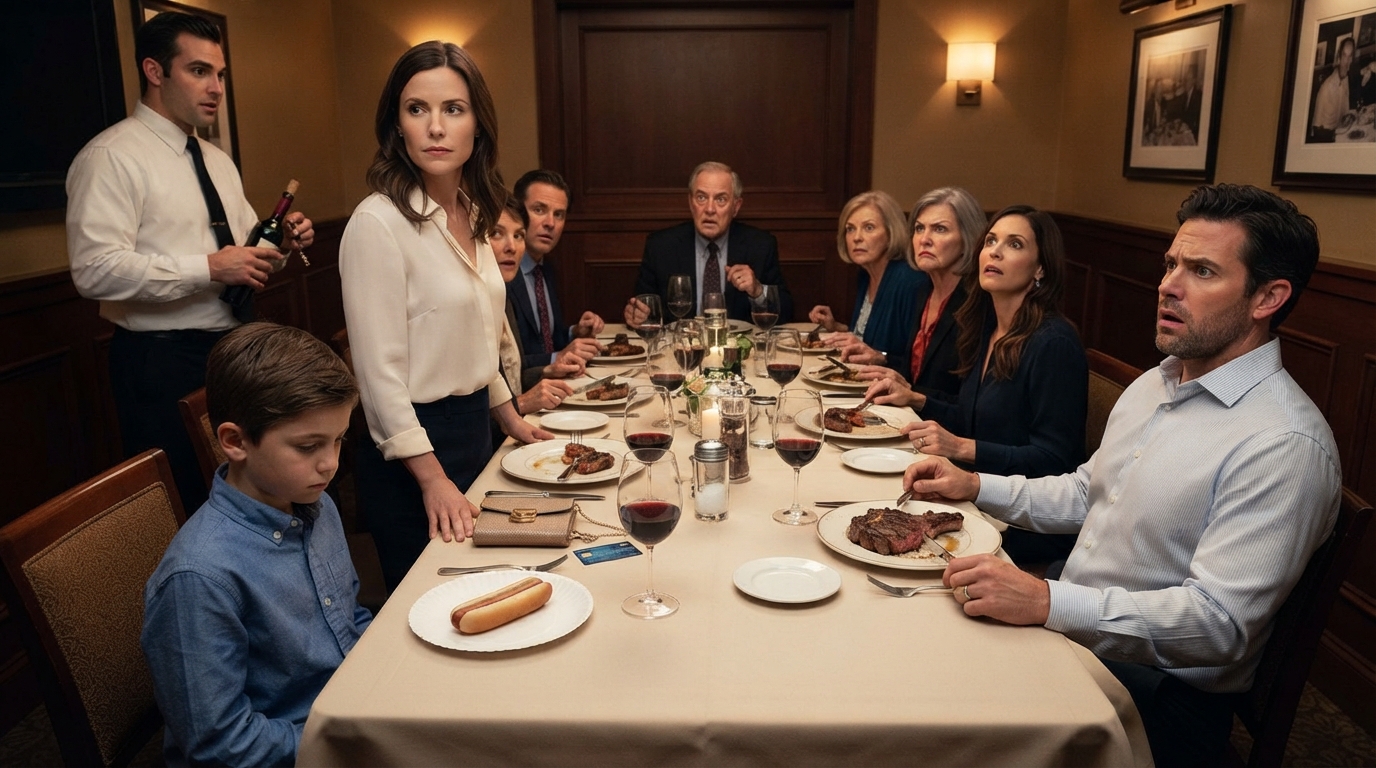
My Son Watched His Cousins Eat Steak While My Brother Served Him a Hotdog, and I Finally Decided to Stop Pretending Nothing Was Wrong
Part 16 of 20