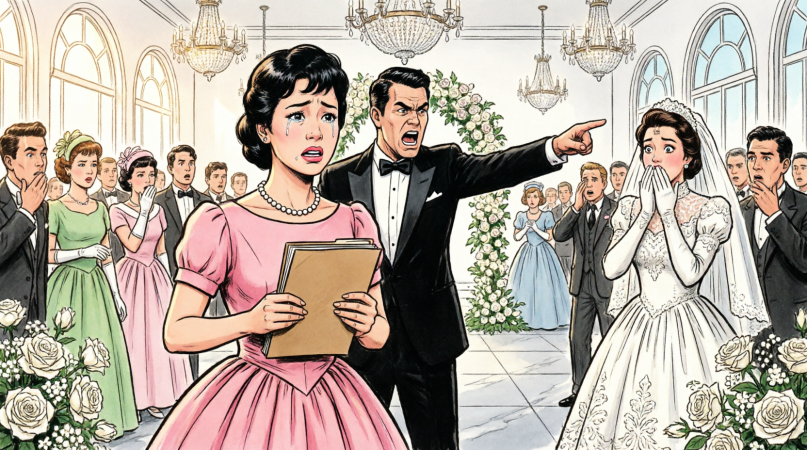
Part 2: The Legacy of Boundaries
Chapter 1: The Grand Opening
Six months after Clara moved into the guest room, the “Robert and Denise Parker Rescue Sanctuary” officially opened its gates. It wasn’t just a building; it was a sprawling ten-acre plot of land an hour outside the city, nestled against a wooded ridge that reminded me of the countryside where Robert and I had spent our earliest anniversaries.
I stood at the podium, the microphone feedback squealing slightly before Martin tapped it for me. The crowd was a mix of local dignitaries, potential donors, and the staff I had personally interviewed. Clara stood off to the side, wearing a simple navy blazer and holding a clipboard. She wasn’t there as my granddaughter; she was there as the sanctuary’s volunteer coordinator. She had earned the title.
“Welcome,” I began, my voice steady despite the breeze rustling the papers on the lectern. “Many of you know me as a businesswoman. Some know me as a widow. But today, I stand before you simply as someone who understands the value of a second chance.”
I looked out at the sea of faces. Somewhere in the back, I knew there were reporters. The story of the grandmother who evicted her son had become a minor local sensation, though I had never spoken to the press.
The facts had leaked out anyway: the wedding humiliation, the financial cutoff, the eviction. Public opinion was overwhelmingly on my side. In a world obsessed with family loyalty at all costs, my story resonated because it touched on a universal truth: loyalty must be reciprocal.
“This sanctuary,” I continued, gesturing to the red ribbon stretched across the entrance of the main kennel building, “is built on the belief that every living creature deserves safety, dignity, and love. Not because they are useful. Not because they are convenient. But because they exist.”
I caught Clara’s eye. She smiled, a genuine, tired smile that reached her eyes for the first time in months. She had lost weight. The designer clothes were gone, replaced by jeans and sturdy boots. She looked healthier than she had as a bride. The poison of entitlement had been purged from her system, replaced by the hard-earned strength of self-reliance.
I cut the ribbon. The applause was thunderous. Dogs barked in the distance, a chorus of gratitude that drowned out the string quartet we had hired.
After the ceremony, during the mingling hour, a man approached me. He was older, distinguished, holding a glass of sparkling water.
“Mrs. Parker,” he said. “I’m Arthur Vance. I run the city’s housing authority.”
“Nice to meet you, Arthur,” I said, shaking his hand.
“I wanted to commend you,” he said quietly. “Not just for the shelter. But for the stance you took with your family. My wife… she’s been dealing with something similar. Her son expects everything. Seeing you stand firm… it gave her courage.”
I felt a lump in my throat. I had thought my actions were purely personal. I hadn’t realized they were political. I hadn’t realized that by drawing a line in the sand, I was drawing a map for others who were lost in the same wilderness.
“It’s not about courage,” I told him. “It’s about clarity. Once you see the truth, you can’t unsee it.”
“Clara seems to be doing well,” Arthur noted, glancing toward my granddaughter.
“She is,” I said. “She’s learning that love isn’t a transaction.”
“Good,” Arthur said. “Because I heard rumors. Your son… Richard… he’s been asking around. Asking about your health. Asking about the shelter’s finances.”
My spine stiffened slightly. “Is that so?”
“Just be careful, Denise. Desperate people do desperate things.”
“I’m aware,” I said. But the warning settled in my stomach like a cold stone. I thought I was done with them. I thought the eviction was the final period on the sentence. But perhaps for people like Richard, there is no final period. Only ellipses.
Chapter 2: The Shadow at the Gate
Two weeks after the opening, the shadow arrived.
It was a Tuesday morning. I was in the shelter’s office, reviewing the quarterly budget with Clara. The door burst open without a knock. One of the kennel assistants, a young man named David, looked panicked.
“Mrs. Parker? There’s… there’s a man at the gate. He’s causing a scene. He says he’s your son.”
My pen stopped moving. Clara froze, her hand hovering over the calculator.
“Is he alone?” I asked.
“Yes, ma’am. But he’s shouting. Saying you stole his inheritance.”
I stood up slowly. “Clara, stay here.”
“No, Grandma,” Clara said, standing up too. Her voice was firm. “I’m coming. He’s my father. If he’s going to scream, he should scream at both of us.”
We walked out to the main gate together. The security guard, a former police officer I had hired specifically for this reason, was holding a clipboard, blocking the entrance. Richard was on the other side of the barrier. He looked terrible. His suit was wrinkled, his tie loose. He had lost weight, but not the healthy kind. He looked gaunt. His eyes were bloodshot.
“Denise!” he screamed when he saw me. “Open this gate! You have no right to keep me out!”
“This is private property, Richard,” I said calmly, stopping ten feet from the barrier. “You are trespassing.”
“Trespassing?” He laughed, a hysterical, jagged sound. “I’m your son! This is my inheritance! You’re giving away my money to stray dogs while I’m living in a motel!”
“You had an inheritance,” I said. “You traded it for pride. You traded it for a wedding where I wasn’t allowed to exist.”
“It was a mistake!” he pleaded, grabbing the metal bars of the gate. His knuckles were white. “Mom, please. Susan left me.”
I glanced at Clara. She flinched, but didn’t look away.
“Susan left?” I asked.
“She took what was left of the jewelry,” Richard spat. “She said I was a failure. She said I should have fought harder for the apartment. She said I should have had you declared incompetent years ago.”
“And now you want me to save you,” I said.
“You’re seventy-two years old!” Richard yelled. “What do you need money for? You’re just going to die anyway! Why not give it to family?”
“Because family protects each other,” I said, my voice rising slightly, carrying over the wind. “You didn’t protect me. You sacrificed me for a party. You sold me for a venue upgrade.”
“I was desperate!”
“We are all desperate sometimes, Richard. But we don’t eat our children to survive. And we don’t sell our mothers.”
Richard started shaking the gate. “Open it! I need to talk to Clara! Clara, tell her! Tell her she’s being cruel!”
Clara stepped forward. She walked up to the gate, standing beside me. She looked at her father. For a long moment, she said nothing. She just looked at him, really looked at him, seeing the man behind the monster. Seeing the weakness behind the aggression.
“Dad,” Clara said softly. “Grandma didn’t take anything from you. You gave it away. You gave away your dignity when you humiliated her. You gave away your home when you stopped paying rent. You gave away your daughter when you asked me to choose between you and her.”
“Clara, I’m your father,” Richard whispered, his voice breaking.
“And she is my grandmother,” Clara said, gesturing to me. “She paid for my dress. She paid for the flowers. She paid for the food. And you kicked her out. I chose her. Because she’s the only one who taught me what love actually looks like.”
Richard slumped against the gate. The fight went out of him. He looked small. Defeated.
“Please,” he whispered. “Just a loan. I’ll pay it back.”
“No,” I said. “But I will give you this.”
I reached into my pocket and pulled out a card. I handed it to the security guard, who passed it through the bars to Richard.
“What is this?” he asked, looking at the card.
“It’s a contact for a shelter,” I said. “The St. Jude Mission. They have a work-for-housing program. You can sleep there. You can eat there. But you have to work. No handouts. Just like everyone else.”
Richard stared at the card. He looked up at me, hatred warring with desperation in his eyes.
“You’d rather give me to a charity than help me yourself?”
“I am helping you,” I said. “I’m giving you a chance to stand on your own feet. If I give you money, you’ll just spend it. If I give you work, you might save yourself. The choice is yours, Richard. But you will not get another dime from me. Not ever.”
Richard crumpled the card in his fist. He threw it on the ground.
“You’ll regret this,” he hissed. “When you’re old and sick, don’t expect me to come.”
“I don’t expect anything from you,” I said. “That’s why I’m free.”
He turned and walked away. He didn’t look back. He walked down the long driveway toward the main road, a solitary figure shrinking in the distance. I watched him until he turned the corner and disappeared.
Clara let out a breath she had been holding. “Do you think he’ll go to the mission?”
“I don’t know,” I said. “But I did what I could. The rest is up to him.”
Chapter 3: The Healing of Clara
That evening, Clara and I sat on the porch of the shelter’s main house. The sun was setting, casting long shadows across the fields where the dogs were playing.
“Thank you,” Clara said quietly.
“For what?”
“For not giving him the money. If you had… I think I would have hated you. And I would have hated myself for hoping you would.”
I sipped my tea. “Why is that?”
“Because it would have proven him right,” Clara said. “It would have proven that money fixes everything. That loyalty can be bought. But it can’t. I learned that the hard way.”
She looked at her hands. “Michael filed for divorce last week. He’s keeping the ring. He said it was a family heirloom, but I know he just wants to sell it.”
“I’m sorry, Clara.”
“Don’t be,” she said. “I’m not. I feel… light. Like I put down a heavy backpack I didn’t realize I was carrying.”
She turned to look at me. “Grandma, I want to stay here. Not just in the guest room. I want to work here. Full time. I want to learn how to run it.”
I looked at her. I saw the spark that had been missing for so long. The spark Robert used to have. The spark of purpose.
“It’s hard work,” I warned. “It pays very little. There will be days when you smell like wet dog and bleach. There will be days when animals die despite your best efforts.”
“I know,” she said. “I want to do it anyway.”
“Then you’re hired,” I said. “But on one condition.”
“What?”
“You pay rent. Not market rate. But something. Even if it’s fifty dollars a month. You need to understand the value of a roof over your head.”
Clara smiled. “Deal.”
We sat in silence for a while, watching the stars come out. The air was cool, crisp with the scent of autumn.
“Grandma?”
“Yes, Clara?”
“Are you lonely?”
The question caught me off guard. I thought about the empty side of my bed. I thought about the quiet dinners. I thought about the parties I no longer attended.
“Sometimes,” I admitted. “But loneliness is better than betrayal. Loneliness heals. Betrayal rots.”
“I wish I could fix it,” she said. “I wish I could go back to that day and stand up for you.”
“You can’t go back,” I said. “But you can move forward. You stood up for me today at the gate. That counts.”
She leaned her head on my shoulder. “I love you, Grandma.”
“I love you too, Clara. More than you know.”
Chapter 4: The Final Letter
A year passed. The shelter became a cornerstone of the community. We rescued over three hundred animals in the first year. Clara was promoted to Assistant Director. She had found a new circle of friends, people who valued her work, not her lineage. She was dating someone—a teacher named Ben who drove a used Honda and brought her coffee just because he liked her smile.
I was seventy-three. My hair was fully white now. I walked with a cane sometimes, when my knees acted up. But my mind was sharp. My spirit was lighter.
One morning, a letter arrived. No return address. Postmarked from a town three states away.
I opened it at the kitchen table. The handwriting was shaky. It was from Richard.
Mom,
I’m at the mission. The one you gave me the card for. It’s hard. The beds are hard. The food is plain. I have to wash dishes for six hours a day.
I hated you for a long time. I blamed you for everything. Susan leaving. The apartment. The cars.
But lately… I’ve been watching the other men here. Some of them are here because of addiction. Some because of bad luck. Some because they made bad choices.
I made bad choices.
I see now that I expected the world to owe me something just because I existed. I expected you to owe me something.
I’m not asking for money. I’m not asking for forgiveness. I just wanted you to know that I’m working. I’m sober. I’m alive.
Thank you for the card.
Richard.
I read the letter twice. I didn’t feel triumph. I didn’t feel sadness. I felt a quiet sense of closure. He hadn’t apologized for the wedding. He hadn’t apologized for the humiliation. But he had acknowledged his own agency. He had admitted that his life was his own responsibility.
It was the first honest thing he had said to me in twenty years.
I took the letter and walked out to the shelter’s garden. There was a small fire pit where we burned old bedding that was too damaged to be donated. I tossed the letter into the fire.
It curled and blackened. The words disappeared into the smoke.
“Goodbye, Richard,” I whispered.
Clara came up behind me. “Was that him?”
“Yes,” I said.
“Are you okay?”
“I am,” I said. “He’s finding his own way. It’s not the way I would have chosen for him. But it’s his.”
“Do you think he’ll come back?”
“Maybe someday. When he has nothing to ask for. When he just wants to say hello.”
“And if he does?”
“Then we’ll see,” I said. “But not today.”
Chapter 5: The True Inheritance
On my seventy-fourth birthday, I didn’t want a party. I didn’t want cakes or balloons. I wanted to go to the beach.
Clara, Ben, Martin, and I drove down to the coast. It was a crisp November day. The ocean was gray and choppy, the waves crashing against the shore with relentless energy.
We walked along the water’s edge. My cane sank into the wet sand. Clara walked beside me, matching my pace.
“I have something for you,” Clara said, handing me a small, wrapped box.
I opened it. Inside was a simple silver locket. I opened it. Inside was a photo of Robert on one side, and a photo of me and Clara at the shelter opening on the other.
“It’s not expensive,” Clara said nervously. “I made it myself. I learned silversmithing at a community class.”
“It’s perfect,” I said, my voice thick. I clasped it around my neck. The metal was cool against my skin.
“I wanted to give you something that lasts,” Clara said. “Something that isn’t just money.”
“Money fades,” I said. “Values don’t.”
We sat on a driftwood log, watching the sunset. The sky turned purple, then orange, then deep blue.
“Grandma,” Clara said. “I’ve been thinking about the future. About the shelter. About… everything.”
“Yes?”
“When you’re… when you’re not here anymore. I want to make sure the shelter stays safe. I want to make sure no one can take it away.”
I looked at her. “Are you asking about the will?”
“Yes,” she said. “I know you haven’t told me. But I want you to know… I don’t want the money for me. I want it for the work. For the dogs. For the mission.”
I smiled. “I know, Clara. That’s why you’re the heir.”
She blinked, surprised. “Really?”
“Really,” I said. “Richard… he’s on his own path. He needs to build his own life. But you… you’ve already built yours. You’ve earned this.”
“I won’t let you down,” she whispered.
“You already haven’t,” I said.
The sun dipped below the horizon. The stars began to appear, one by one, piercing the darkness.
I thought about the woman I was two years ago. The woman in the pink dress, standing on the gravel driveway, humiliated and heartbroken. She felt so far away now. Like a character in a book I had read long ago.
That woman thought her worth was tied to her son’s approval. She thought her legacy was her bloodline. She thought love meant sacrifice without boundaries.
The woman sitting on the beach now knew better.
My worth was tied to my integrity. My legacy was the shelter, the animals, the woman my granddaughter had become. My love was fierce, but it was protected.
“Grandma?” Clara asked. “What are you thinking?”
“I’m thinking,” I said, watching the waves crash against the shore, “that I’m finally home.”
“Not at the house?”
“No,” I said. “Home isn’t a place. It’s a feeling. It’s knowing who you are. It’s knowing you don’t have to apologize for taking up space.”
Clara squeezed my hand. “You take up plenty of space, Grandma. And we’re all better for it.”
We sat there until the cold drove us back to the car. As we drove back toward the city, toward the shelter, toward the life we had built from the ashes of the old one, I felt a profound sense of peace.
Richard was finding his way. Susan was gone. Clara was thriving. And I… I was free.
The wedding had been a funeral for the family I thought I had. But from that grave, something stronger had grown. A family of choice. A family of respect. A family of truth.
As the city lights came into view, twinkling like stars fallen to earth, I closed my eyes and leaned back in the seat.
The pink dress was gone. The pearls were in the safe. The pain was in the past.
All that remained was the future. And for the first time in my life, I wasn’t afraid of it.
Epilogue: The Garden
Five years later.
The shelter is thriving. We have expanded to three states. Clara is the Executive Director. I am retired, officially, though I still come in every Tuesday to review the books.
I sit in the garden we planted behind the main office. Roses. Lavender. Sunflowers. Robert’s favorites.
A young woman approaches me. She’s holding a clipboard. She looks nervous.
“Mrs. Parker?” she asks. “I’m Sarah. I’m the new volunteer coordinator.”
“Welcome, Sarah,” I say. “How are you settling in?”
“Well,” she hesitates. “I… I heard about your story. About your son.”
I smile gently. “And?”
“I just… I wanted to say thank you,” she says. “My mother-in-law… she’s been trying to move in with us. Expecting us to pay for everything. I was feeling guilty. Saying no. But reading about what you did… it gave me permission to set boundaries.”
“Boundaries aren’t walls,” I tell her. “They’re gates. You decide who comes in.”
“Thank you,” she says. She looks relieved.
“You’re welcome,” I say.
She walks away. I watch her go.
I look down at the roses. They are in full bloom. Red. Vibrant. Alive.
I think about Richard. I hear from him sometimes. A card at Christmas. A letter every few months. He’s working at a warehouse now. He’s sober. He’s alone, but he’s okay. We talk sometimes. Short conversations. Polite. Distant. But honest.
I think about Susan. I heard she remarried. A wealthy man this time. I hope she learned her lesson. I hope she finds what she’s looking for.
I think about Clara. She’s getting married next month. To Ben. It’s a small wedding. In the shelter garden. No lobster. No designer gown. Just love.
I paid for it. Not because I had to. But because I wanted to. Because this time, I was on the guest list. This time, I was family.
I close my eyes and feel the sun on my face.
The wind rustles the leaves. The dogs bark in the distance. The world moves on.
I am Denise Parker. I am a widow. I am a grandmother. I am a protector.
And I am finally, completely, at peace.
The End.
If you want more stories like this, or if you’d like to share your thoughts about what you would have done in my situation, I’d love to hear from you. Your perspective helps these stories reach more people, so don’t be shy about commenting or sharing.