Greg was eighty-one when he stopped working.
Not retired.
He disliked the word.
“Retirement implies golf.”
Emily stared at him.
“You can retire without golf.”
“Then what do I call it?”
“Stopping.”
“That sounds like dying.”
“You are exhausting.”
He smiled.
Margaret would have recognized the exchange.
Greg had spent nearly twenty years working with reentry and financial-boundary programs after prison.
Long enough for new employees to know his conviction as history rather than scandal.
Long enough for some clients to have no idea who Margaret Parker had been.
That pleased him.
His mother did not need to remain public evidence forever.
Emily was seventy-seven.
Still making furniture.
Slower.
More selective.
More expensive.
Margaret would definitely have complained about the prices.
One autumn afternoon, Priya called.
They had not spoken in years.
Her family was moving.
The old Parker house would be sold again.
Emily listened.
She felt something.
Not ownership.
Not grief exactly.
Recognition.
Priya asked whether Emily wanted to visit before they listed it.
Emily’s first instinct was no.
Then she called Greg.
“Do you want to see the house?”
He was quiet.
“Do you?”
“I asked first.”
“That’s not how choice works.”
She laughed.
They agreed to go.
Together.
The neighborhood had changed.
Several old houses were gone.
New construction filled former gardens.
The corner store Walter once complained about had become a pharmacy, then a café, then something selling expensive candles.
Greg parked across the street.
Neither moved immediately.
“There it is,” Emily said.
“Yes.”
The house looked smaller.
Everyone eventually says that about childhood places.
Painted pale green now.
New roof.
Different front door.
No maple.
The workshop remained.
Priya welcomed them.
Her children were adults.
The dog had died years earlier.
A new dog barked from behind the kitchen gate.
Life replacing itself without asking permission.
They walked through.
Greg recognized less than he expected.
Emily recognized more.
A patch in the hallway floor.
A scratch on a doorframe.
The window where Margaret once watched the street.
The kitchen had been remodeled completely.
The table was gone because Emily owned the original.
Greg stood where the old one had been.
“This is where I put the papers.”
Emily knew.
“Yes.”
“I thought seeing it again would feel worse.”
“Does it?”
“No.”
“Better?”
“Not really.”
“What then?”
“Smaller.”
Emily understood.
Some memories expand because we keep living inside them.
Returning can restore proportion.
They went downstairs.
The basement clock had been sold by Priya years earlier.
Emily had known.
Greg had not.
He stared at the empty wall.
“Where is it?”
“Gone.”
“You knew?”
“Yes.”
“To whom?”
“No idea.”
Greg laughed.
“That thing survived Dad, Mom, prison, federal investigations, and ninety years just to end up at an estate sale?”
“Probably.”
He shook his head.
“Good.”
The stairs remained.
Greg looked at them.
Emily watched him.
He did not approach.
Did not need to.
“I used to dream about this basement.”
“I know.”
“Not anymore.”
“When did that stop?”
“I don’t know.”
He looked toward the stairs.
“Maybe that’s why it stopped.”
No dramatic moment had announced healing.
No final nightmare.
No morning when Greg woke declared free.
One day the dream simply did not come.
Then another.
Eventually absence became normal.
They returned upstairs.
In the workshop, the shelf remained.
W.P.
G.P.
E.P.
Nathan had varnished around the initials years earlier.
Priya had kept them.
Now she asked again.
“Do you want the board this time?”
Emily looked at Greg.
He looked at her.
“No,” they said together.
Everyone laughed.
Priya showed them the listing photographs.
The house would be marketed as a four-bedroom family home with detached workshop and mature garden.
No mention of Margaret.
No mention of forged documents.
No mention of the nursing home.
No mention of federal investigations, hidden boxes, Samuel Parker, Walter’s secrets, or Greg’s crime.
Exactly right.
A house did not owe future owners its entire history.
Before leaving, Emily walked into the backyard.
The maple stump was completely gone.
In its place grew a young pear tree.
Priya had planted it.
Greg joined her.
“Dad would complain.”
“Why?”
“He hated pear trees.”
“Did he?”
“He said they were messy.”
Emily smiled.
“Grandma would plant one just to annoy him.”
“Absolutely.”
They stood beneath the small branches.
No shade yet.
Maybe someday.
On the drive home, Greg asked Emily whether she planned to sell her studio.
“Eventually.”
“To whom?”
“Whoever pays enough.”
“That sounds like Grandma.”
“She would demand I charge more.”
“Yes.”
Emily looked out the window.
“What about your apartment?”
“I rent.”
“I know.”
“I’ll probably move somewhere with fewer stairs.”
She glanced at him.
“You choosing?”
“Yes.”
“Good.”
He smiled.
The phrase still mattered after all those years.
A month later, Greg moved into a senior community.
Not Hawthorne.
That building no longer existed.
It had been replaced by a larger medical complex.
He toured three places.
Rejected two.
Chose the third because it had a woodworking room.
Emily helped pack.
Not for him.
With him.
He decided what went.
Clothes.
Books.
Photographs.
Walter’s repaired mug.
The gold line had darkened slightly.
Still intact.
Emily picked it up.
“You keeping this?”
“Yes.”
“Sure?”
“Yes.”
She wrapped it.
No argument.
Among Greg’s papers was the old replacement watch.
The one Margaret had engraved:
CHOOSE YOUR WAY HOME.
Greg had stopped wearing it years earlier.
His eyesight made the face difficult to read.
He handed it to Emily.
“Take it.”
“You already gave it to me once.”
“And you gave it back.”
“I don’t remember.”
“I do.”
“Why?”
“You said I needed it more.”
Emily smiled.
“That sounds annoyingly thoughtful.”
“You have your moments.”
She took the watch.
At Greg’s new residence, they unpacked together.
The mug went on his desk.
Photographs on a shelf.
Margaret in the red convertible.
Walter younger.
Emily.
Laura.
No photograph of the old house.
Greg noticed.
“I thought I had one.”
“Want me to find one?”
He considered.
“No.”
The house no longer needed representation.
That evening, they ate in the residence dining room.
Greg complained about the soup.
Emily reminded him he had chosen the place.
“I did not choose the soup.”
“Choice has limits.”
He laughed.
After dinner, they walked outside.
Greg used a cane now.
Emily slowed without mentioning it.
They sat beneath a covered patio.
A younger resident argued with his daughter near the entrance.
Nothing serious.
The daughter wanted him to attend physical therapy.
He refused.
Greg listened briefly.
Then looked away.
Years earlier, he might have judged.
Now he knew fragments did not reveal whole families.
Emily checked the time on Margaret’s watch.
“Six forty.”
Greg looked at it.
“Still works?”
“Yes.”
“Mom would like that.”
Emily smiled.
“You know what she would say.”
“What?”
“It’s a replacement.”
Greg laughed.
“Yes.”
Because that had mattered.
The watch was not Walter’s original.
The repaired mug was still broken.
The house belonged to strangers.
Laura had not become the mother Emily never lost.
Greg had not become innocent.
Margaret had not lived forever.
Nothing had returned to its first form.
That was not failure.
Life was not restoration.
It was continuation.
Months later, Emily received an envelope from Priya.
Inside was one photograph.
The old house.
A SOLD sign outside.
On the back Priya had written:
NEW FAMILY MOVED IN TODAY. THREE CHILDREN.
Emily showed Greg.
He smiled.
“Good.”
No urge to know names.
No need to visit.
The photograph went into a drawer.
Not framed.
Years passed.
Greg’s health declined.
Emily visited when she wanted.
Often.
Not every day.
He never demanded more.
One evening, while she was leaving, Greg called her back.
“Emily.”
She turned.
“What?”
“I’m glad you came.”
“Me too.”
He looked as if he wanted to add something.
Then stopped.
“What?”
“Nothing.”
She waited.
He smiled.
“I was going to tell you to come tomorrow.”
“And?”
“I remembered that’s your decision.”
Emily laughed.
“Good training.”
“Slow learner.”
“Very.”
She kissed his forehead.
“I probably will.”
“Probably is fine.”
The next day she did.
Not because she owed him.
Because she wanted to.
That distinction remained the quiet center of everything Margaret had left them.
Greg died three years later.
Emily was beside him.
By choice.
His last hours were peaceful enough, though Emily refused to use that word at the memorial because Claire had once objected to it and Margaret would have found the sentimentality suspicious.
Greg’s memorial was small.
No one called him redeemed.
Marcus spoke.
He described Greg as a man who had caused serious harm, accepted legal consequences, and spent later decades helping others recognize the boundary between support and control.
Emily appreciated the precision.
She spoke last.
“My father did terrible things.”
The room became still.
“He also changed.”
No one moved.
“Those statements do not cancel each other.”
She looked at Walter’s repaired mug sitting beside a photograph of Greg.
“We do people no favor by reducing them to either their worst act or their best apology.”
That was all.
Afterward, Emily took the mug home.
It joined Margaret’s maple table in the studio.
Years later, when Emily finally closed the studio, she gave most of the tools to a community woodworking program.
Walter’s hand plane went too.
She kept the maple table.
The mug.
The watch.
Three objects.
Enough.
She moved into a smaller apartment overlooking a park.
No stairs.
Her choice.
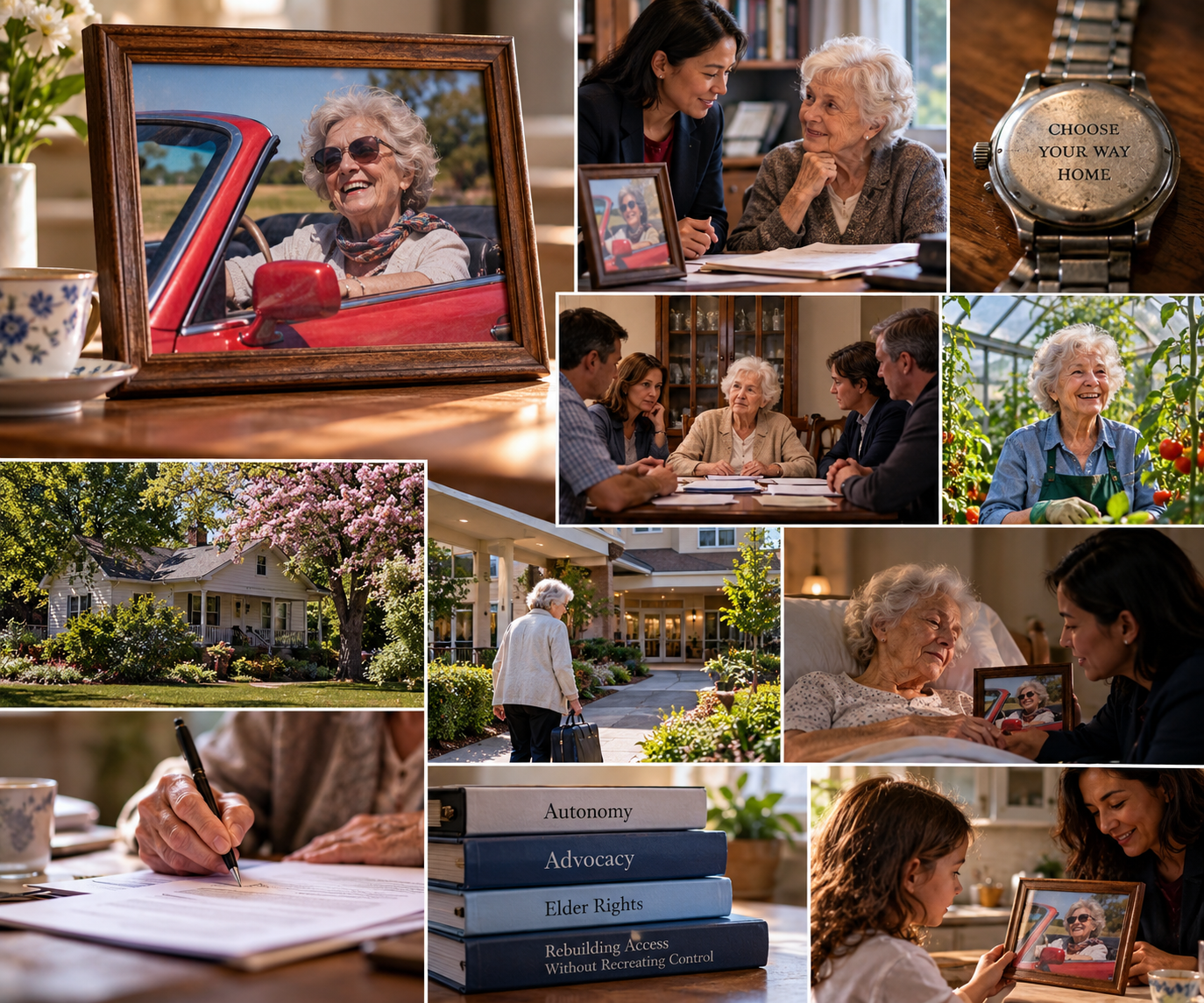
On her first evening there, she placed Margaret’s photograph on the maple table.
The red convertible.
The sunglasses.
That ridiculous smile.
Beside it she placed Walter’s repaired mug.
Then the watch.
CHOOSE YOUR WAY HOME.
Emily stood back.
For a moment, the arrangement looked too deliberate.
Too symbolic.
Margaret would complain.
So Emily put her grocery list beside them.
Better.
Outside, children crossed the park.
A woman walked a dog.
Traffic moved beyond the trees.
Nobody in those lives knew the Parker house.
Nobody needed to.
Emily opened the window.
She thought about the story people might tell if they knew only its beginning.
An elderly woman.
A son.
A nursing home.
A house secretly sold.
They might call it revenge.
Margaret never did.
Selling the house had not been revenge.
It had been preparation.
A legal decision made quietly by a woman who realized someone else had begun treating her future as property.
Everything important came afterward.
The confrontation.
The consequences.
The discoveries.
The mistakes.
The years required to build relationships that did not depend on ownership.
Emily touched the engraved watch.
Her grandmother’s real inheritance had never been the house.
Not the money either.
It was a question.
Who gets to choose?
Ask it before signing.
Before helping.
Before forgiving.
Before staying.
Before leaving.
Before deciding what someone else needs.
Sometimes the answer would be complicated.
Sometimes people would choose badly.
Sometimes love would ache because respecting another person meant allowing a decision you disliked.
But the question still mattered.
Especially then.
Emily made tea.
She sat at the maple table.
No hidden compartment opened.
No letter waited beneath it.
No forgotten Parker relative knocked at the door.
Nothing happened.
Exactly right.
The room belonged to the present.
The house that started everything belonged to strangers.
The people who fought over it were gone.
The old luggage tag had become ash years earlier.
Even the maple tree was gone.
But Margaret’s lesson remained because it no longer needed an object to carry it.
Emily lifted her cup.
Outside, evening settled over the park.
She had nowhere she was required to go.
No destination chosen for her.
No family obligation waiting to disguise itself as love.
Tomorrow she might visit a friend.
Or stay home.
She had not decided.
That was the point.
Click here to continue reading: PART 29: Years After Greg’s Death, Emily Received a Request About the Old House That Tested Whether She Truly Believed Margaret’s Lesson
The Morning My Son Packed My Suitcase, He Still Believed the House Waiting Behind Me Was His
Part 28 of 35