I told Greg about Anna Mercer during our next prison call.
There was no elegant way to explain it.
“Your grandfather had a child with Anna, took the baby, raised him under another woman’s name, later had Helen with Anna, then concealed both children’s inheritance.”
Greg was silent.
Finally he said, “Our family is exhausting.”
I laughed before I could stop myself.
“Yes.”
He laughed too.
It was the first time we had laughed together since his arrest.
The sound hurt.
But not entirely.
Then I told him about Walter’s hidden account.
Greg became quiet again.
“How much?”
“Two hundred eighty-six thousand.”
“Dad had that?”
“Yes.”
“And you didn’t know?”
“No.”
He exhaled.
“That sounds like him.”
I bristled.
Then remembered I had said the same thing myself.
“Do you know why he kept it?”
Greg hesitated.
“I might.”
There it was.
I waited.
He explained that after Walter began suspecting Talbot, he stopped trusting accounts Greg could see.
He moved money gradually.
Some came from savings.
Some from investment proceeds.
Some from selling an old parcel of land I had forgotten Walter inherited.
“He told me once he had enough to get you out.”
“Out of what?”
“Everything.”
Greg said Walter feared Vale’s network might target me directly if his investigation became known.
He researched temporary housing.
Private security.
Even flights.
My husband had prepared to make me disappear without ever asking whether I wanted to disappear.
The contradiction would have infuriated me once.
Now it mostly made me tired.
“He loved me,” I said.
“Yes.”
“He also had a terrible habit of making plans for me.”
Greg gave a small laugh.
“Yes.”
Then he stopped.
“I did that too.”
I looked at the prison screen.
“That is different.”
“Is it?”
“Yes.”
“Why?”
“Walter planned to move me to keep me alive. You planned to move me to steal my house.”
Greg absorbed that.
“Right.”
“Intent matters.”
“But Dad still didn’t ask.”
“No.”
“So that matters too.”
I studied him.
Prison had not made him wise.
Pain did not automatically improve people.
But he was beginning to hold two truths at once.
That was something.
Then I told him about the Mercer inheritance.
Walter’s share might pass through his estate.
Greg could potentially assert rights depending on legal interpretation.
He immediately said, “I don’t want it.”
I had not expected that.
“You should speak to your lawyer before deciding.”
“I don’t need a lawyer to know.”
“It could be substantial.”
“I stole from Emily because I thought money would fix everything.”
He looked directly at me.
“It never fixed anything.”
I wondered whether he meant it.
Then I remembered that belief did not require immediate proof.
People demonstrated change through repetition.
Time would answer.
“What should happen to it?” I asked.
“The foundation.”
No hesitation.
“Helen’s?”
“Yes.”
“Why?”
Greg looked down.
“Because Grandpa Samuel used money to make people disappear. Maybe the money should help people stay visible.”
That sounded like something Walter might have said.
Or perhaps I wanted it to.
I resisted turning Greg’s one decent sentence into evidence of transformation.
Hope could become another form of denial if handled carelessly.
Still, I wrote it down.
After the call, Emily and I met with attorneys.
The Mercer case had become complicated enough to require diagrams.
I hated diagrams.
Helen enjoyed watching lawyers suffer.
Ruth enjoyed correcting them.
Eventually, the legal position became clearer.
Anna’s original will was valid evidence but had been fraudulently suppressed.
Corporate successors faced exposure.
A settlement was likely.
Walter’s estate could assert a claim.
Greg, as Walter’s descendant, might also possess derivative rights.
Greg formally waived any personal claim in favor of the foundation.
The document arrived two weeks later.
Signed.
Witnessed.
No conditions.
Emily read it.
“He really did it.”
“Yes.”
“How do you feel?”
“Suspicious.”
She laughed.
“I’m serious.”
“So am I.”
Then I folded the paper.
“But also relieved.”
That was allowed.
Suspicion and relief could occupy the same chair.
My emergency account created another problem.
Not legal.
Personal.
I had nearly three hundred thousand dollars Walter intended for me.
I already had enough to live comfortably.
Emily refused it.
Laura refused it.
Helen threatened to stop speaking to me if I offered it to the foundation without spending some on myself.
Ruth was more direct.
“If you donate every cent, I will have you declared incompetent.”
“You spent years fighting fraudulent incompetency declarations.”
“I contain multitudes.”
I bought the butter.
Then I bought something genuinely unreasonable.
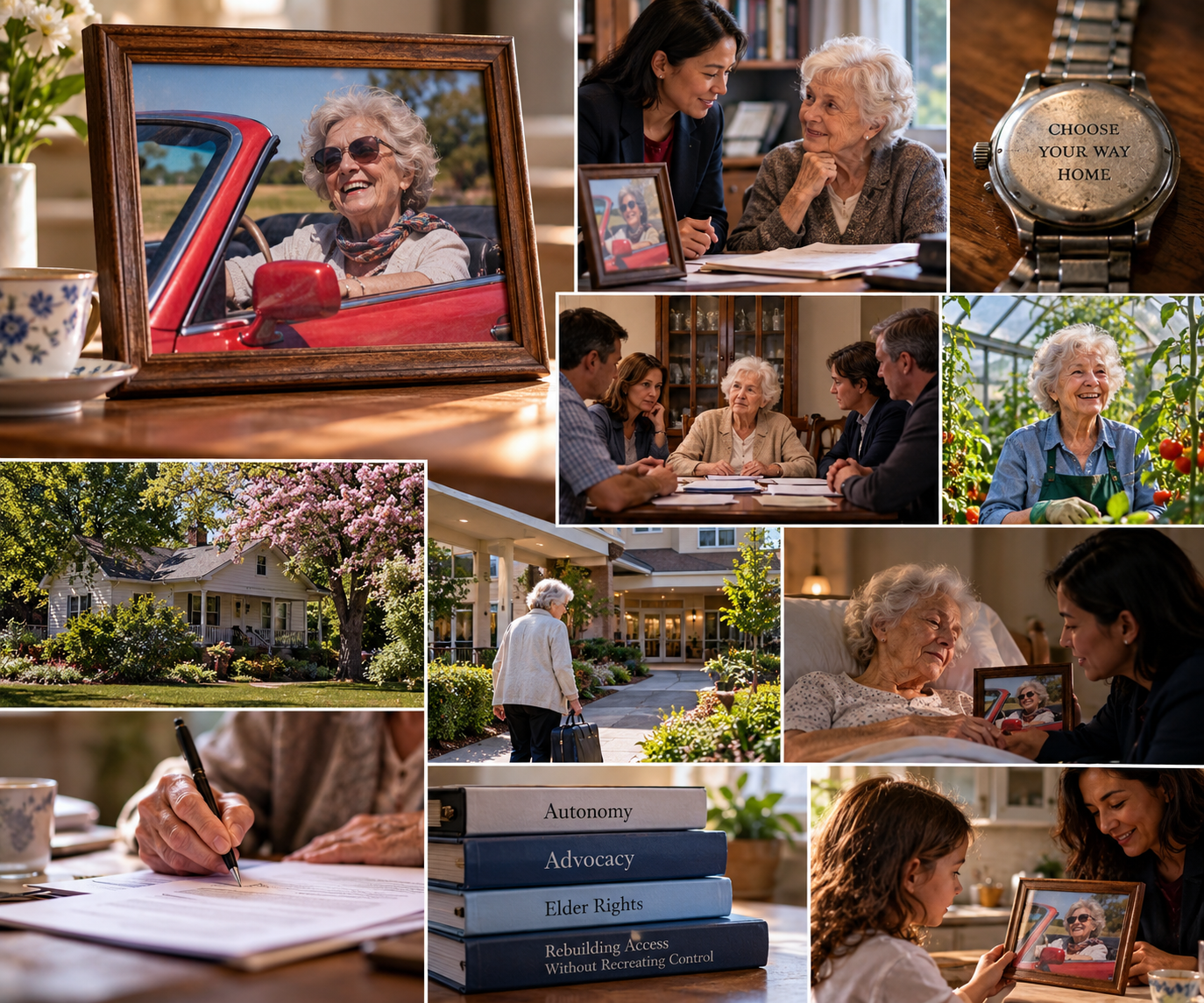
A red convertible.
Used.
Not new.
I had limits.
Emily found it in the driveway.
She stared for a full minute.
“Grandma.”
“Yes?”
“You bought a convertible.”
“Yes.”
“You are eighty-three.”
“I checked. There is no age restriction.”
“You complained my rental car was too low.”
“This one is attractively low.”
“It has two seats.”
“I only need one.”
“What about passengers?”
“They can compete.”
Emily walked around it.
Then started laughing.
“Grandpa would hate this.”
“No.”
I opened the driver’s door.
“Walter would pretend to hate this.”
That distinction made us both smile.
I drove carefully.
Very carefully.
Rebellion did not require poor braking.
The rest of the money went into three places.
A travel account.
A reserve for my care if I ever actually needed assistance.
And a small scholarship under Walter’s name for family members of financial-exploitation victims who had interrupted education to deal with crises.
I did not put my own name on anything.
I had enough of seeing Parker attached to institutions.
Months passed.
The foundation opened its first legal-advocacy office.
Helen attended the ceremony.
So did Ruth.
They argued about the ribbon color.
Charles came from Arizona.
Laura sat beside Emily.
I stood near the back.
The first speaker was a twenty-year-old woman named Jasmine whose guardian had controlled her disability payments and prevented her from attending college.
The foundation helped her obtain independent representation.
She was enrolling that fall.
Helen listened without moving.
Afterward, she disappeared into a restroom for fifteen minutes.
When she returned, her eyes were red.
I did not mention it.
Some emotions deserve privacy.
Later, Helen found me near the refreshment table.
“Samuel would hate this.”
“Yes.”
“That pleases me more than it should.”
“I think you’ve earned a little pettiness.”
She smiled.
Then her expression changed.
“I received something.”
I sighed.
“If it is another letter from Walter, burn it.”
She laughed.
“It isn’t.”
She handed me a photocopy.
A court record.
1946.
Anna Mercer had filed a petition seeking custody of Walter.
Samuel opposed it.
The case disappeared from the docket.
No ruling.
No explanation.
But a handwritten note appeared in the margin.
PETITIONER WITHDREW AFTER PRIVATE SETTLEMENT.
Helen had never seen it.
“What settlement?”
“We don’t know.”
Then she showed me another document.
Three days after the petition was withdrawn, Anna transferred half her remaining property to Samuel.
A month later, she wrote a letter to a lawyer.
Helen had the first page only.
The rest was missing.
The first page began:
I did not surrender my son willingly. Samuel threatened the life of—
The sentence ended at the torn edge.
Whose life?
Walter’s?
Anna’s?
Someone else?
Helen looked at me.
“Do we need to know?”
That question surprised me more than the document.
Months earlier, she would have chased the answer immediately.
I looked at the torn page.
Our family had spent years opening boxes because secrets controlled living people.
But Samuel was dead.
Anna was dead.
Walter was dead.
The missing sentence might explain history.
It might also become another tunnel with no end.
“What changes if we find it?”
Helen thought.
“Maybe nothing.”
“Does anyone’s safety depend on it?”
“No.”
“Does anyone’s property?”
“Not according to the lawyers.”
“Does it affect the foundation?”
“No.”
I handed the page back.
“Then I don’t need to know.”
Helen stared.
“You’re serious?”
“Yes.”
“What if it explains everything?”
“Nothing explains everything.”
That might have been the most useful thing age had taught me.
Human beings loved final explanations.
One secret cause.
One villain.
One revelation that reorganized every memory.
Life was rarely so cooperative.
Samuel had been cruel.
Anna had been trapped.
Walter had been wounded.
Greg had made choices.
Those facts were already enough.
Helen folded the document.
“I think I’m going to keep looking.”
“That is your choice.”
“You won’t help?”
“If you ask me to drive somewhere, perhaps.”
She smiled.
“Not chase records?”
“No.”
“What happened to Margaret Parker?”
“She bought a convertible.”
That evening I drove home with the roof down.
The air was colder than expected.
I refused to admit this until my teeth began chattering.
At a red light, my phone rang through the car system.
Greg.
I answered.
“Mom?”
“Yes.”
“Are you driving?”
“Yes.”
“What is that noise?”
“Wind.”
“Why is there so much wind?”
I smiled.
“I bought a convertible.”
Silence.
Then my son began laughing.
Not mocking.
Not bitter.
Genuinely laughing.
“Dad would lose his mind.”
“He would.”
“You bought it with his secret money?”
“Partly.”
Greg laughed harder.
I did too.
The light changed.
I drove on.
For three minutes, we were simply mother and son sharing a ridiculous joke.
It did not erase the basement stairs.
It did not return Emily’s money.
It did not unlock the years he stole from our family.
But neither did those crimes erase every earlier memory of the boy he had been.
I was learning that accountability did not require rewriting the past into one color.
When the call ended, I turned onto the road home.
The sky had darkened.
My hands rested comfortably on the wheel.
For once, I was not driving toward a secret.
I was simply driving.
And that felt more valuable than another answer.
Click here to continue reading: PART 16: When I Finally Stopped Searching Walter’s Past, My Family Discovered That the Future Required a Different Kind of Courage
The Morning My Son Packed My Suitcase, He Still Believed the House Waiting Behind Me Was His
Part 15 of 35