The first anniversary of Margaret Parker’s death arrived without ceremony.
Emily noticed the date when her phone reminded her about a dental appointment.
For several seconds she stared at September 14 on the screen, aware that something about the number felt heavier than it should.
Then she remembered.
She did not call Greg.
She did not visit a cemetery.
There was no cemetery to visit for Margaret anyway. Some of her ashes had been placed beside Walter’s, some scattered in the garden before the house was sold, and the rest had gone with Emily to the coast in Maine.
Margaret had been characteristically unhelpful about distribution.
“Use judgment,” she had said.
Emily still heard the words whenever she wanted instructions that no longer existed.
The house belonged to another family now.
A couple named Nathan and Priya had bought it six months earlier. Their children had immediately claimed the backyard, and their dog had developed an enthusiasm for digging near the remains of the old maple stump.
Emily knew this because Priya occasionally sent photographs.
She had asked permission first.
That mattered.
The workshop remained the only part of the property Emily had struggled to surrender.
Not legally.
Emotionally.
Before closing, she removed Walter’s remaining personal tools, Margaret’s maple table, several boxes of photographs, and the old green metal box that had once opened the first serious door into the Parker family’s hidden history.
The box was empty now.
Emily checked.
Twice.
Margaret would have approved.
Everything went into Emily’s own studio, a converted warehouse space fifteen minutes away.
For months she left the objects untouched.
Then, on the anniversary morning, she went there before sunrise.
The studio smelled of sawdust, paint, and coffee.
Walter’s old hand plane sat on a shelf.
Margaret’s maple table stood beneath a window.
The cracked coffee mug was missing because it belonged to Greg now.
Emily had almost objected when Margaret left it to him.
Almost.
Then she understood.
Broken did not mean useless.
Greg understood that better than she did.
She made coffee and sat at the maple table.
A dark line ran through the wood where the old tree had once split.
Margaret had liked that line.
“Don’t sand out everything interesting,” she had told Emily.
Emily had been talking about furniture.
Margaret probably had not.
On the wall opposite the table was an empty rectangle.
Emily had removed a framed photograph weeks earlier and never replaced it.
The blank space bothered her.
Not because blank spaces always needed filling.
Margaret had cured her of that.
But this one seemed to be waiting.
Emily opened a storage box.
Inside were photographs she had not yet sorted.
Walter at twenty-three in France.
Claire as a child.
Anna Mercer holding infant Walter.
Helen.
Ruth.
Laura.
Greg before prison.
Greg after prison.
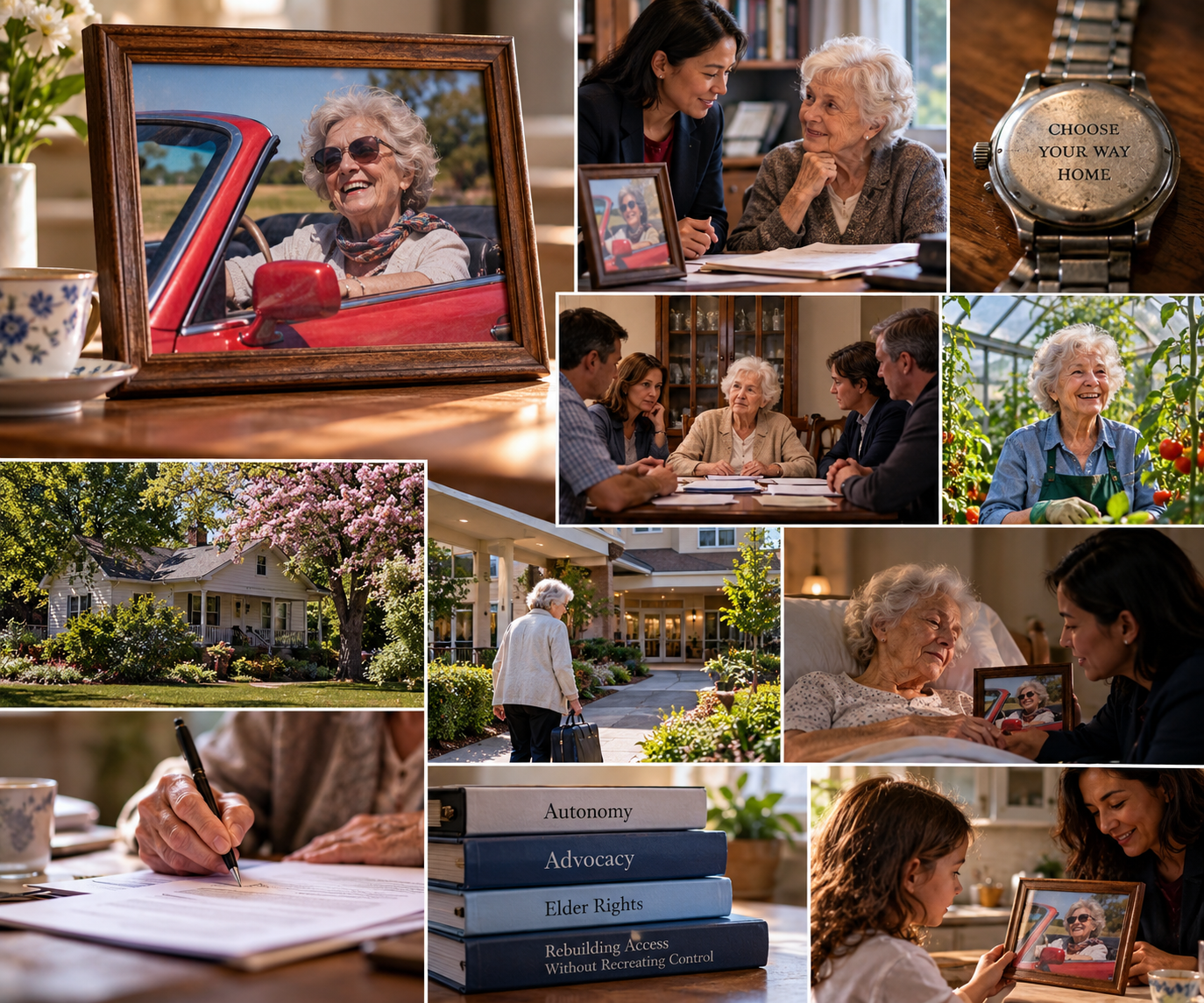
Margaret in the red convertible wearing sunglasses too large for her face and looking absurdly pleased with herself.
Emily smiled.
That photograph won.
She placed it in the empty frame.
No caption.
No explanation.
Just Margaret laughing behind the steering wheel.
Emily stepped back.
“Better.”
Her phone rang.
Greg.
She considered letting it go to voicemail.
Then answered.
“Hi.”
“Did I wake you?”
“I’m at the studio.”
“At six-thirty?”
“Yes.”
He paused.
“You remembered.”
She knew what he meant.
“Yes.”
“So did I.”
Neither said anniversary.
They had become better at allowing shared understanding without forcing language around it.
Greg asked whether she wanted breakfast.
Emily almost said no automatically.
Then Margaret’s voice appeared in her mind.
Choose.
Not react.
Choose.
“Okay.”
They met at a diner halfway between Greg’s apartment and Emily’s studio.
Greg arrived carrying Walter’s cracked mug inside a cardboard box.
Emily stared.
“What happened?”
“Nothing.”
“Then why is Grandpa’s mug in a box?”
“I need you to repair it.”
“No.”
“You haven’t even looked.”
“I know what repair means.”
The mug had developed another crack.
Not catastrophic.
But deep enough that Greg no longer trusted it to hold pencils.
“I don’t repair ceramics.”
“You repair everything.”
“That is exactly the kind of family mythology Grandma warned us about.”
Greg smiled.
“Can you find somebody?”
“That I can do.”
He relaxed.
The distinction was small.
Important.
He had asked for help rather than transferring responsibility.
Emily took the box.
Breakfast arrived.
They talked about ordinary things.
Greg’s work.
Emily’s latest commission.
A leak in his bathroom.
A client who wanted a dining table large enough for fourteen people but lived in an apartment with a room large enough for six.
Then Greg said, “I got a letter.”
Emily stopped cutting her toast.
“From whom?”
“Marcus.”
The man Margaret had once helped indirectly through the reentry program.
Emily remembered.
“What does he want?”
“Nothing.”
That sounded promising.
Marcus had opened a bookkeeping service employing people with financial-crime convictions who had completed compliance training and agreed to independent oversight.
No employee handled client funds directly.
Every account had dual review.
Marcus wanted Greg to consider joining the advisory board.
Emily watched her father.
“You want to?”
“I don’t know.”
“Why not?”
“Because putting a convicted fraudster on a financial-compliance board sounds like satire.”
“You wouldn’t control money.”
“No.”
“You have relevant experience.”
“That is one way to describe it.”
She smiled despite herself.
“What are you afraid of?”
Greg looked toward the window.
“Thinking I deserve something.”
Emily understood immediately.
For years after prison, Greg had treated humility almost like another sentence.
He accepted work.
Friendship.
Limited family contact.
But whenever recognition appeared, he became suspicious of it.
As though accepting respect might reopen the door to entitlement.
“Dad.”
He looked at her.
“Grandma never told you to spend the rest of your life proving you’re ashamed.”
“I know.”
“Do you?”
Greg was quiet.
“She told me not to turn her death into punishment.”
“Yes.”
“I’m trying.”
“Choose.”
He smiled faintly.
“She really ruined that word for us.”
“No. She rescued it.”
Greg looked at Marcus’s letter again.
“I’ll meet with them.”
“Good.”
“That isn’t agreeing.”
“I know.”
The ceramic specialist Emily found was an elderly Japanese American woman named Keiko who practiced kintsugi.
She explained that the repair would leave the crack visible beneath a line of gold.
Greg immediately disliked the idea.
“Can’t you make it look original?”
Keiko looked over her glasses.
“No.”
Emily nearly laughed.
Greg noticed.
“Don’t.”
Keiko turned the mug carefully.
“I can stabilize it. I can make the repair part of the object. I cannot make the damage unhappen.”
Greg went still.
Emily looked away.
Their family had apparently reached the stage where even ceramic repair became metaphor.
Margaret would have complained.
Greg eventually agreed.
Three weeks later, the mug returned.
A narrow golden seam followed the old crack.
Greg held it beneath the studio lights.
“It looks more broken.”
“No,” Emily said.
“It looks repaired.”
“That’s different?”
“Yes.”
He turned it in his hands.
Then nodded.
He returned it to his apartment.
Still did not drink from it.
It held pencils.
That autumn, Emily received another message from Priya.
Would she like to visit the old house?
One of the children had discovered writing beneath a loose workshop shelf.
Emily’s stomach tightened.
Her first thought was absurd.
Walter.
Another message.
Another secret.
Another compartment.
Then she remembered Margaret’s final instruction about coded documents.
Throw them away unless a lawyer says otherwise.
Emily laughed.
Priya sent a photograph.
The writing was carved directly into wood.
Three initials.
W.P.
G.P.
E.P.
Walter Parker.
Greg Parker.
Emily Parker.
Emily recognized the shelf.
Walter built it when she was nine.
Greg had helped.
Emily had “helped” by dropping screws and asking questions.
Walter made all three of them carve initials underneath.
She had forgotten.
Nothing secret.
Nothing dangerous.
Just memory.
Emily visited on Saturday.
Priya opened the door.
The house looked different.
Blue walls where Margaret had preferred cream.
A new sofa.
Children’s shoes scattered near the stairs.
The kitchen table was gone.
Emily had taken Margaret’s old table when she sold the house, and Priya’s family had bought another.
For one second, Emily felt resistance.
Then relief.
The house had escaped them.
That was what Margaret wanted.
In the workshop, Nathan had turned one corner into a bicycle-repair area.
The rest remained woodworking space.
The shelf was off the wall.
Emily crouched.
There they were.
Three sets of initials.
Walter’s deep and careful.
Greg’s uneven.
Emily’s tiny.
Below them Walter had carved a date.
1989.
Nathan asked, “Do you want the board?”
Emily almost said yes.
Instead she ran her fingers over the letters.
“No.”
“You sure?”
“Yes.”
“Should we preserve it?”
“If you want.”
Nathan looked surprised.
“It’s your family history.”
“It’s your shelf.”
That answer felt like Margaret.
On the way out, Priya’s younger daughter ran past carrying a red backpack.
The dog followed.
The hallway filled with noise.
Emily stopped near the front door.
There had once been a framed luggage tag there.
Then an empty frame.
Now there was a row of hooks.
Coats.
Backpacks.
A bicycle helmet.
Nothing Parker.
Good.
Outside, Greg waited in his car.
Emily had invited him.
He declined to enter.
Not from shame exactly.
Respect.
When she got in, he asked, “How was it?”
“Different.”
“Bad?”
“No.”
She showed him the photograph of their initials.
Greg stared.
“I remember that.”
“I barely did.”
“Dad made me carve mine twice because the P looked like a D.”
Emily laughed.
“That sounds like Grandpa.”
Greg zoomed in on the image.
“Did you take the board?”
“No.”
He looked at her.
Then smiled.
“Mom would approve.”
“Probably.”
They drove away.
Neither looked back.
Months later, Marcus offered Greg the advisory position formally.
Greg accepted.
With conditions.
No access to client accounts.
No signing authority.
Public disclosure of his conviction.
Annual independent review.
Marcus agreed.
Emily attended the first community presentation.
Greg spoke for twelve minutes about financial boundaries.
He never mentioned Margaret by name.
But near the end, he said, “If someone depends on you, that dependence is not permission.”
Emily felt her throat tighten.
Afterward, she waited until everyone else had left.
Greg stacked chairs.
“You were good.”
“Careful.”
“I said good, not redeemed.”
He laughed.
“Thanks.”
Emily helped with the chairs.
No speeches.
No reconciliation milestone.
Just work.
That evening, she returned to her studio.
Margaret’s photograph hung in the once-empty space.
Red convertible.
Ridiculous sunglasses.
Wide smile.
Emily stood beneath it.
“You would have liked today.”
Then she corrected herself.
“No. You would have found something to criticize.”
The room remained silent.
That was all right.
Emily no longer needed dead people to answer.
She sat at the maple table and opened her sketchbook.
On the first blank page, she drew a doorway.
Not the old house.
Not Hawthorne.
Just a doorway standing open.
She did not yet know what belonged beyond it.
For once, that uncertainty felt less like a problem than an invitation.
Click here to continue reading: PART 26: Greg’s New Responsibility Brought Him Face-to-Face With a Family Repeating His Old Mistakes, and This Time He Refused to Take Control
The Morning My Son Packed My Suitcase, He Still Believed the House Waiting Behind Me Was His
Part 25 of 35