
Sophie was ninety-four when she began considering where she wanted to die.
Not because death was imminent.
That was precisely why she wanted to decide while the question remained theoretical enough to think clearly.
She had no children.
No spouse.
No one person naturally positioned to inherit the role Emily once played for her.
Friends existed.
Colleagues.
Maya, now in her forties and running much of the Open Door Fund’s legal program.
Grace, older too.
Tessa from Marcus’s cooperative.
But affection did not automatically make someone appropriate for every responsibility.
The Parker family had learned that painfully.
Sophie approached the question methodically.
Housing.
Medical decision-making.
Finances.
End-of-life preferences.
Possessions.
Access to records.
Who could visit if she lost capacity.
Who could not.
She did not assume the same person should handle everything.
Her attorney suggested a professional fiduciary for finances.
Sophie agreed.
For medical proxy, she asked Maya.
Maya stared.
“Me?”
“Yes.”
“You have known me because I annoy you professionally.”
“That is one qualification.”
“I’m forty-eight.”
“Excellent. Likely to outlive me.”
“That is an alarming recruitment strategy.”
Sophie smiled.
“Will you?”
Maya did not answer immediately.
Good.
She understood what the question meant.
“I need to think.”
“Yes.”
A week later, Maya returned.
“I’ll do it under conditions.”
“Good.”
“Written directives.”
“Yes.”
“Second opinion for major irreversible decisions if time allows.”
“Yes.”
“If you become difficult—”
“I am already difficult.”
“More difficult.”
Sophie laughed.
“Continue.”
“I get to ask for professional support.”
“Yes.”
“And if I cannot keep doing it, I can step down.”
That mattered most.
“Yes.”
No role should become captivity simply because it began as care.
Maya accepted.
They drafted everything.
Sophie added her own language.
No one was to preserve her life solely because others were uncomfortable stopping treatment.
No one was to withhold ordinary comfort because cognitive impairment made communication harder.
Pain expressions should be treated as communication.
Refusals should be interpreted seriously.
Touch should be requested whenever practicable.
She wanted access to outdoors as long as possible.
She wanted tea stronger than care facilities usually served.
Maya underlined that.
“Medical priority?”
“Critical.”
They laughed.
Then came possessions.
Sophie owned less than previous generations.
That had been intentional.
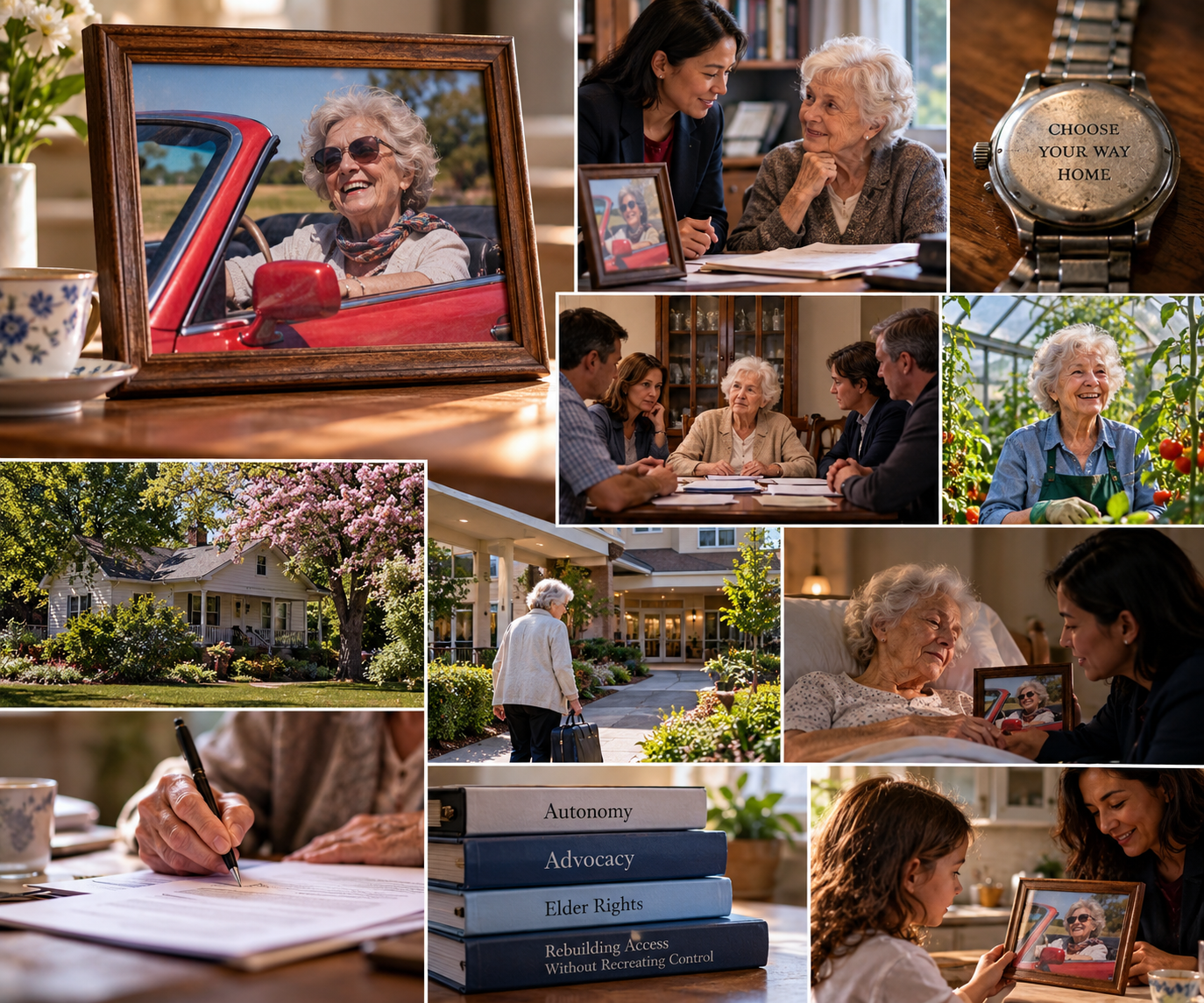
The Margaret photograph.
Walter’s repaired mug had already gone to the community program after Emily’s death, then later into the archive.
The watch lived in the foundation archive too.
The maple table remained at the consultation room.
Sophie had books.
Furniture.
Artwork.
Tools.
The photograph felt different.
She held it.
Red convertible.
Margaret laughing.
For years, that image had carried the entire family story more effectively than any legal file.
Sophie wondered whether to donate it to the Open Door Fund archive.
Then heard Margaret in her head.
Enough with museums.
So Sophie did something else.
She made a high-quality copy for the archive.
The original remained hers.
That felt balanced.
At ninety-five, Sophie moved voluntarily into a continuing-care community.
Not because she could no longer manage her apartment.
Because she did not want another emergency move later.
Maya toured places with her.
Sophie rejected five.
One smelled aggressively of air freshener.
One had tiny windows.
One described residents as “our seniors.”
Immediate no.
The sixth had gardens.
Private apartments.
A small studio room where Sophie could still work with wood.
Good tea after she complained.
She chose it.
Moving day brought an old familiar image.
Suitcase beside the door.
Sophie stopped.
Maya noticed.
“What?”
“My family had a thing about suitcases.”
“I know.”
Sophie looked at the bag.
No fear.
No symbolic heaviness.
Just luggage.
“Carry it?”
Maya asked.
Sophie nodded.
“Yes.”
That was all.
Her new apartment looked over a courtyard.
She placed Margaret’s photograph beside the window.
No maple table.
No Walter mug.
No watch.
Just Margaret.
Not because Margaret mattered more than the others.
Because the photograph made Sophie laugh.
That was reason enough.
Years passed.
Sophie’s body slowed.
Her mind remained mostly clear into her late nineties.
She served on fewer committees.
Then none.
Maya visited.
Not because she had to.
Because she wanted to.
They argued about policy even after Sophie stopped working.
Some habits survived retirement.
One afternoon, Maya brought a new training draft.
Sophie groaned.
“I resigned.”
“You’re reading one paragraph.”
“No.”
“Half a paragraph.”
“You are abusing your proxy relationship.”
“Your proxy authority isn’t active.”
“Technicality.”
Maya laughed.
Sophie read it.
The module concerned adult children pressuring aging parents to transfer property early for tax convenience.
Sophie crossed out a sentence.
Too broad.
Changed another.
Too judgmental.
Added one question.
HAS THE OLDER PERSON RECEIVED ADVICE FROM SOMEONE WHO DOES NOT BENEFIT FROM THE DECISION?
Maya nodded.
“Still good.”
“Unfortunately.”
At ninety-nine, Sophie developed heart failure.
Manageable at first.
Then less so.
Hospitalizations began.
Each discharge weakened her.
Doctors discussed an implanted device.
Potential benefit.
Potential complications.
Sophie listened.
Asked questions.
Then declined.
Maya asked once.
“Want another opinion?”
“Yes.”
They obtained one.
Same basic recommendation.
Sophie still declined.
“Why?” Maya asked, not to challenge but to document understanding.
“I don’t want another procedure for a small chance of a longer version of this year.”
Maya nodded.
No persuasion.
No emotional argument.
Decision recorded.
At one hundred, Sophie entered hospice care.
Her apartment.
Her choice.
She had outlived nearly everyone she once expected to outlive her.
That amused her.
“You made a poor bet,” she told Maya.
Maya was sixty.
“You are impossible.”
“Temporarily.”
Margaret’s line.
Passed down accidentally.
During hospice, Sophie had good days.
She sat outside.
Drank tea.
Complained about birds.
Bad days came too.
Breathlessness.
Pain.
Fatigue.
Maya followed instructions.
Staff knocked.
Choices remained where possible.
Medication now or later.
Window open or closed.
Visitor or quiet.
Music or silence.
Sophie occasionally changed her mind.
That was allowed.
A directive was not a prison either.
One morning, Maya found her staring at Margaret’s photograph.
“You know, I never met her when she was young.”
“Obviously.”
“She always looked old to me.”
“In the photo?”
“She was eighty-three.”
Maya smiled.
“That is old.”
“You’ll revise that opinion eventually.”
“Probably.”
Sophie touched the frame.
“She spent half her life thinking survival meant enduring.”
“And the other half?”
“Learning survival can mean leaving.”
Maya sat.
“What did Emily learn?”
“That help and control aren’t the same.”
“Greg?”
“That remorse doesn’t buy access.”
“Walter?”
Sophie thought.
“That secrecy can be loving in motive and still damaging in effect.”
“Helen?”
“That truth doesn’t need forgiveness to be true.”
“Laura?”
“That returning doesn’t erase leaving.”
“Ruth?”
Sophie smiled.
“Never trust hospital coffee.”
Maya laughed.
“Most practical lesson.”
“Yes.”
“What did you learn?”
The question surprised Sophie.
She had spent decades explaining everyone else.
Very Parker.
She looked toward the courtyard.
“I learned that inheritance is often disguised expectation.”
Maya waited.
“Houses. Money. Roles. Stories. Even moral lessons.”
“And Margaret’s lesson?”
“That too.”
Maya frowned.
“You think choice can become an expectation?”
“Of course.”
“How?”
“If we turn it into a purity test.”
Sophie’s voice was weaker now.
“People sometimes cannot choose clearly. Sometimes choices conflict. Sometimes someone asks for something impossible or unsafe. Respect is not pretending every answer can be granted.”
Maya nodded.
“So what survives?”
“Process.”
“Ask.”
“Yes.”
“Listen.”
“Yes.”
“Accept?”
Sophie smiled.
“When possible.”
That was new.
Maya noticed.
Sophie continued.
“When not possible, explain. Limit only what must be limited. Keep asking about everything else.”
Maya wrote it down.
Sophie saw.
“Don’t turn that into a poster.”
“No promises.”
“You’ve learned badly.”
“From excellent teachers.”
Later that week, Sophie signed one final revision to her care plan.
She wanted fewer routine vital-sign checks.
They disturbed sleep without changing treatment.
The hospice nurse agreed.
Small choice.
Important.
Three days later, Sophie became weaker.
Conversation shortened.
Maya visited in the afternoon.
“Want company?”
Sophie nodded.
“Yes.”
They sat in silence.
After twenty minutes, Sophie said, “Photo.”
Maya handed her Margaret’s photograph.
Sophie held it.
The red convertible looked almost unreal now.
A piece of another century.
“Take this.”
“Me?”
“Yes.”
“You sure?”
“Yes.”
“What do you want me to do with it?”
Sophie smiled.
“Choose.”
Maya laughed and cried at once.
“That’s cruel.”
“Good.”
Maya placed the photograph beside her bag.
Sophie closed her eyes.
After a while she said, “Go.”
Maya hesitated.
Then remembered every story.
Every lesson.
Every mistake the family had spent generations repairing.
“You want me to leave?”
“Yes.”
“Okay.”
Maya stood.
She leaned down.
“Can I hug you?”
Sophie opened her eyes.
“Yes.”
They hugged.
Then Maya left.
No final speech.
No promise to return in the morning.
She intended to.
But intention was not certainty.
Sophie died during the night.
A nurse found her before dawn.
The window had been left slightly open at Sophie’s request.
Cool air moved through the curtains.
Nothing symbolic happened.
No clock stopped.
No hidden document appeared.
No impossible phone call arrived.
She was simply dead.
Maya came at seven-thirty.
The photograph remained in her bag because Sophie had given it to her.
She almost placed it beside the bed.
Then stopped.
No.
Sophie had transferred it.
That meant it no longer belonged in the room.
She carried it home.
The memorial occurred two weeks later.
Small.
Maya spoke briefly.
She did not give a Parker history lecture.
She said Sophie spent much of her life helping families make decisions without erasing the person at the center.
Then she told one story.
When Sophie was ninety-five, a young staff member once asked whether she needed help carrying her suitcase.
Sophie said yes.
The staff member carried it.
Nothing dramatic happened.
“That,” Maya said, “was the point.”
People expected more.
She gave them none.
After the memorial, the Open Door Fund board discussed naming a program after Sophie.
Maya opposed it.
Not because Sophie lacked importance.
Because the organization had deliberately resisted family dynasties and personality monuments.
The board agreed.
Instead they created an unrestricted fund supporting independent advocates for people whose decision-making capacity was disputed.
No Parker name.
No Mercer name.
No plaque.
Useful.
That would have pleased Sophie.
Margaret’s original photograph stayed with Maya.
For a year, it sat in a drawer.
Then Maya found it while moving apartments.
She considered the archive.
Again.
Instead she placed it in her kitchen.
Not office.
Not training center.
Kitchen.
Friends occasionally asked who the woman was.
Maya gave different answers depending on her mood.
“Someone who bought a ridiculous car.”
“A woman who hated being managed.”
“The reason I ask too many questions.”
All were true.
Years later, Maya had a daughter.
No grand family inheritance connected them to Margaret.
No blood.
No property.
No legal duty.
One afternoon, the daughter was helping Maya pack for another move.
She found the photograph.
“Who’s this?”
Maya looked.
Margaret still laughed from behind giant sunglasses.
“A woman named Margaret.”
“Family?”
“No.”
“Then why do you have her picture?”
Maya considered.
“Because somebody once tried to decide her life for her.”
Her daughter waited.
“And?”
“She made sure they couldn’t.”
“That’s it?”
“No.”
Maya smiled.
“Then she spent the rest of her life learning that independence didn’t mean never accepting help.”
Her daughter looked at the picture.
“She looks fun.”
“Apparently difficult.”
“Same thing sometimes.”
Maya laughed.
Maybe Margaret would have liked her.
Maybe not.
The photograph went into the new kitchen.
Years passed.
The Open Door Fund changed leadership repeatedly.
Programs evolved.
Laws changed.
Terminology changed.
Some training materials were retired.
Margaret’s story remained in one historical module, shorter now.
No mythology.
An older woman.
A son who tried to take control.
A legal response.
A family that later confronted what control had cost them.
The final slide contained no photograph.
Only questions.
What can the person decide?
What support preserves those decisions?
What evidence justifies limiting them?
Who benefits from the proposed change?
Has the person been asked?
There was no quote attributed to Margaret.
No dramatic moral.
She would have disliked one.
The house was gone.
Everyone directly involved was gone.
Even the replacement house on the property had eventually been remodeled beyond recognition.
The Open Door Fund’s consultation table, made from Walter’s maple, survived longer.
Then one year a pipe burst.
Water damaged the room.
The table warped beyond practical repair.
Staff asked whether it should be preserved.
The current director checked records.
There was no plaque.
No donor restriction.
No special designation.
Just an old table.
They discarded it.
Exactly right.
Nothing physical remained that needed saving.
No maple.
No luggage tag.
No workshop wall.
No watch in active use.
No house.
No table.
Only practices.
A caregiver knocking.
An attorney asking who benefits.
A daughter refusing to sign for her mother without explanation.
A doctor speaking directly to the older patient first.
A family using an independent assessment before claiming incapacity.
A son accepting no.
A proxy understanding that authority should be narrow, documented, and accountable.
A person changing her mind without being accused of inconsistency.
A suitcase carried only after someone asks.
Those things spread farther than any inheritance.
Nobody knew where they began.
That was fine.
Lessons did not need ownership either.
Decades after Margaret Parker placed her teacup beside unsigned papers and refused to surrender her house, no one remembered the exact sound of her voice.
No one needed to.
The important part was never the sentence.
It was the act.
Someone asked her to give up control.
She answered.
Then, through every mistake and consequence that followed, her family slowly learned how to hear the answer.
That was what remained.
Not property.
Not victory.
Not a perfect family repaired into something clean.
A habit.
Ask.
Listen.
Respect what is still possible.
And when help becomes necessary, make sure help does not quietly become ownership.
Margaret once believed she was defending a house.
In the end, the house disappeared.
What she had actually defended was smaller and larger at the same time.
The right to remain a person inside other people’s concern.
The right to make choices while choices were still hers.
The right to be helped without being possessed.
The right to change her mind.
The right to leave.
The right to stay.
The right to say yes.
The right to say no.
And, when her own voice eventually grew weak, the right to have the choices she made earlier treated as instructions rather than inconveniences.
No one could inherit that right from her.
They already had their own.
They only had to remember not to take it from one another.
The End
Read more original stories on Feel Every Story.
The Morning My Son Packed My Suitcase, He Still Believed the House Waiting Behind Me Was His
Part 35 of 35

One Comment on “PART 35 – Long After Margaret’s House Was Gone, One Final Choice Proved Her Family Had Finally Learned What She Fought to Keep”