I arrived at the benefits office shortly before noon.
The sky was gray, and the parking lot was almost full. I sat in my car for a moment with my hands resting on the steering wheel.
I had spent the previous evening thinking about what Marcus had told me.
A child had disappeared in 1990.
A record connected to that child said the child had died.
And the Social Security number attached to that historical case was the same number I had used throughout my life.
Those were the facts.
Everything else was a question.
I kept reminding myself of that distinction because my mind had begun filling the empty spaces with possibilities.
I could imagine a mistake made decades ago. I could imagine someone entering the wrong number or transferring information from one file to another.
I could also imagine explanations that frightened me more than I wanted to admit.
But imagining something did not make it true.
I got out of the car and walked toward the entrance.
Inside, the waiting room smelled faintly of floor cleaner and old paper. A television mounted in one corner played a morning program with the volume turned low.
I checked in at the reception desk.
The clerk asked whether I had an appointment.
I gave her Marcus Cole's name.
She looked at her screen, typed something, and asked me to take a seat.
I chose the chair nearest the wall.
There was a stack of forms on a table beside me, along with a plastic container of pens. One pen had a cracked blue cap.
I picked it up, turned it between my fingers, and put it back.
I did not want another form to fill out.
I wanted an explanation that could be supported by something more than a line on a screen.
After several minutes, Marcus appeared in the doorway.
He wore the same dark jacket I remembered from our earlier meetings. He held a thin folder against his side.
"Mr. Miller."
I stood.
"Good morning."
"Thank you for coming back."
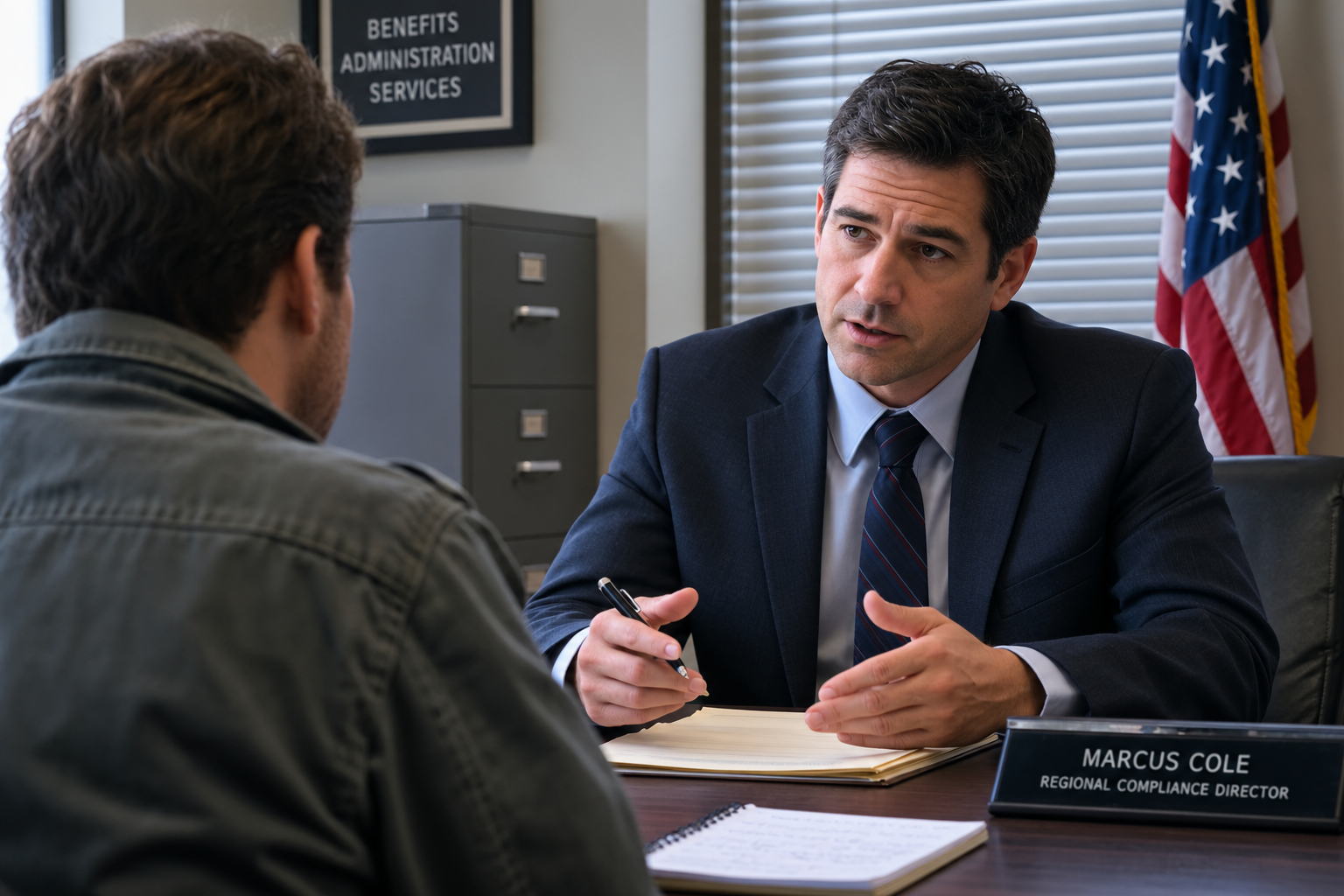
He led me down the hallway to the private office.
The room looked exactly as it had before. Three chairs stood around the desk, and the filing cabinet remained closed beneath the window.
The American flag beside the blinds hung perfectly still.
Marcus placed the folder on the desk but did not open it immediately.
"Before we begin," he said, "I want to make sure we're clear about what we know and what remains unconfirmed."
"That's what I want, too."
He nodded.
"The historical record identifies a child who disappeared in 1990. The record was later associated with a death designation. Your Social Security number is connected to that case."
"Does it say my name?"
Marcus paused.
"I can't confirm that the historical file identifies you by the name you use today."
"That's not the same as saying it doesn't."
"No," he said. "It isn't."
I leaned back in my chair.
For a moment, I watched him rather than the folder.
He did not seem eager to frighten me. He also did not seem willing to soften his answers just to make the conversation easier.
I appreciated that, although I wished he had something better to tell me.
"Then what does the number prove?" I asked.
"It proves that the number is associated with the historical record we're reviewing."
"Does it prove that I am the child?"
"No."
"Does it prove that I am not?"
"No."
The answers were simple.
They were also exhausting.
I had come hoping that the investigation had moved forward enough to give me something definite. Instead, I was still standing between two possibilities with no reliable way to choose between them.
Marcus opened the folder.
He glanced at a page, then turned it toward himself again.
"I understand why this feels personal," he said. "But I need to be careful about making a conclusion before the records support it."
"I understand being careful. What I don't understand is why a child could be recorded as dead when someone might still be alive under the same number."
"That is one of the questions the review needs to address."
"Was the child actually declared dead?"
"The historical record contains a death designation."
"That's not what I asked."
"I know."
He folded his hands on the desk.
"I don't yet have enough verified information to explain how that designation was entered or what evidence supported it."
I looked down at the folder.
"Then you don't know whether the child died."
"I can't give you a definitive answer based on what I can confirm today."
The word today caught my attention.
"Does that mean you expect to know more later?"
"It means the review is continuing."
I rubbed my palms against my trousers.
I had always believed that official records were dependable because people used them to make decisions. They determined whether someone could work, receive benefits, open accounts, or prove who they were.
I had never considered how a person might feel when an official record called his identity into question.
"Can you tell me what happened to the child before the disappearance?" I asked.
"Not from the information I can presently discuss with you."
"Do you know the child's name?"
Marcus looked at me for a moment.
"I can't responsibly give you a name without confirming that doing so would be appropriate and accurate."
I felt a familiar frustration rising in my chest.
"You're asking me to wait while you investigate a record connected to my life, but I can't even find out what name is in it."
"I'm asking you to allow the review to establish the facts before we treat an unverified detail as an answer."
I wanted to argue.
Instead, I looked at the folder again.
There was nothing visible on its cover except a printed label and a small reference number. I could not read the number from where I sat.
It seemed strange that something so ordinary could contain information capable of changing how I understood my own past.
"Is there anything you need from me?" I asked.
"Any original identity documents you still possess may be useful. Birth certificates, old identification cards, school records, or other documents that show how your identity was established."
"I already looked through what I have."
"Did you find anything?"
"Nothing that explains this."
"Please keep those documents together. Don't write on them or alter them. If we need to examine any originals, we'll discuss the proper process."
I nodded.
"Will you tell me if you find something that contradicts what I remember about my childhood?"
"If the information is relevant and I can share it with you, I will explain what it means as clearly as possible."
I studied his expression.
"And if you find something that suggests I've been using someone else's identity?"
Marcus did not answer immediately.
"At this stage, I have no basis to accuse you of knowingly using a false identity."
"That's not quite the same as saying my identity is correct."
"No," he said. "It isn't."
I looked toward the window.
The blinds were closed tightly enough that I could see only a narrow strip of daylight along one edge.
For years, I had thought of my identity as one of the few things I did not need to question. I knew the name on my documents. I knew the number I entered on forms. I knew the dates I used when employers and offices asked for them.
I had never imagined that those familiar details might be connected to a child whose disappearance had been recorded decades earlier.
"How long can a review like this take?" I asked.
"That depends on what records are available and whether they can be verified."
"So there is no timeline."
"I don't want to give you a date I can't promise."
I appreciated the honesty, but it did not make the uncertainty easier to carry.
Before leaving, I asked one final question.
"If the historical record turns out to contain an error, can it be corrected?"
"Errors can be reviewed and corrected through the appropriate process when the evidence supports that action."
"And if the record isn't an error?"
"Then we would need to understand what it actually establishes before deciding what happens next."
I stood and buttoned my jacket.
Marcus closed the folder.
"I know this is difficult," he said.
I almost told him that difficult was too small a word for it.
Instead, I thanked him and walked back through the hallway.
Outside, the air felt colder than it had when I arrived.
I sat in my car without starting the engine.
The conversation had not answered the questions that mattered most to me, but it had forced me to recognize something important.
The record was real.
The connection was real.
The explanation was still unknown.
I could not turn those three facts into a conclusion simply because I needed one.
When I finally started the car, I decided I would keep asking questions.
I would also stop treating every frightening possibility as though it were a discovery.
For now, I had to live with what I knew.
Click here to continue reading: PART 10: I Tried to Reconstruct the Paper Trail of My Life, but the Documents I Trusted Could Only Tell Me When My Name Had Been Used
I Went to the Benefits Office Expecting a Simple Answer, but One Red Warning on a Computer Screen Changed Everything
Part 9 of 20