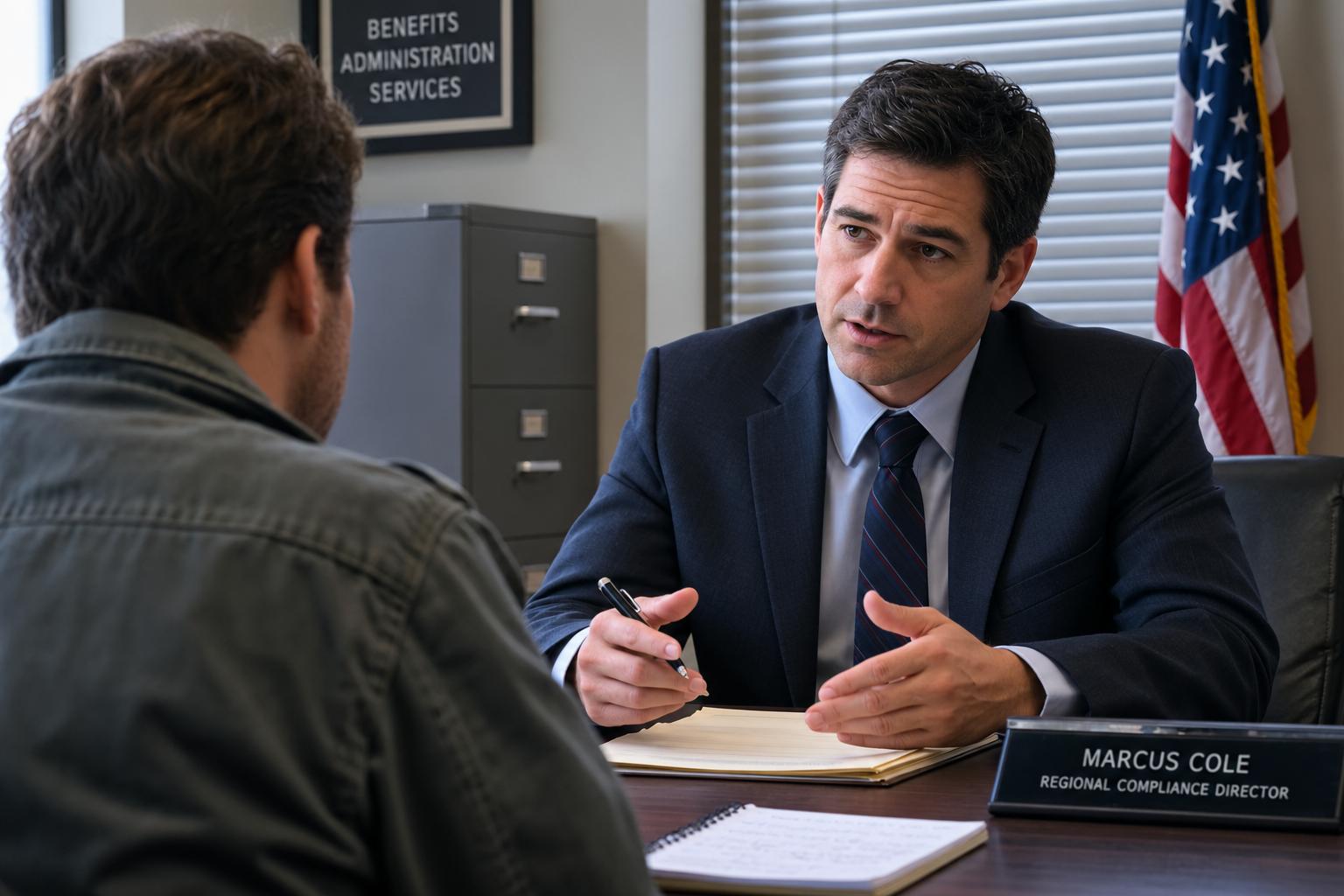
For several days after my meeting with Marcus, I left the envelope in the drawer.
I still thought about the case, but I tried not to examine every memory as though it might contain a hidden clue.
That habit had started to wear me down.
I could remember ordinary things from my childhood without knowing whether they mattered. I could remember the name I used, the places I had lived, and the people who had been around me.
What I could not remember was the first official moment when all those details had been put together.
I had never needed to think about it before.
When someone asked for identification, I showed it. When a form required my Social Security number, I entered it. When an employer asked me to confirm my information, I did so.
I had treated those steps as ordinary parts of adult life.
Now I understood that the documents I carried could show how my identity had been used without necessarily showing how it had first been established.
That difference stayed with me.
On Saturday morning, I took the envelope out of the drawer and spread the papers across the kitchen table again.
This time, I did not begin by looking for something suspicious.
I began by checking the dates.
I wanted to know which document was the oldest, which ones referred to earlier records, and whether any of them named the person or office responsible for issuing them.
I wrote the dates in my notebook.
Some documents referred to other paperwork that I no longer possessed. A few gave only a date and a reference number.
I made a list of those references.
None of them immediately explained the historical case, but they gave me a more useful starting point than my guesses had.
I was no longer asking whether a particular paper looked strange.
I was asking what the paper could actually establish.
One document showed that my name had been recorded at a particular time.
Another confirmed that the same basic information had been used later.
A third referred to an earlier record without providing a copy of it.
The sequence was incomplete.
Still, it was a sequence.
I marked the gaps in pencil.
I did not fill them with explanations.
When I finished, I placed the papers in chronological order and made a copy of the list for myself.
Then I put everything back into the envelope.
The exercise took most of the morning.
It did not reveal a hidden identity or establish why my number was connected to the missing child.
But it gave me a clearer understanding of what I possessed and what I lacked.
I had records from different points in my life.
I did not have the earliest record that established the identity I had used.
That seemed like a reasonable question to raise at my next meeting with Marcus.
Until then, I decided to make no further assumptions.
The following week, I returned to work with the same routine I had followed before the benefits office called my life into question.
I answered messages, completed my assignments, and handled the ordinary problems that came with the day.
There were moments when my attention drifted.
I would look at a date on a form and think about 1990.
I would hear someone mention an old record and wonder how much information could disappear over the years.
Whenever that happened, I brought myself back to the task in front of me.
I could not solve a historical discrepancy by letting it interrupt every hour of my day.
That evening, I opened my notebook and added a new question beneath the others.
What is the earliest verified record connecting my name to my Social Security number?
It was a simple question.
It did not assume that anyone had lied to me.
It did not assume that the missing child was me.
It asked for a starting point that could be checked.
I felt better having written it down.
The next morning, I called the office to confirm my appointment with Marcus.
The receptionist checked the schedule and confirmed the time.
I thanked her and hung up.
There was no new information, but I appreciated knowing exactly when I would have another opportunity to ask my questions.
I gathered my notebook and the list of documents.
I left the originals at home.
Marcus had told me not to send anything without discussing the proper process, and I intended to follow that instruction.
When I arrived at the office, the waiting room was quieter than it had been during my earlier visits.
A man near the reception desk was filling out a form. Someone behind the counter was speaking softly on the telephone.
I checked in and took a seat.
A few minutes later, Marcus came to get me.
"Mr. Miller. How have you been?"
"Busy. I've been organizing the records I already have."
"Did you find anything new?"
"Not an answer. But I found some references to earlier documents that I don't possess."
He opened the office door and motioned for me to enter.
I placed my notebook on the desk.
"I think I understand my paperwork a little better now," I said. "I can show when my information was used in some places, but I can't show where the whole identity record began."
Marcus looked at my notes.
"That is a useful distinction."
"I want to know whether the historical review can identify an earlier record that connects the number to the child."
He considered the request before answering.
"That is a reasonable question for the review. Whether the necessary record is available and can be verified is another matter."
"I understand."
I showed him the list of dates and references.
He read it carefully, asking me to explain where each document had come from and whether I had the original or only a copy.
I answered as accurately as I could.
When he reached the final entry, he set the notebook down.
"I don't want to suggest that these documents will establish more than they actually show," he said. "But organizing them this way may help us identify what additional information would be useful."
"That's what I'm hoping."
He returned the notebook to me.
I felt no sudden relief.
I had not expected one.
Instead, I felt that I had finally brought something practical to the conversation: a clear account of the records I possessed and the gaps I could identify.
Marcus said he would continue the review and consider whether any of those references were relevant to the next step.
He did not promise a result or a date.
I did not ask him to.
When I left the office, I carried my notebook under my arm and walked slowly toward the parking lot.
The case remained unresolved.
But I had stopped asking my imagination to do the work of evidence.
For now, that was progress enough.
Click here to continue reading: PART 14: I Asked Marcus What Would Count as Proof, Because I Could No Longer Live Between Two Possible Identities Without Knowing How Either Could Be Established
I Went to the Benefits Office Expecting a Simple Answer, but One Red Warning on a Computer Screen Changed Everything
Part 13 of 20