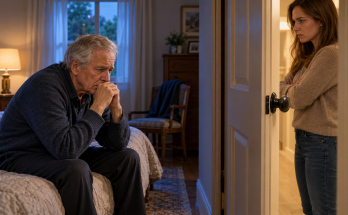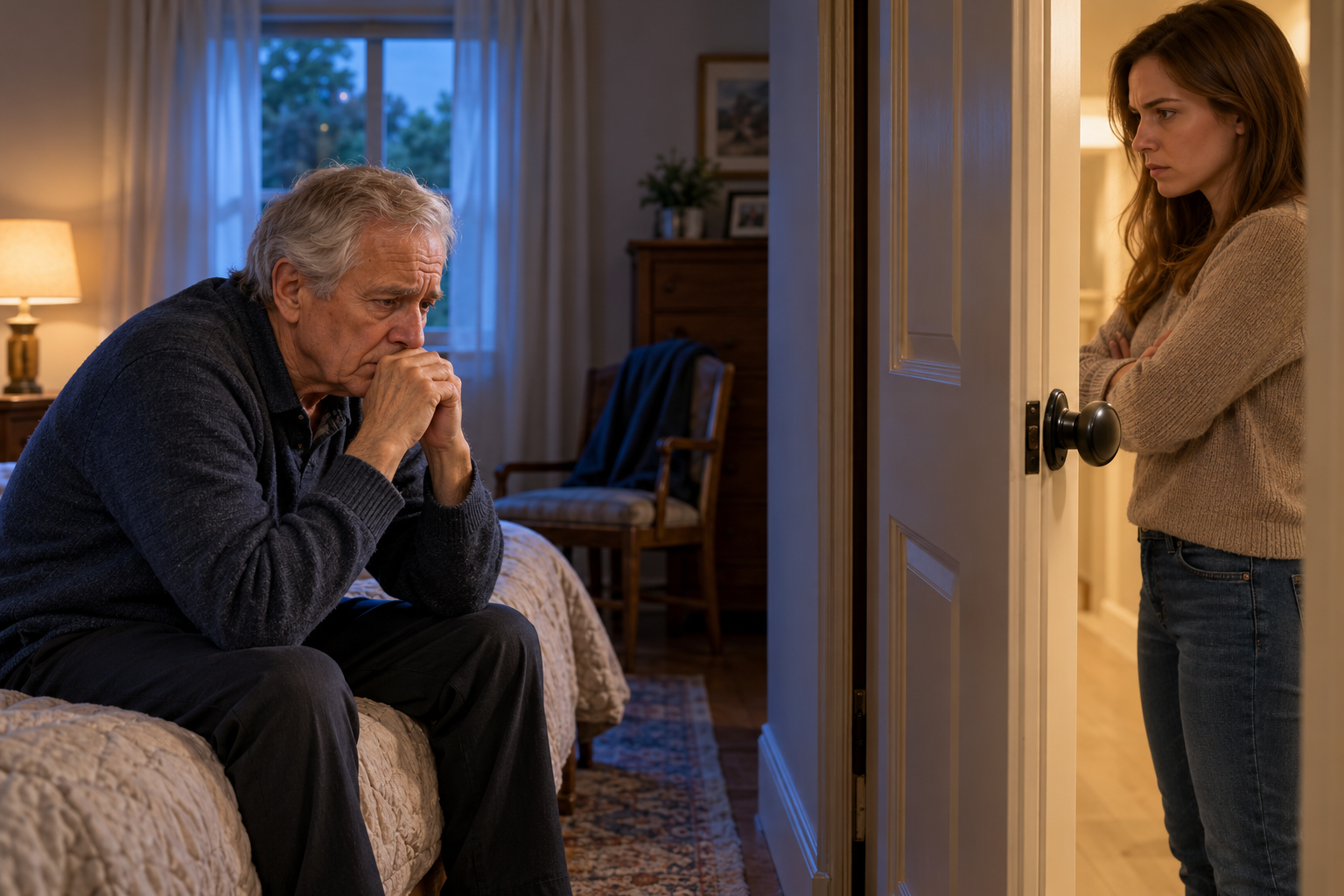
I sat on the bed and listened to the quiet house.
Every small sound seemed important.
A faint creak came from somewhere beyond the room.
I heard what might have been a cupboard closing.
Then everything became still again.
I kept looking at the door.
I had no way of knowing whether Lauren was nearby or whether she had gone to another part of the house.
I wanted to believe she was reconsidering what she had done.
I wanted to believe that, once she had time to think, she would understand that locking me in my room had crossed a line neither of us could simply pretend wasn't there.
But I couldn't build my next decision around what I hoped she might do.
I stood and tested the handle again.
It didn't open.
I let go.
I had already tried it enough times to understand that repeating the same movement would not change anything.
Still, the act of checking had become almost automatic.
I would sit down, look toward the door, and feel the urge to try it again.
Each time, the same result reminded me of how little control I had over the immediate situation.
I went to the window and looked outside.
The light had changed.
I couldn't tell exactly how much time had passed, but the day no longer looked the way it had when Lauren first shut me inside.
I wondered whether anyone had tried to reach me.
I wondered whether someone might notice that I had not answered a call or followed my usual routine.
I had no way to know.
The uncertainty was difficult to bear.
I returned to the bed and tried to remember where I had last seen my phone.
It had been outside the room.
I pictured it lying where I had left it, beyond my reach.
I imagined calling someone and explaining what had happened.
I did not know how that conversation would go.
I only knew I wanted the chance to have it.
I rose and knocked on the door.
"Lauren?"
There was no answer.
I knocked again.
"I need some water."
I waited.
For a moment, I thought I heard movement.
Then the hallway became quiet again.
I stood with my hand against the door.
I didn't want to believe that she had heard me and chosen to ignore the request.
But I could not rule it out.
I stepped back and sat down.
The room was familiar enough that I could have described every object in it without looking.
I knew the small mark on the wall near the chair.
I knew the drawer that sometimes stuck when I pulled it open.
I knew where the morning light usually fell across the floor.
Those details had never mattered much before.
Now I found myself noticing them because I needed something steady.
I thought about the house itself.
It had been part of my life for so long that I rarely considered what it meant to me.
It wasn't simply a building with rooms and doors.
It held my work, my memories, and the ordinary things I had collected over the years.
It also held the documents Lauren wanted me to surrender.
I had kept original business papers, property records, old contracts, and financial statements because I believed important things should be preserved carefully.
I had never considered those documents a weapon.
They were records.
They showed what I had done, what I had signed, and what belonged to me.
The house did not become Lauren's because she wanted it.
My papers did not become hers because she believed she could manage them better.
I had tried to explain that distinction calmly.
I had assumed it was something we could discuss without damaging our relationship.
Now I was locked behind a door while she waited for me to reconsider.
I rubbed my hands together.
I was angry, but I didn't want anger to make me careless.
I had to think clearly.
I could not force Lauren to accept my decision.
I could not make her unlock the door by repeating my reasons.
I could, however, refuse to agree to something simply because she had placed me under pressure.
That decision was still mine.
I stood and approached the door.
"Lauren, I want you to hear me."
For several seconds, there was no answer.
Then I heard her voice.
"I'm here."
Relief came so quickly that I almost laughed.
At least she was close enough to hear me.
"I need water," I said. "And I need you to open the door."
"You need to think about what we're discussing."
"I have thought about it."
"You're not taking this seriously."
I stared at the handle.
"I am taking it very seriously. That's why I won't agree to it."
She told me I was making her feel as if I didn't trust her.
I tried to keep my voice level.
"This isn't about whether I love you."
"Then why won't you let me help?"
"Because I don't want to transfer the house or hand over my original documents."
There was a long pause.
I could hear her breathing faintly through the door.
I waited for her to answer the actual question.
Instead, she said that I would regret making everything so difficult.
I felt a coldness settle in my chest.
I had hoped that hearing my answer clearly might make her reconsider the way she was treating me.
Instead, she had returned to the same pressure.
"Lauren, I am not going to change my answer because you keep me in here."
"I'm not trying to hurt you."
"Then open the door."
She didn't respond.
I waited until I heard her move.
"Lauren?"
The footsteps went away.
I remained beside the door for several seconds after she had left.
Then I stepped back.
I wanted to cry, but I couldn't bring myself to do it.
The situation was too strange.
My daughter had locked me inside a room, and I was standing there trying to decide whether I should call out to her again.
I sat down.
I thought about the times she had asked me to sign papers.
She had always spoken as though the decision were already settled and the remaining task was getting me to agree.
When I asked what the papers would change, she grew impatient.
When I wanted to read something carefully, she said I was making things complicated.
When I told her I needed time, she said I was refusing to trust her.
I had tried to be patient because she was my daughter.
I had told myself that family disagreements required more understanding than ordinary disagreements.
That was true, but it did not mean every demand deserved to be accepted.
I looked at the closed door.
I could no longer pretend that patience alone would solve this.
I needed to be able to leave the room.
I needed access to my phone.
I needed someone else to know what was happening.
And I needed to protect the documents that showed the truth about the house.
I couldn't reach those papers from where I sat.
But I knew where they were.
I remembered the old office.
I remembered the careful order in which I had stored the records.
I remembered the importance of keeping the originals safe.
I also remembered that the house had parts I had not thought about for a long time.
There were rooms and storage spaces that had faded into the background of daily life.
Some things had been left where they belonged because there had never been a reason to move them.
The thought of those places brought a brief sense of clarity.
The documents existed.
My ownership did not depend on Lauren's agreement.
Whatever happened in the next few hours, the papers would remain what they were.
I held on to that fact.
I stood again and tested the handle.
Still locked.
I let my hand fall.
I was tired, frightened, and angry.
But I had not agreed to give her the house.
I had not agreed to surrender the documents.
And I would not pretend that being locked inside had somehow changed the truth.
Click here to continue reading: PART 15: I Stopped Trying to Win an Argument With Lauren and Focused on the Choice She Could Not Make for Me
I Thought My Daughter Wanted the House Until I Realized She Needed Something I Had Never Agreed to Give Her
Part 14 of 20