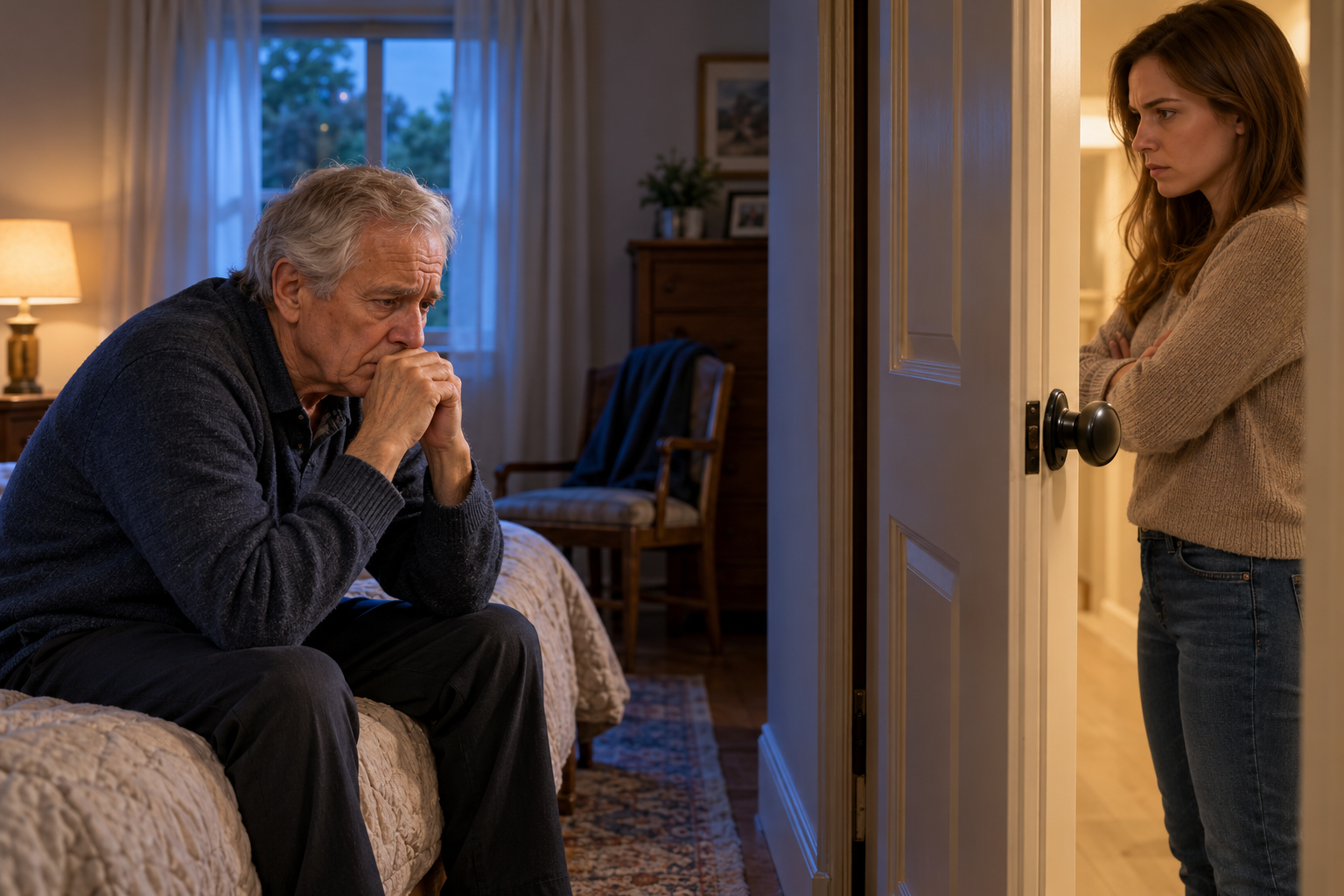
I expected Lauren to call before her next visit.
She didn't.
She arrived one afternoon while I was in the office, and I heard her moving around the kitchen before she called out to me.
I put down my pen.
When I came into the hallway, she was standing beside the counter with her handbag on a chair.
She looked calm.
That was the first thing I noticed.
The second was that she seemed to have already decided how the afternoon would go.
"How are you feeling?"
"I'm fine."
"Have you had lunch?"
"Yes."
She nodded and looked toward the office.
I waited.
After everything that had happened, I no longer believed these questions were simply questions.
She asked whether I had been working on the records.
I said I had.
She asked whether I had found everything I needed.
I told her I hadn't been looking for anything in particular.
She studied my face.
"You're still keeping all the important papers in there?"
I felt my patience thinning.
"Lauren, what is this really about?"
She took a breath.
"I'm worried about you."
"You've said that before."
"Because it's true."
"Then tell me what you're worried about."
She looked down at the counter.
For a moment, I thought she might answer honestly.
Instead, she said she was worried about what would happen if I couldn't manage the house anymore.
I told her that was my decision to make.
She said I wasn't being realistic.
I asked what she meant.
She gave me the same answer she had given me before: things would become complicated if I didn't make arrangements now.
I told her I had already made arrangements for my affairs.
She asked whether those arrangements included the house.
I said they did.
She asked whether she could see the paperwork.
I refused.
The conversation lasted only a few minutes, but it left the kitchen feeling smaller than it had before.
Lauren stood still, holding the strap of her handbag.
Then she said something I hadn't expected.
"You don't trust me anymore."
I looked at her.
I wanted to tell her that trust wasn't something I had decided to withdraw.
It was something she had been asking me to give without explaining why she needed it.
But I didn't say that.
I told her I trusted her to be my daughter.
I also trusted myself to make decisions about my own property.
She shook her head.
"That's not an answer."
"It is the answer you're getting."
Her eyes narrowed slightly.
Then she picked up her handbag.
I thought she was leaving.
Instead, she walked toward the office.
I followed her.
"Where are you going?"
"I want to see something."
"Not in there."
She stopped at the doorway.
I stood between her and the desk.
For several seconds, neither of us moved.
Then she stepped back.
"Fine."
She returned to the kitchen.
I stayed in the hallway until I heard her pick up her keys.
When the front door closed, I went directly to the office.
I checked the cabinets.
I checked the drawers.
I checked the folders I had moved earlier.
Nothing appeared to be missing.
I sat down at my desk and stared at the papers in front of me.
I had spent years believing that the most important thing about keeping records was being organized.
Now I understood that security mattered just as much.
A record was useful only if it remained available when you needed it.
And if someone wanted to take control of your life, the documents that established your rights could become the first things they tried to control.
I didn't know whether Lauren understood that.
I didn't know whether she had thought through the consequences of what she was asking.
I only knew that she had tried to enter the office after I told her not to.
That was enough to change how I handled things.
I made a list of the records I considered essential.
I checked where I kept the originals.
I reviewed the property papers and the older contracts.
I made sure the financial statements were accounted for.
I did not destroy anything.
I did not hide anything from the people who had a legitimate reason to see it.
I simply wanted to know where my documents were and who could reach them.
As I worked, I remembered a room I had not used in a long time.
It was a small room tucked away from the main living areas, one that had once served a practical purpose when I needed more storage.
Over the years, I had stopped thinking about it.
It wasn't a place I visited every week.
It wasn't a place anyone would notice unless they knew to look for it.
I remembered that there were things stored there that I had kept apart from my everyday office records.
The thought stayed with me.
I didn't go looking for the room that afternoon.
I was tired, and I didn't want to turn a difficult family situation into a search for danger around every corner.
Instead, I finished my work and made dinner.
I ate alone.
Afterward, I sat in the living room and tried to remember the last time Lauren and I had spent an entire day together without discussing my property.
I couldn't remember.
That realization hurt more than I expected.
We had once been able to talk about anything.
She had told me about school, about work, about people who had disappointed her and people who had helped her.
I had listened.
Sometimes I had offered advice she didn't want.
Sometimes I had simply sat there while she talked.
I never expected her to agree with me about everything.
I never expected her to become a copy of me.
I had only expected that when she wanted something from me, she would say what it was.
That expectation seemed naïve now.
The following morning, I went into the office early.
I wanted to finish reviewing the property documents before the day became busy.
The house was still quiet.
I opened the cabinet and removed the folder containing the original records.
I checked each document carefully.
The papers were old, but they were in good condition.
The ownership information was clear.
The signatures were where they belonged.
I returned the documents to the folder and put it away.
Then I sat at the desk and thought about Lauren's questions.
She had asked whether I still had the originals.
She had asked where I kept them.
She had asked whether she could see them.
At the time, I had treated those questions as separate incidents.
Now they seemed connected.
I couldn't prove what she intended.
I didn't want to accuse my daughter based on suspicion alone.
But I could stop pretending that the pattern meant nothing.
I decided to speak with her once more.
Not to argue.
Not to persuade her to agree with me.
I wanted to give her an opportunity to explain herself without the usual excuses about simplifying things or making life easier.
I called her that afternoon.
She answered after several rings.
I asked whether she could come by the following day.
She wanted to know why.
I told her there were things we needed to discuss.
She went quiet.
Then she agreed.
The next day, I prepared coffee and waited at the kitchen table.
I had written down a few questions.
I didn't want the conversation to drift into complaints about my attitude or accusations about her feelings.
I wanted answers.
When Lauren arrived, she looked at the paper beside my cup.
"What's that?"
"Things I want to ask you."
She pulled out a chair but didn't sit immediately.
"Are we going to do this again?"
"That depends on whether you answer me."
She sat down.
I asked her why she wanted me to transfer the house.
She said she wanted to make things easier.
I asked what would become easier if the house were in her name.
She said it would prevent problems later.
I asked what problems.
She looked away.
I asked whether she believed I was incapable of managing my affairs.
She said she hadn't said that.
I asked why she kept asking to see documents that belonged to me.
She rubbed her forehead.
"Because I need to know what's going on."
"Why?"
She didn't answer.
I waited.
The clock above the doorway ticked several times.
Then she said she was trying to protect the family.
I asked her what she thought the family needed protection from.
She looked at me with an expression that made me feel suddenly distant from her.
"You don't understand everything," she said.
"Then explain it."
She stood up.
"I can't do this right now."
I looked at the paper on the table.
I had asked four direct questions.
She had answered none of them.
"Lauren."
She stopped near the doorway.
"If there's something I need to know, tell me."
She didn't turn around.
"I've tried to help you."
"I know you've said that."
She left without another word.
I sat at the table for a long time.
I was angry.
I was also sad, because I had begun to see how little control I had over the kind of relationship my daughter and I would have from that point forward.
I could set boundaries.
I could protect my records.
I could refuse to sign documents I didn't understand.
But I couldn't force her to tell me the truth.
That evening, I went back into the office and looked at the list I had made.
The important records were accounted for.
The property documents were safe.
The business papers were organized.
Still, I couldn't shake the memory of Lauren saying that I didn't understand everything.
Perhaps she had meant that I was getting older.
Perhaps she had meant that she knew something I didn't.
Perhaps she had simply been angry because I refused to do what she wanted.
I couldn't tell.
What I could do was stop leaving my peace of mind in her hands.
I decided to check the other room the next morning.
Not because I expected to find anything dramatic.
Because I remembered that I had stored important things there, and I wanted to make certain they were still secure.
It was a simple decision.
One I should have made earlier.
I went to bed believing I would spend the next day checking a forgotten storage space and returning to my ordinary life.
I still thought the problem was a disagreement over paperwork.
I had not yet understood that the house itself was becoming part of the struggle.
Click here to continue reading: PART 4: The Forgotten Door, the Keys I Had Kept for Years, and the Documents That Could Prove My Daughter Was Wrong About the House
I Thought My Daughter Wanted the House Until I Realized She Needed Something I Had Never Agreed to Give Her
Part 3 of 20