I spent the following morning trying to shake off the previous day's discomfort.
I told myself I was tired.
I told myself that a few awkward conversations didn't mean my daughter intended to do anything harmful.
I told myself that I needed to stop treating ordinary events as warnings.
Some of that was probably true.
But I was also using those explanations to avoid admitting how deeply the situation had unsettled me.
I had never expected to feel wary of Lauren.
Even now, I struggled to say it plainly.
I was wary of my own daughter.
I finished breakfast and went into the office.
I worked for a couple of hours, then paid a few bills.
Around midday, I called an old acquaintance to discuss something unrelated to the house.
The conversation helped.
For a while, I remembered what it felt like to talk without measuring every word.
After the call, I ate lunch.
I washed the plate and returned to the office.
The day remained quiet.
I checked the cabinet once before closing the room.
I didn't open the forgotten room.
I wanted to prove to myself that I could leave the documents alone.
I could trust the locks.
I could trust the fact that I had kept the keys.
I could return to living normally.
That was what I told myself.
In the afternoon, Lauren sent a message.
She asked whether I was feeling better.
I replied that I was fine.
She asked if she could visit.
I looked at the message for a long time.
Part of me wanted to say no.
I was tired of the arguments.
I was tired of feeling uncomfortable in my own home.
But I also knew that refusing every visit would not solve anything.
I told her she could come by.
She replied that she would arrive later.
I spent the next hour doing small tasks around the house.
I straightened the living room.
I put a few things away in the kitchen.
I made coffee.
I tried not to think about what we might discuss.
When Lauren arrived, I opened the door and let her in.
She greeted me quietly.
She seemed distracted.
I asked whether something was wrong.
She said she was tired.
I offered her coffee.
She accepted.
We sat at the kitchen table.
For a while, she said very little.
I asked about her week.
She answered briefly.
I told her about a few things I had been doing.
She listened without much reaction.
I began to wonder whether she had come simply because she didn't want us to go another day without speaking.
I wanted that to be the reason.
Then she asked whether I had thought about her proposal.
I put my cup down.
"Lauren, no."
She looked at me.
"You haven't even considered it?"
"I have considered it. My answer is still no."
She shook her head.
"You make everything final."
"When I've made a decision, I don't keep changing it because someone asks again."
She stared at me.
I could see that she wanted to argue.
Instead, she asked whether I had any plans for the evening.
I said I didn't.
She nodded.
Then she said she needed to use the bathroom.
I told her where it was.
She stood and walked down the hallway.
I remained at the table.
I could hear the clock ticking.
I looked at the coffee in my cup and realized I had barely touched it.
I was too tense to enjoy it.
I heard a door close.
Then I heard nothing.
I waited.
After a short while, I called out to ask whether she was all right.
She answered that she was.
I returned my attention to the table.
A few minutes later, I heard footsteps.
Lauren came back into the kitchen.
She looked at me.
"Can I ask you something?"
I nodded.
"Why do you think I'm trying to take your house?"
I felt a sudden sadness.
I hadn't wanted to have that conversation again.
But I answered honestly.
"Because you keep asking me to put it in your name."
She looked down.
"And because you keep asking about the documents," I continued. "You won't explain why you need them, and you won't accept my answer."
She was quiet.
For a moment, I thought she might finally tell me what she wanted.
Then she said I had misunderstood her.
I asked her to explain.
She shook her head.
"I can't do this."
I stood up.
"Then we need to stop having the same conversation."
She picked up her handbag.
I expected her to leave.
Instead, she looked toward the hallway again.
I followed her gaze.
There was nothing unusual there.
The doors were closed.
The lights were on.
Everything looked familiar.
I turned back toward her.
"Lauren, if you have something to tell me, tell me."
She didn't answer.
She walked out of the kitchen.
I followed her into the hallway.
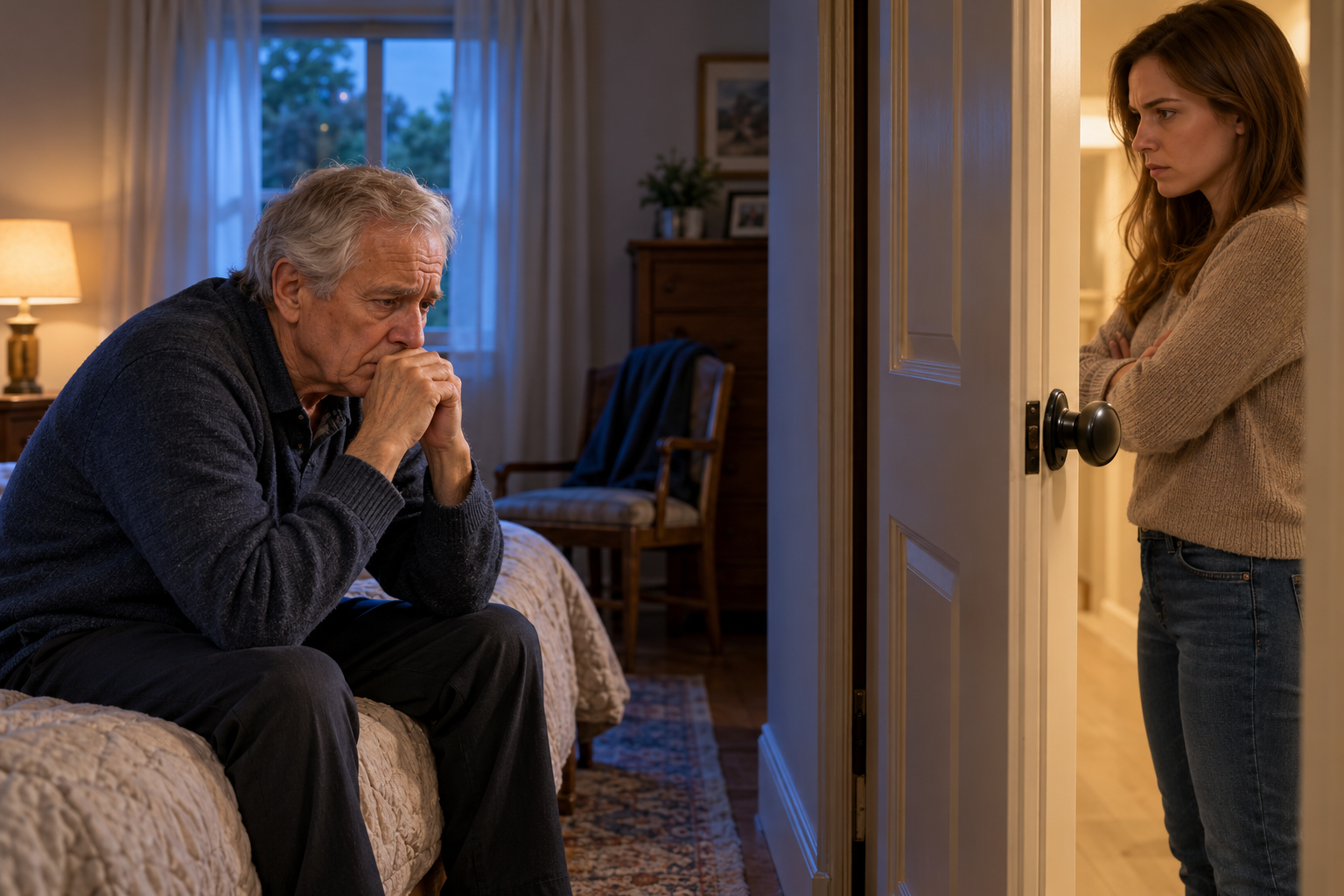
She stopped near the door to my room.
For a moment, I thought she was going to turn and speak.
Instead, she looked at the door.
Then she looked at me.
"You're making this harder than it needs to be."
I felt a chill run through me.
"What does that mean?"
She didn't answer.
She moved past me and continued toward the front door.
I followed her.
She opened it and stepped outside.
Then she turned around.
"I'll talk to you later."
I stood in the doorway.
"Lauren."
She paused.
"I need you to be honest with me."
She looked at me for a long moment.
Then she left.
I closed the door slowly.
I remained in the hallway, trying to understand what had just happened.
Her words had sounded less like an argument than a decision.
I didn't know what she had decided.
I only knew that she had stopped trying to persuade me in the way she used to.
She was no longer asking me to consider her proposal.
She was speaking as though the matter had moved beyond my answer.
I went into the office.
I checked the cabinet.
The documents were still there.
I returned to the hallway and looked at the door to my room.
It was closed.
Nothing had happened.
Nothing had changed.
Yet I felt less secure than I had the previous morning.
I wanted to call someone and explain what was going on.
But I didn't know what to say.
My daughter kept asking about my property.
She kept refusing to explain why.
She had visited several times, and each visit had left me more uneasy.
Those were the facts.
I couldn't tell anyone what she intended because I didn't know.
I sat in the living room until the light began to fade.
Then I made dinner.
I ate alone and washed the dishes.
Before going to bed, I checked the locks.
The front door was secure.
The side entrance was secure.
I looked at the forgotten room and thought about the black key.
The papers were protected.
But I was beginning to understand that documents could not protect me from every possibility.
I could prove that I owned the house.
I could prove that I had the right to make decisions about it.
What I could not do was make Lauren accept those facts.
I went to bed with that thought in my mind.
I still hoped that a clear conversation might settle things.
I still hoped she would come to understand that I wasn't her enemy.
I had no reason to believe that my next difficult moment would come not from a signature or a missing document, but from a door I had opened and closed thousands of times without thinking.
Click here to continue reading: PART 12: The Day My Daughter Came Back, I Was Still Thinking About Property Papers When I Should Have Been Paying Attention to the Door Behind Me
I Thought My Daughter Wanted the House Until I Realized She Needed Something I Had Never Agreed to Give Her
Part 11 of 20